
An auto dealership network adopts an AI tool that drafts personalized marketing messages for service reminders. A regional manager calculates ROI by comparing only the tool's annual license fee against the labor cost it replaced, and concludes the tool barely breaks even. What is the most likely flaw in this calculation?
Select an answer to reveal the explanation.
Short Explanation
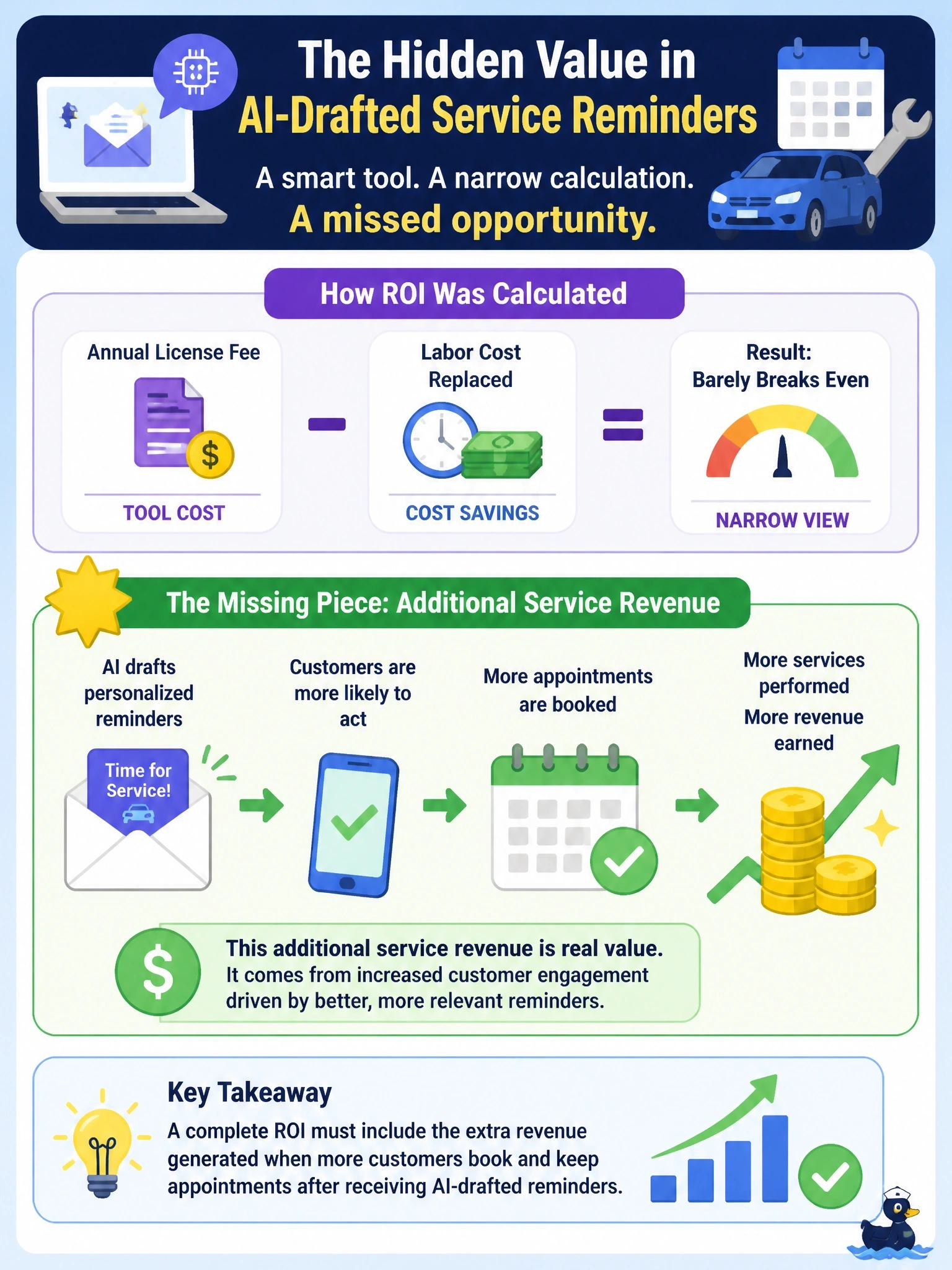
The manager only looked at one side of the ledger — what the tool cost against the labor it replaced. What you're missing is the other half: customers were actually booking appointments off those AI-drafted reminders, and that extra service revenue never made it into the math.
Full Explanation
The manager's calculation compares one cost category, the license fee, against one benefit category, labor savings, but leaves out an entire second benefit stream: the additional service revenue generated when customers book appointments after receiving the AI-drafted reminders. Substituting the dealership's total annual revenue for the tool's cost would be a separate error — it would misrepresent the actual investment amount and produce a comparison that means nothing, since total company revenue has no direct relationship to what the tool itself costs. Dismissing labor cost savings as something that should never appear in an ROI calculation is also wrong; labor savings are a legitimate benefit category, just not the only one that matters here. Likewise, license fees belong in the calculation as a necessary and valid cost input — the flaw isn't including the fee, it's stopping the analysis there. The broader lesson: whenever an AI tool touches both cost and revenue, an ROI calculation built on only one cost line and one benefit line will systematically understate the initiative's real value, because it never accounts for the revenue-side effects the tool also produces.