
A trucking company estimates that its AI dispatch assistant saves each of its 50 dispatchers 5 hours per week, at a fully loaded cost of $40 per hour. The AI tool costs $250,000 per year. Over one year (50 working weeks), what is the annual time-savings value, and does it exceed the tool's cost?
Select an answer to reveal the explanation.
Short Explanation
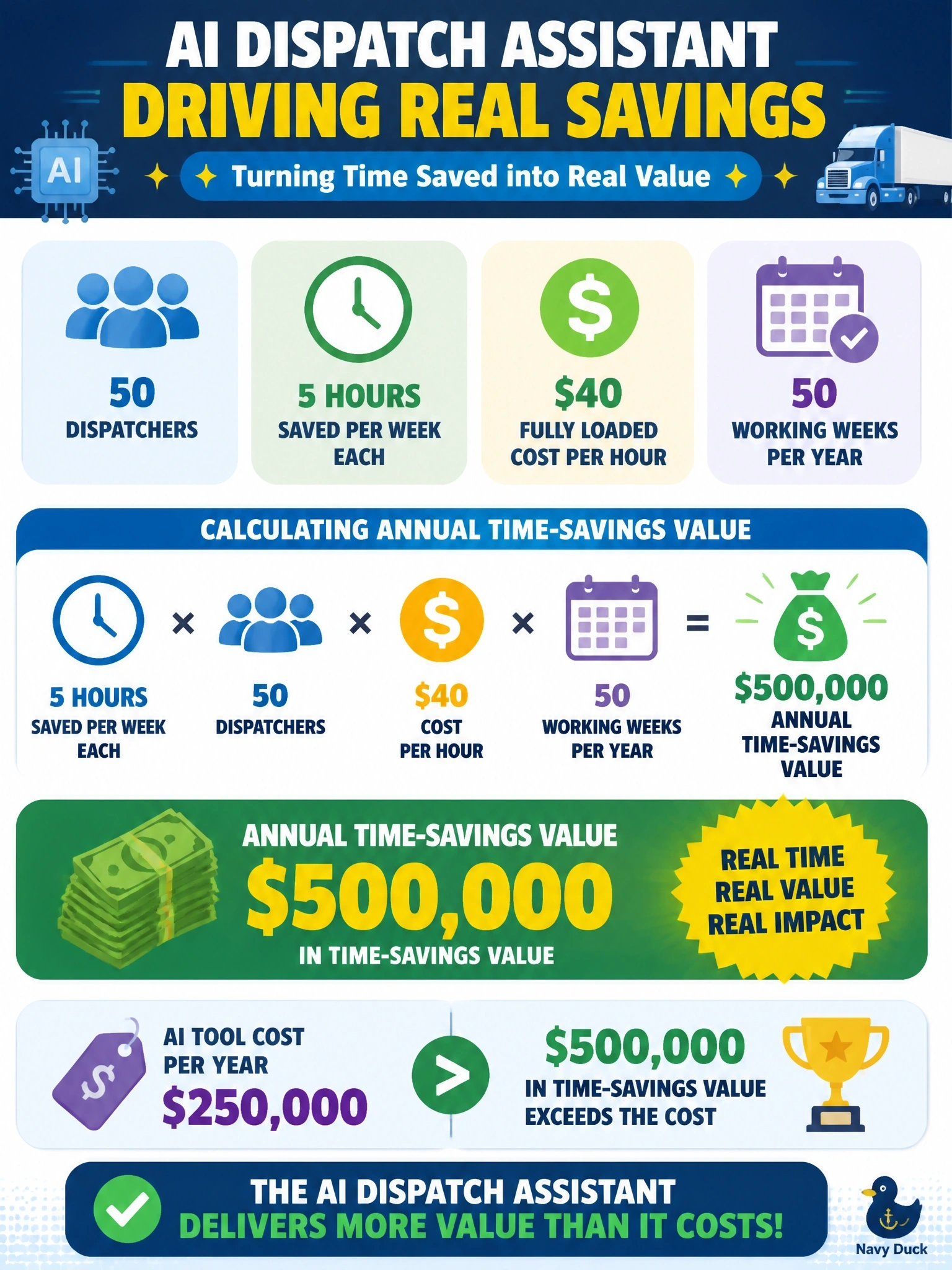
Multiply it out step by step: 50 dispatchers, 5 hours each, $40 an hour, 50 weeks — that's $500,000 in time saved. Stack that against the $250,000 the tool costs and you're looking at double the return, not a break-even or a loss.
Full Explanation
The math here is a straight multiplication chain: 50 dispatchers × 5 hours saved per week × $40 per hour × 50 weeks = $500,000 in time-savings value, twice the tool's $250,000 annual cost. One answer lands at $250,000, exactly half the correct total, as if the calculation dropped one of the four multiplying factors along the way — a common error when the weekly figure doesn't get carried out across all 50 weeks. Another answer drops even further, to $100,000, a total so low it would make the tool look like a losing investment, which the underlying numbers simply don't support once all four factors are multiplied correctly. A third answer reaches the correct $500,000 figure but then pairs it with the wrong conclusion, claiming it falls short of the $250,000 cost when it actually doubles it — a reminder that getting the arithmetic right doesn't guarantee the comparison that follows is right too. The reliable way to check this kind of question: multiply people affected × time saved per person × loaded hourly rate × time period, then hold that dollar figure directly up against the stated cost before choosing an answer.