
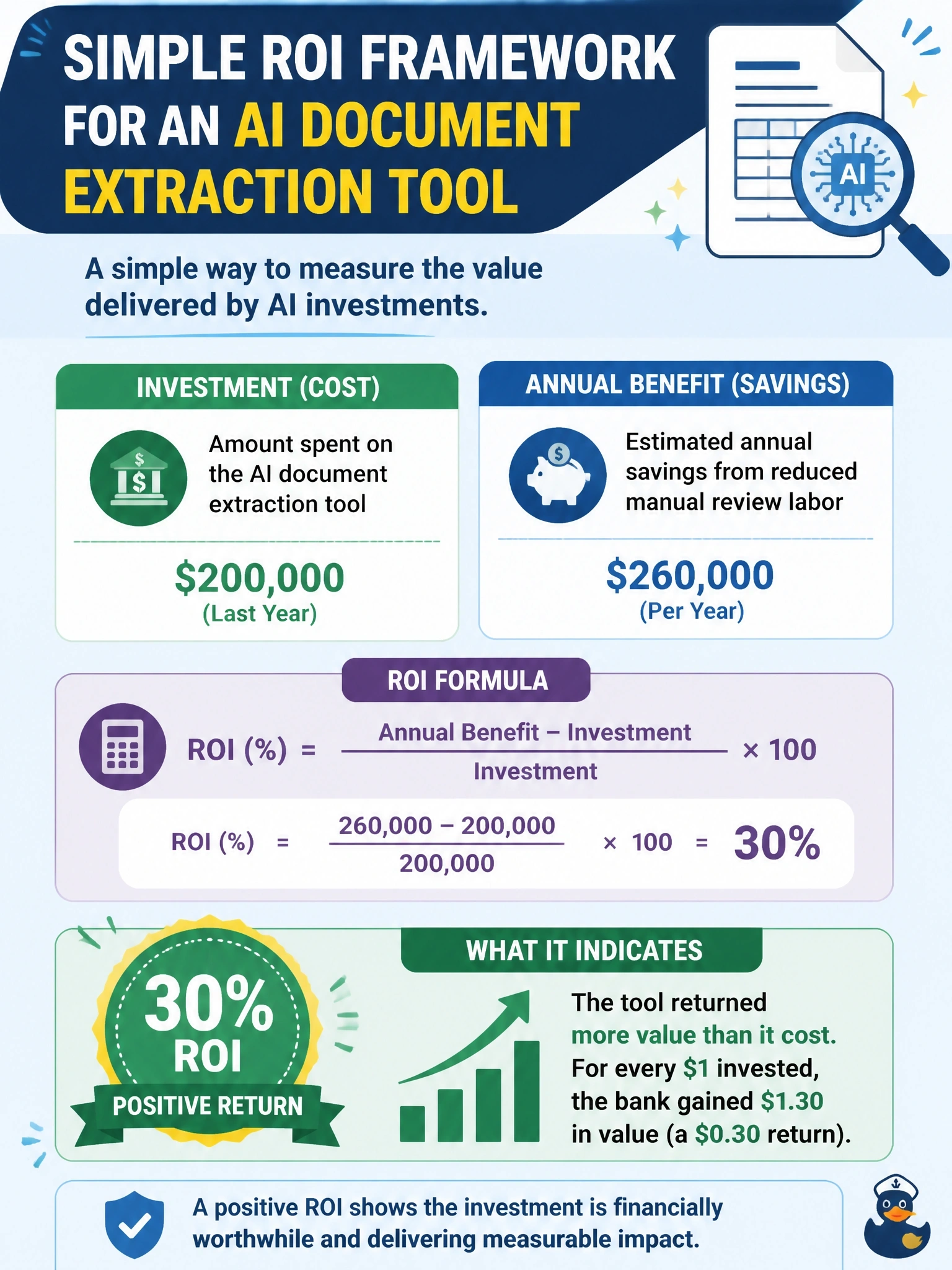
A bank's document processing team spent $200,000 last year on an AI document extraction tool. The tool saves the team an estimated $260,000 annually in reduced manual review labor. Using a simple ROI framework, what is the ROI, and what does it indicate?
Select an answer to reveal the explanation.
Short Explanation
Run the math the way you'd balance a checkbook: subtract what you spent from what you got back, then divide by what you spent. Here that's ($260,000 - $200,000) / $200,000 = 30%, a healthy positive ROI — the tool paid for itself and then some.
Full Explanation
ROI measures net benefit against cost: subtract cost from benefit, then divide by cost. Here that's ($260,000 - $200,000) / $200,000 = $60,000 / $200,000 = 30%, and any positive percentage means the initiative returned more value than it consumed. The answer that reports 130% makes the classic mistake of dividing total benefit by cost instead of net gain by cost — $260,000 / $200,000 — which inflates the figure by folding the original investment back into the return. Another answer flips the calculation entirely, dividing cost by benefit ($200,000 / $260,000 ≈ 77%), which produces a number that isn't ROI at all — it's closer to a cost-to-benefit ratio and tells you nothing about net return. A third answer lands on the right percentage, 30%, but then reads it backward, calling a clear gain a loss; a negative ROI would look like -30%, not a positive one. Watch for this exact trap on the exam: two answer choices can share the same correct number while only one pairs it with the correct interpretation. Whenever an ROI question comes up, do the subtraction first — benefit minus cost — before dividing, and confirm the sign of the result matches the conclusion stated in the answer.