
An insurer plans to move its claims-triage process from an existing, well-established AI vendor platform to a newer platform offering better accuracy, but the new platform requires claims data in a different format and the migration will take an estimated three months. During those three months, claims must still be triaged without interruption. Which consideration is most important to address before starting the migration?
Select an answer to reveal the explanation.
Short Explanation
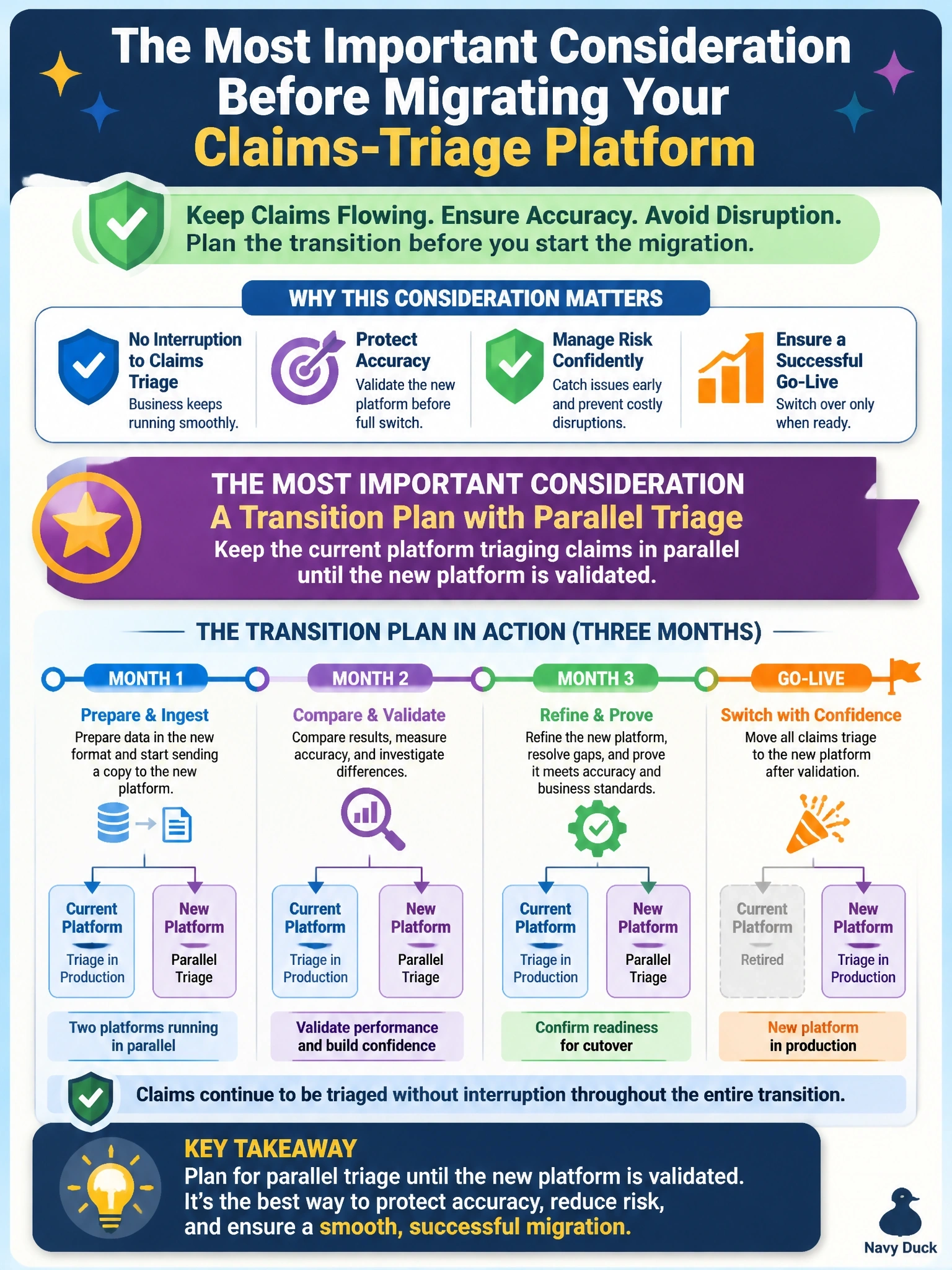
You wouldn't swap out your car's engine while it's still driving down the highway. Claims still need triaging every day during that three-month migration, so the old platform keeps running in parallel until the new one proves itself. That parallel run is what keeps the lights on while you make the switch.
Full Explanation
The stem names two concrete risks: a data-format change the new platform requires and a three-month migration window during which claims still have to be triaged without interruption. A transition plan that keeps the current platform actively triaging in parallel, only cutting over once the new platform is validated against real claims, directly neutralizes both risks by never leaving a gap where nothing is triaging. Worrying about a new keyboard shortcut is a training footnote that has zero bearing on whether claims keep moving during migration. Where the new vendor's headquarters sits relative to the insurer's offices doesn't affect data flow, validation, or uptime in any way; it's geographically interesting and operationally irrelevant. Comparing marketing materials for visual polish says nothing about whether the platform can reliably triage claims once it's live, and it ignores the format and timeline risks entirely. None of those three touch business continuity, which is the one thing explicitly put at risk by the scenario's own details. As an operational check: whenever a migration has a defined timeline and a data or process change, ask what covers the gap if validation takes longer than planned, and make sure the current system stays live until that answer is proven.