
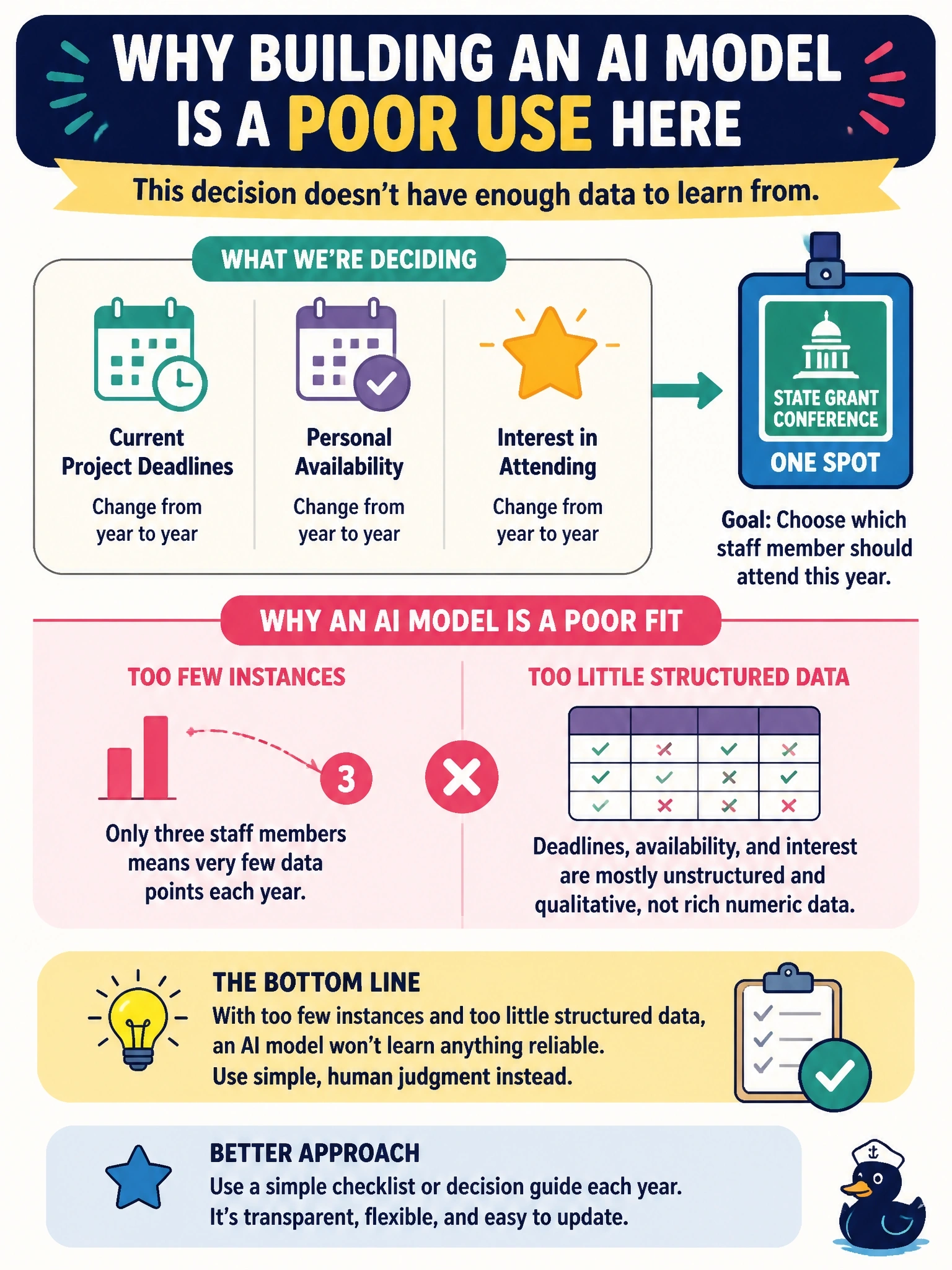
A small community non-profit is deciding which of its three staff members should attend an annual state grant conference, a decision based on each person's current project deadlines, personal availability, and interest, which shift from year to year. Someone suggests building an AI model to make this decision automatically. Why is this a poor use of AI?
Select an answer to reveal the explanation.
Short Explanation
Think of it like building a spreadsheet formula for a decision you only make once a year with three people involved. There's just not enough data or repetition to teach a model anything useful, so a quick conversation beats a model every time here.
Full Explanation
The real problem is scale and data, not capability: choosing among three staff members for one annual conference happens once a year, involves shifting factors like deadlines and personal interest, and leaves behind no structured, repeatable dataset a model could learn patterns from. Building and maintaining a model for a decision this infrequent costs more effort than it could ever save, and there's simply no historical volume to validate whether the model's picks would even be good ones. Claiming AI models are technically incapable of processing information about employee schedules under any circumstances overstates a limitation that doesn't exist, since AI handles scheduling and resource-allocation problems in plenty of other contexts; the issue here is the absence of data and repetition, not a technical wall. Framing AI as appropriate only for customer-facing decisions, never for internal ones, is a false generalization, since organizations routinely and successfully apply AI to internal business problems, so that's not what rules this case out. Invoking the AWS shared responsibility model as a prohibition is a mismatch entirely, since that framework governs security and compliance obligations between AWS and its customers, and has nothing to say about whether a use case is a good fit for AI. The operational check to apply broadly: before building a model, ask whether the decision recurs often enough, and generates enough structured history, to make training and maintaining that model worth it. If the answer is no, as it clearly is here, the right tool is a conversation, not a model.