
A workers' compensation insurer's legal team must decide, case by case, whether to contest a disputed claim in court. Each decision depends on nuanced factors including case-specific legal precedent, ethical judgment about a claimant's circumstances, and reputational considerations that vary by case. A vendor proposes an AI model to make the final contest-or-settle decision autonomously. What is the most appropriate response?
Select an answer to reveal the explanation.
Short Explanation
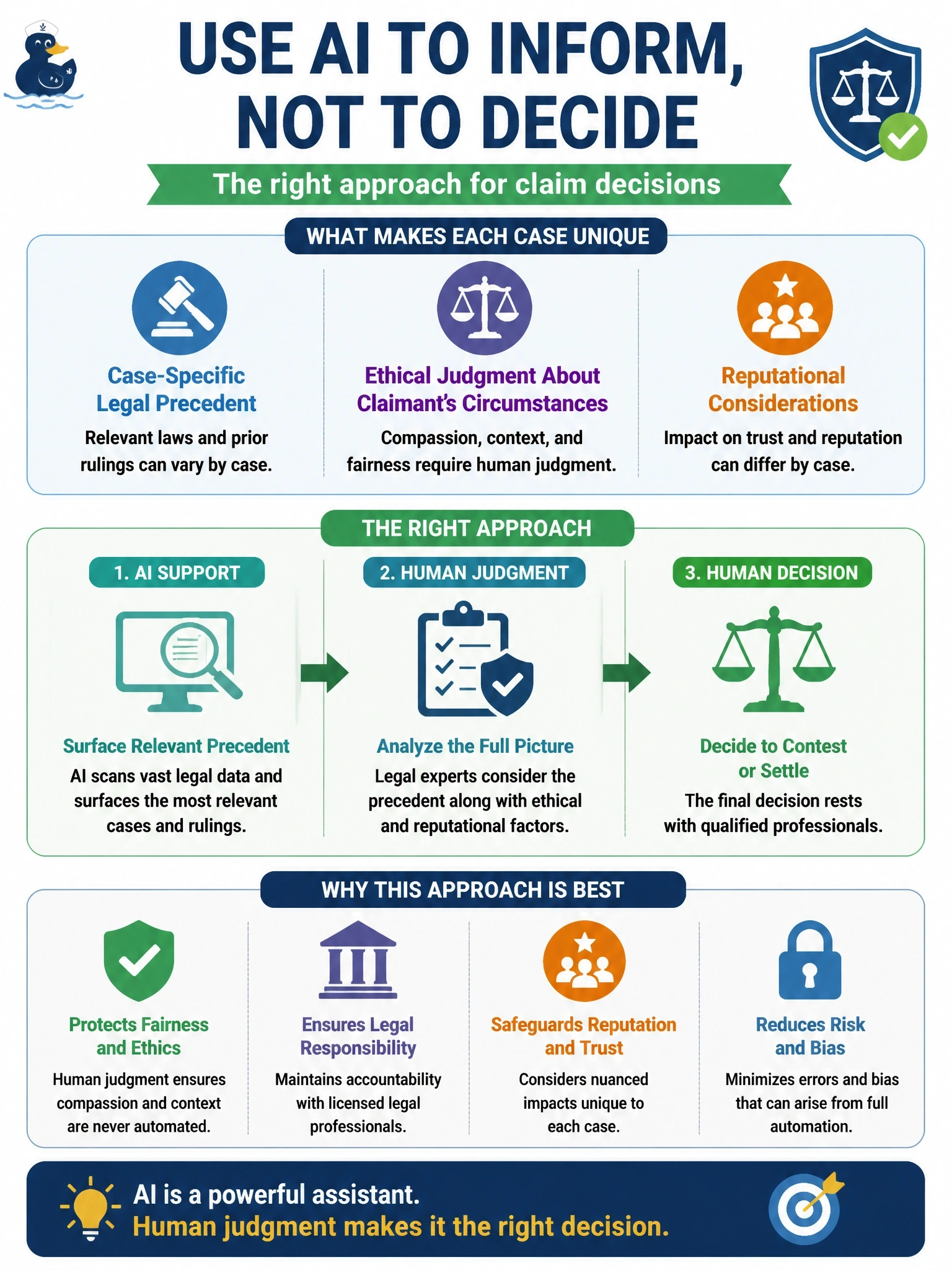
A paralegal pulling case law for a lawyer is invaluable for gathering information, but you still need a human making the final call, because that call requires judgment a machine can't own. These contest-or-settle decisions hinge on ethics, reputation, and case-specific nuance, so the right role for AI here is research support, not decision-maker.
Full Explanation
Limiting AI to a supporting research role, surfacing relevant precedent, while keeping the actual contest-or-settle call with a human, matches what the scenario describes: a decision built on ethical judgment about a claimant's circumstances and reputational considerations that shift case by case, not a pattern a model can reliably learn and apply. Rejecting AI involvement whatsoever, including for research, throws away a task AI genuinely does well, finding and organizing relevant legal precedent, over a concern that only applies to the final decision itself. Proposing to use Amazon Bedrock to automate the entire legal decision-making process without any human review step hands the highest-stakes, most judgment-dependent part of the workflow to a system with no mechanism for weighing ethics or reputational nuance the way a person can. Adopting the AI model to make the final contest-or-settle decision autonomously, even framed as reducing legal team workload, commits the same core error: it treats a decision requiring human accountability and contextual judgment as if it were a routine classification task. The pattern to watch for generally: when a decision mixes structured information, precedent and case facts, with unstructured judgment calls, ethics and reputation, split the workflow, letting AI handle the structured retrieval while leaving the judgment call to the humans who can be held accountable for it. Check any AI proposal touching legal or ethical decisions against that split before approving it.