
A furniture manufacturer wants to automate applying a fixed, unchanging set of shipping labels to outbound pallets based on destination zip code, a simple lookup with no exceptions or judgment involved. A vendor has proposed a generative AI system to handle this. What is the most appropriate recommendation?
Select an answer to reveal the explanation.
Short Explanation
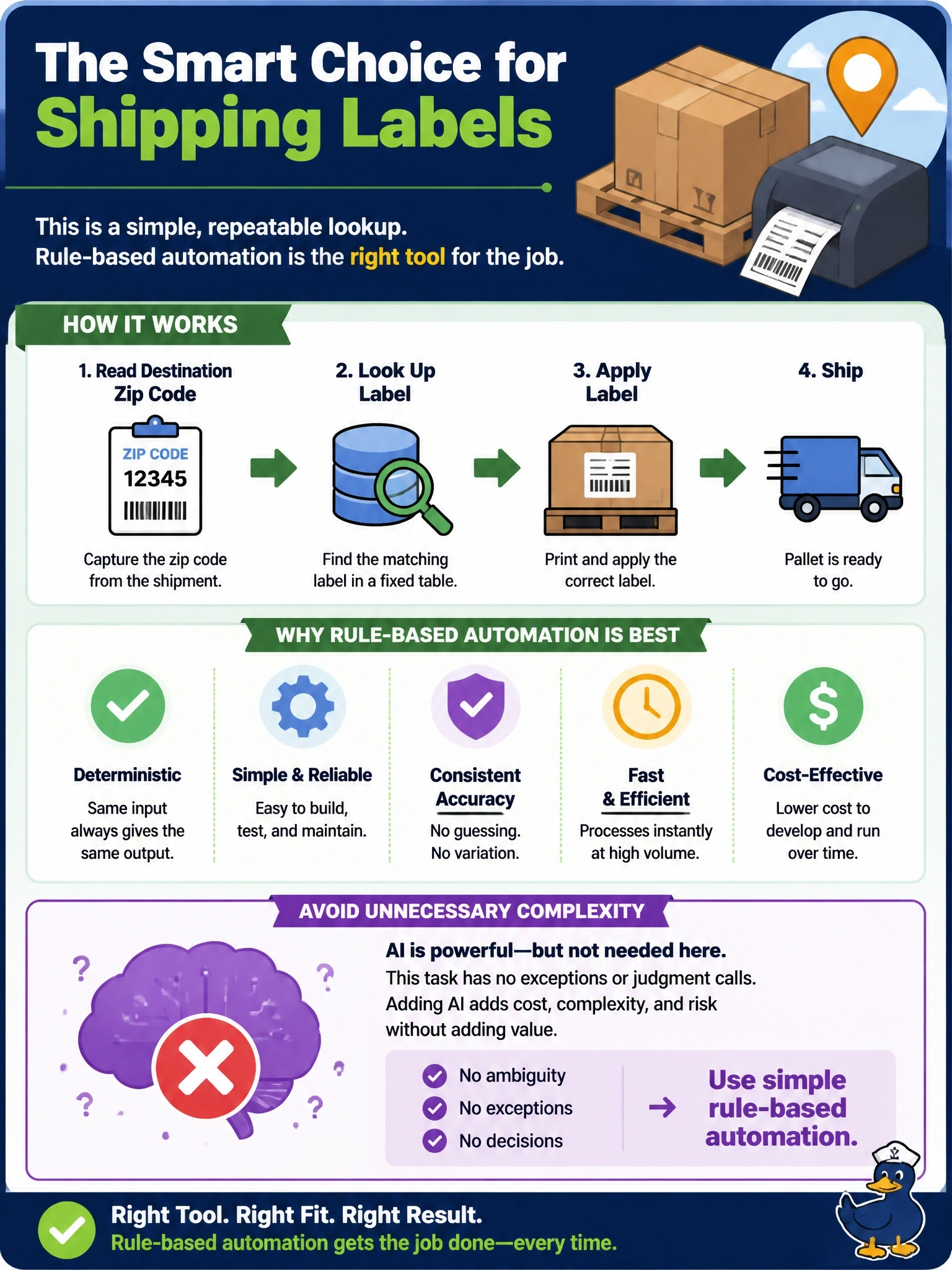
Think of it like using a phone book instead of hiring a detective. When the answer is a fixed lookup with no ambiguity, you don't need a system that reasons or learns, you need a table. Matching a zip code to a shipping label has no exceptions and no judgment involved, so simple rule-based automation does the job cheaper and more predictably than any AI model.
Full Explanation
Rule-based automation is the right call because the task itself has no ambiguity to resolve: a zip code maps to one shipping label every time, with no exceptions, no shifting patterns, and nothing for a model to learn from experience. That description is a textbook deterministic lookup, and a simple if-this-then-that rule set, or even a static reference table, handles it with complete predictability at a fraction of the cost and complexity of any AI approach. Proposing Amazon SageMaker AI to train a custom machine learning model misreads the problem as one involving prediction or pattern recognition when it's really just retrieval, since there's no signal to learn, training a model only adds infrastructure, latency, and maintenance overhead for zero added accuracy. Adopting the generative AI system on the logic that the most advanced available technology should always be used falls into the same trap from the vendor's side, since sophistication isn't a virtue when the underlying task doesn't need it, and generative AI in particular introduces unpredictability, exactly what you don't want in a shipping process with zero tolerance for ambiguity. Delaying automation entirely until the company can hire a dedicated AI team solves a problem that doesn't exist here, since this task requires no AI expertise at all. The operational test to apply going forward: if the mapping from input to output never changes and involves no judgment, reach for rules or a lookup table first, and save AI for the cases that actually involve variability or pattern recognition.