
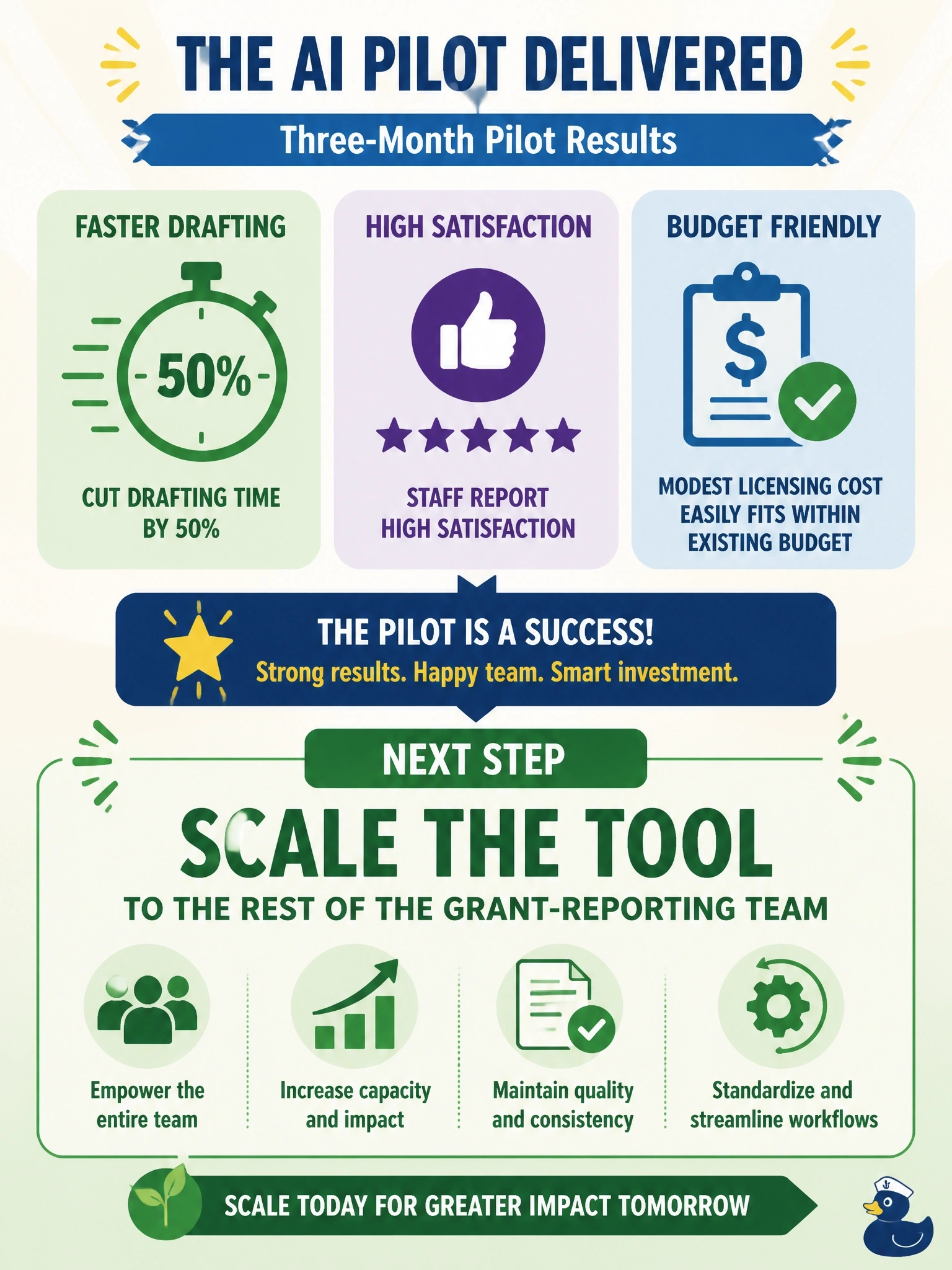
A non-profit launched a three-month AI pilot to draft grant reports faster. Results after three months show the tool cut drafting time by 50%, staff report high satisfaction, and the modest licensing cost easily fits within the existing budget. What should the non-profit do next?
Select an answer to reveal the explanation.
Short Explanation
You ran the pilot to answer one question, and it came back a clear yes: drafting time dropped in half, staff liked using it, and the cost fits the budget without a fight. When a result lands that clean, there's no reason to keep it small — scale it to the rest of the grant-reporting team.
Full Explanation
Scaling is the natural next step once a pilot has already answered the question it was designed to test: a fifty percent cut in drafting time, positive staff feedback, and a licensing cost that fits comfortably within the existing budget are exactly the signals an organization looks for before expanding a tool beyond its initial test group. Treating three months as too short a trial period mischaracterizes what actually happened, since the pilot wasn't inconclusive or ambiguous, it produced a clear, measurable result on the metric that mattered, so length of trial isn't the limiting factor here. Keeping the tool restricted to the original small group, with no plan to expand, wastes a proven benefit by denying it to the rest of the grant-reporting team for no stated reason. Leaving the tool paused indefinitely, with a decision that's never scheduled, is the same failure in a different shape: it stalls a decision the data has already made easy, letting a successful pilot quietly stagnate instead of delivering its value organization-wide. The operational check for scaling is straightforward: did the pilot hit a defined, measurable target, did the people using it want to keep using it, and does the cost fit the budget without displacing other priorities? When all three land yes, as they do here, scaling is the default move, not another round of evaluation.