
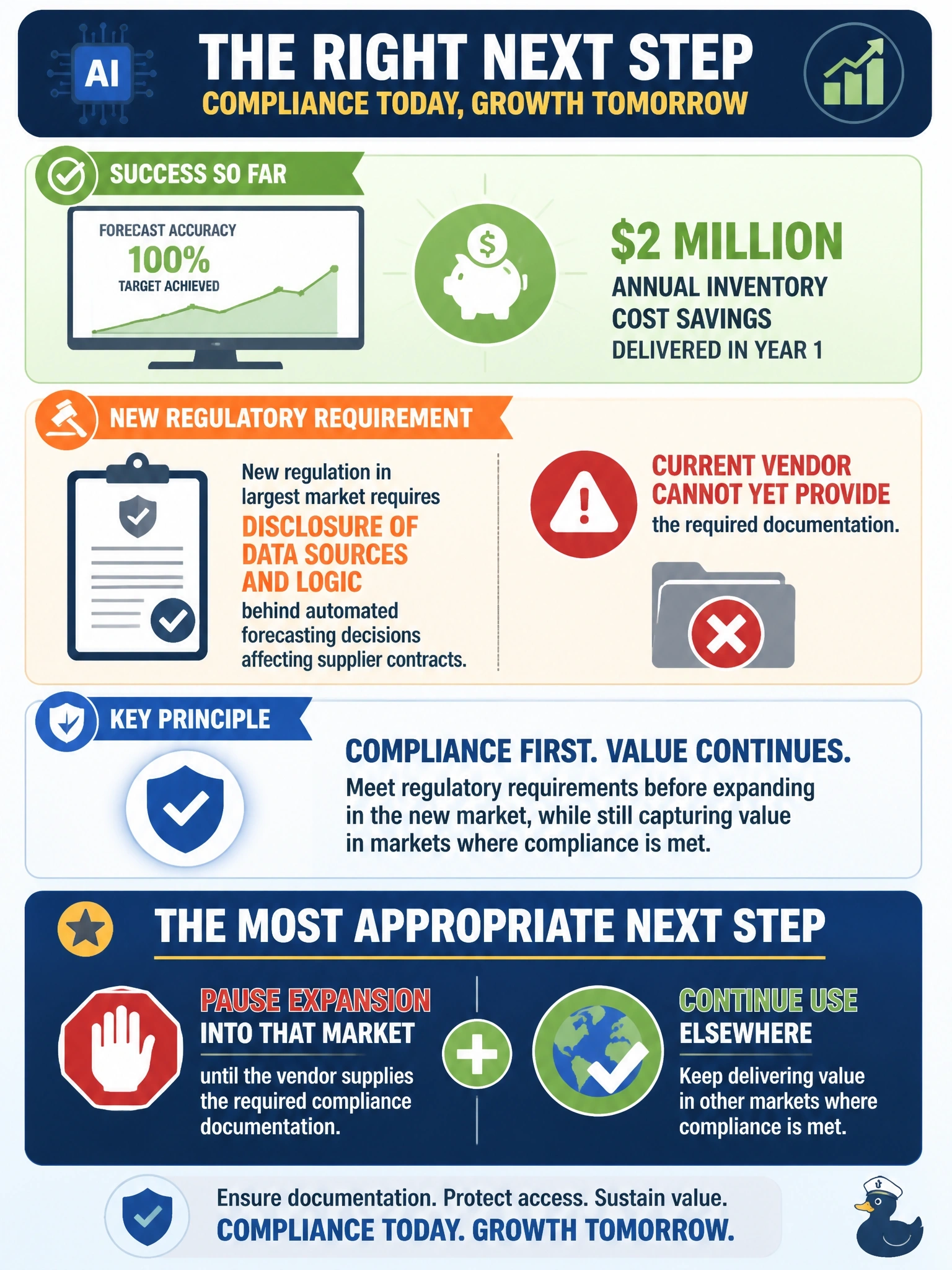
A consumer appliance manufacturer's AI-based supply chain forecasting tool has hit its accuracy targets and produced $2 million in annual inventory cost savings during its first year. A newly passed regulation in its largest market will require the company to disclose the data sources and logic behind any automated forecasting decisions affecting supplier contracts, and the current vendor cannot yet provide that documentation. What is the most appropriate next step?
Select an answer to reveal the explanation.
Short Explanation
Think of it like a store chain that's fully licensed everywhere except one state that just added a new permit requirement — you don't shut the whole chain down, and you don't ignore the new rule either. The tool's already proven itself elsewhere, so the fix is scoped exactly to the problem: pause expansion into that one market, not the whole operation.
Full Explanation
The right response scopes the fix to the size of the actual problem: a documentation gap that applies to one regulated market, not to the tool's overall value. The forecasting system already hit its accuracy targets and delivered two million dollars in savings, so nothing here suggests the technology itself is flawed, only that expansion into this particular market needs to wait for compliance paperwork the vendor doesn't yet have. Scaling into that market immediately to beat competitors ignores a documented regulatory requirement and exposes the company to disclosure violations the moment automated decisions start affecting supplier contracts there. Continuing to expand while the vendor develops documentation in parallel is the same mistake on a slower timeline, since the company would still be operating in the market before it can meet the disclosure requirement, hoping the paperwork catches up before regulators notice. Terminating the entire initiative worldwide massively overcorrects: it discards a proven, profitable system everywhere else because of a compliance gap that exists in exactly one market. The operational check is simple geography-plus-condition: does the blocking regulation apply in this market? If yes, hold expansion there. If the tool is already running and profitable somewhere the regulation doesn't reach, that value keeps flowing untouched while the compliance team and vendor close the documentation gap.