
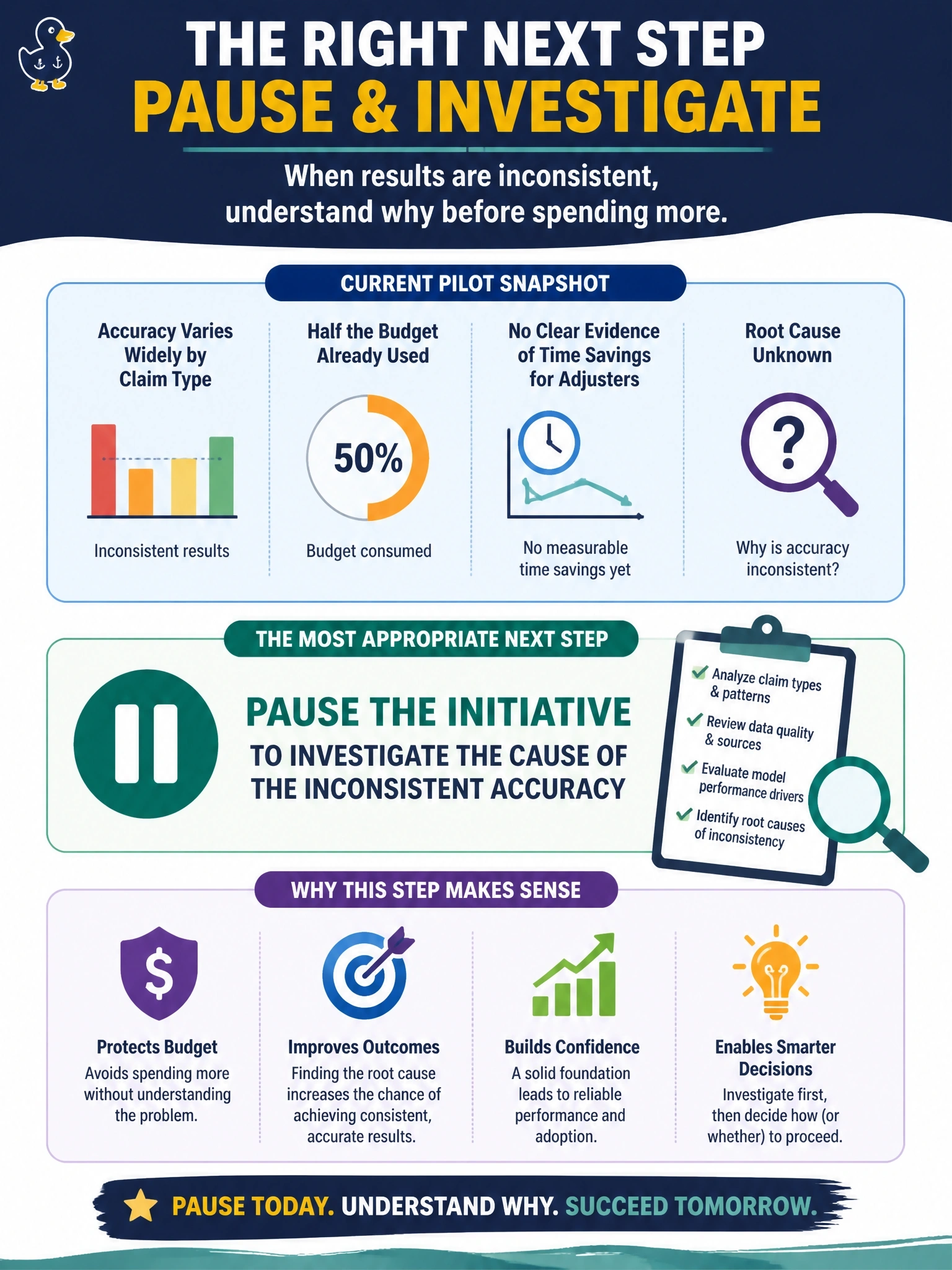
An insurer's six-month pilot of an AI claims-summarization tool has produced inconsistent results: accuracy varies widely by claim type, and the team hasn't yet determined why. The pilot has consumed half its allocated budget, and there is no clear evidence yet of measurable time savings for adjusters. What is the most appropriate next step?
Select an answer to reveal the explanation.
Short Explanation
Think of it like a doctor who won't prescribe more treatment until the diagnosis is confirmed. You've still got budget left and a real question mark on why accuracy swings by claim type, so the responsible move is to stop, dig into the root cause, and only spend more once you know what you're fixing. That's a pause, not a retreat.
Full Explanation
Pausing is the only choice that matches both facts on the table: money is still available, and the cause of the accuracy swings hasn't been identified. Continuing the pilot exactly as-is just burns through the remaining budget while the mystery stays a mystery, spending without learning anything new. Scaling to every claim type before you understand why performance varies is worse: you'd multiply an unexplained problem across the whole claims operation, potentially making the inconsistency bigger and harder to trace. Terminating the initiative outright is premature too, since nothing in the scenario says the underlying approach is broken, only that it needs more investigation before anyone commits more resources to it. A pause buys you exactly what's missing: time to run root-cause analysis, whether the variance is coming from claim complexity, thin training data for certain claim types, or something in how the model was tuned, without either abandoning a possibly salvageable tool or throwing good money after bad. Operationally, treat a pause as a defined, time-boxed diagnostic sprint with a decision checkpoint at the end, not an open-ended hold. If the team can isolate the cause and show a credible fix, resume; if not, that's the moment to reconsider scaling or termination, but only after you actually know what's wrong.