
A machinery manufacturer piloted an AI-based defect-detection system on one production line six months ago. The pilot met its accuracy target, reduced defect escapes by 30%, and plant managers at other facilities have asked to adopt it. Budget is available, and the underlying technology has proven stable in production. What is the most appropriate next step?
Select an answer to reveal the explanation.
Short Explanation
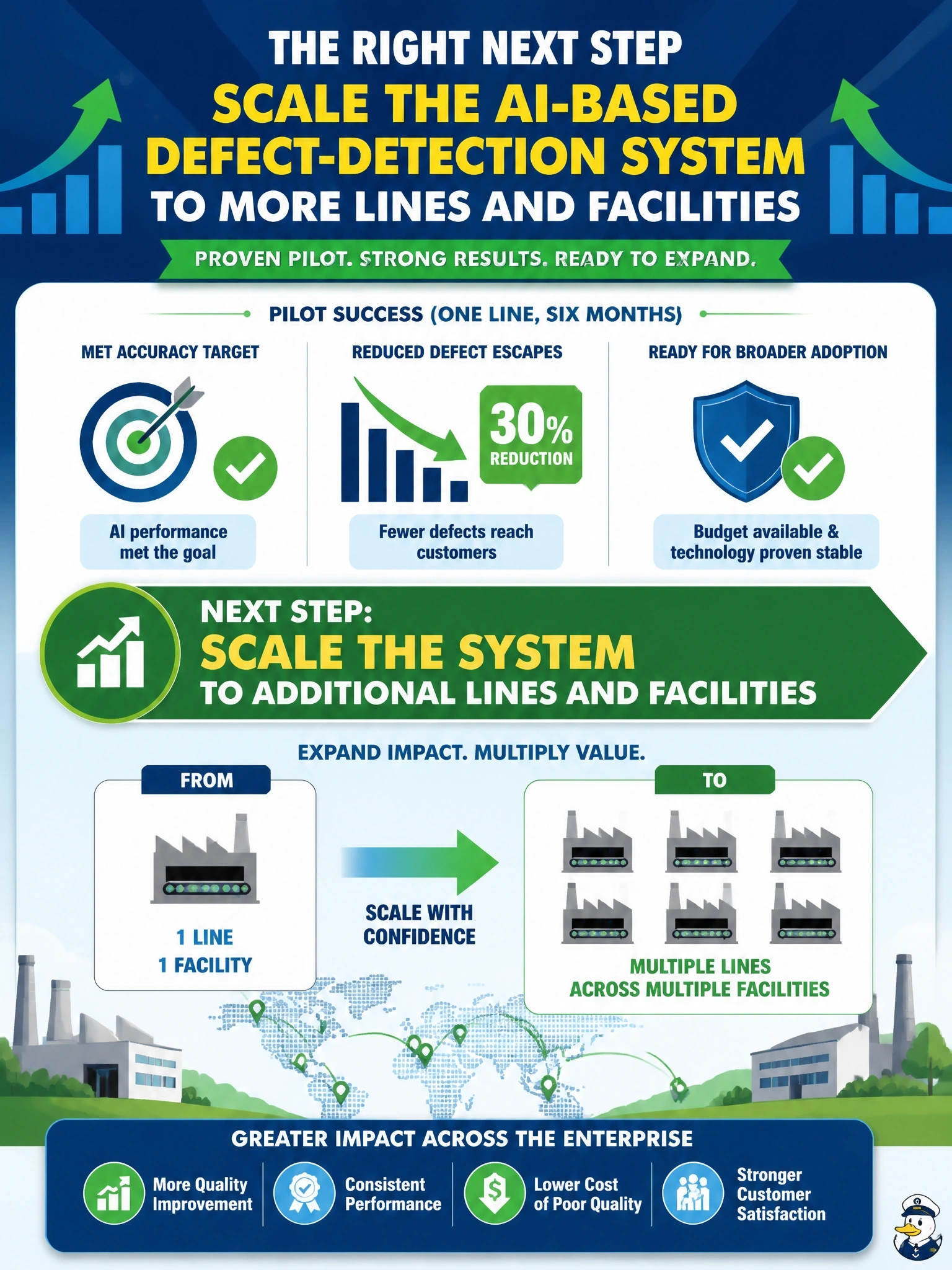
Think of it like this: the pilot hit its accuracy target, cut defect escapes by 30%, other plants are asking for it, and the money's there — that's not a signal to test again, it's a signal to scale. Running another six-month pilot on evidence you already have just delays value the results already earned.
Full Explanation
The correct answer follows directly from the evidence: the pilot met its accuracy target, produced a measurable 30% reduction in defect escapes, generated demand from other facilities, and funding is available. When success, demand, and resources all line up, scaling to additional lines and plants is the next logical step. Running a second six-month pilot on the same line ignores that validation has already happened; repeating it wastes the window of opportunity the first pilot created without adding new information. Terminating the initiative and starting over with a different vendor makes no sense here, since nothing in the scenario points to a problem with the technology or the vendor; it discards a proven success for no stated reason. Keeping the system confined to the original line indefinitely under-uses a capability that's already been validated, leaving real value on the table while other plants wait. The operational check for any scale decision: has the pilot cleared its success criteria, is there demonstrated demand beyond the pilot site, and are resources available to expand? When all three are true, as they are here, delaying expansion carries a real, avoidable opportunity cost.