
A mid-size automotive parts manufacturer wants to add AI-driven demand forecasting within four months, ahead of its next fiscal year budget cycle. The company has no in-house data science team, and its IT staff already have a full workload maintaining production systems. Several established vendors offer forecasting products that already integrate with the company's existing ERP system. Which approach best fits these constraints?
Select an answer to reveal the explanation.
Short Explanation
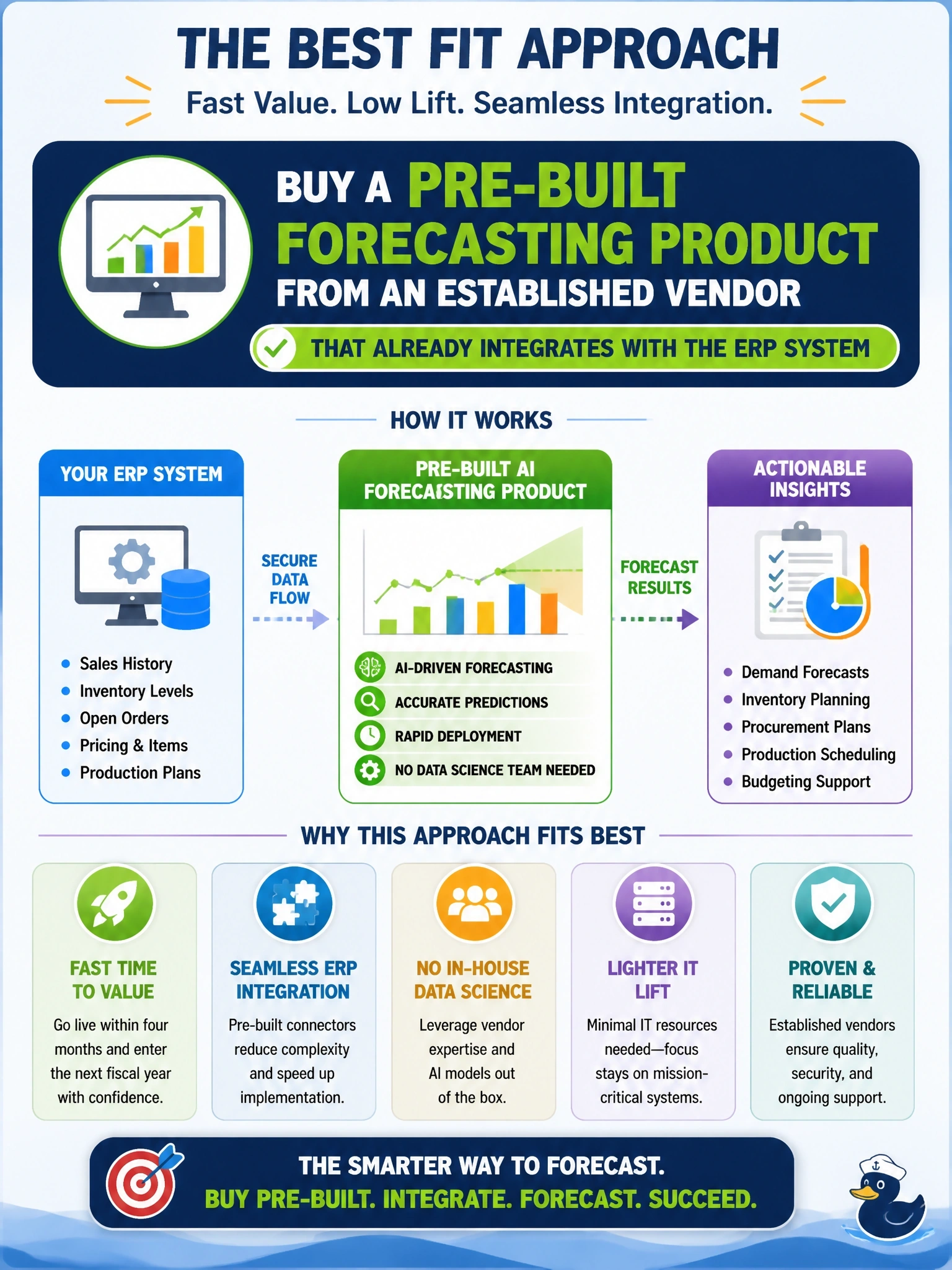
Think of it like this: you've got four months, no data science team, and IT already stretched thin — that's not a build timeline, and it's definitely not an eighteen-month research timeline. When a mature vendor product already plugs into your ERP, buying is the option that actually fits the calendar and the skills on hand.
Full Explanation
The correct choice works because it satisfies all three constraints at once: a four-month deadline, no in-house data science capability, and a ready-made product that already integrates with the existing ERP system. That combination is the textbook trigger for buying rather than building or partnering. Building in-house is ruled out because the IT staff are already at full capacity maintaining production systems and don't have the specialized forecasting skill set, so a custom build would blow the timeline and stretch a team that has none to spare. The university research partnership sounds appealing since it could produce a tailored model and grow internal capability, but its eighteen-month timeline runs more than a year past the fiscal-year deadline, which makes it the wrong fit no matter how good the research would be. Postponing until a dedicated data science team is hired throws away a workable near-term option and forfeits the budget cycle for no real reason, since a vendor solution is sitting right there. The operational check for build-buy-partner calls: line up the timeline, the in-house skill gap, and vendor maturity, and here all three point the same direction, toward buying.