
An environmental non-profit wants to increase individual donor contributions by sending more personalized outreach messages that reference each donor's past giving history and stated interests. Which AI use case best maps to this business outcome?
Select an answer to reveal the explanation.
Short Explanation
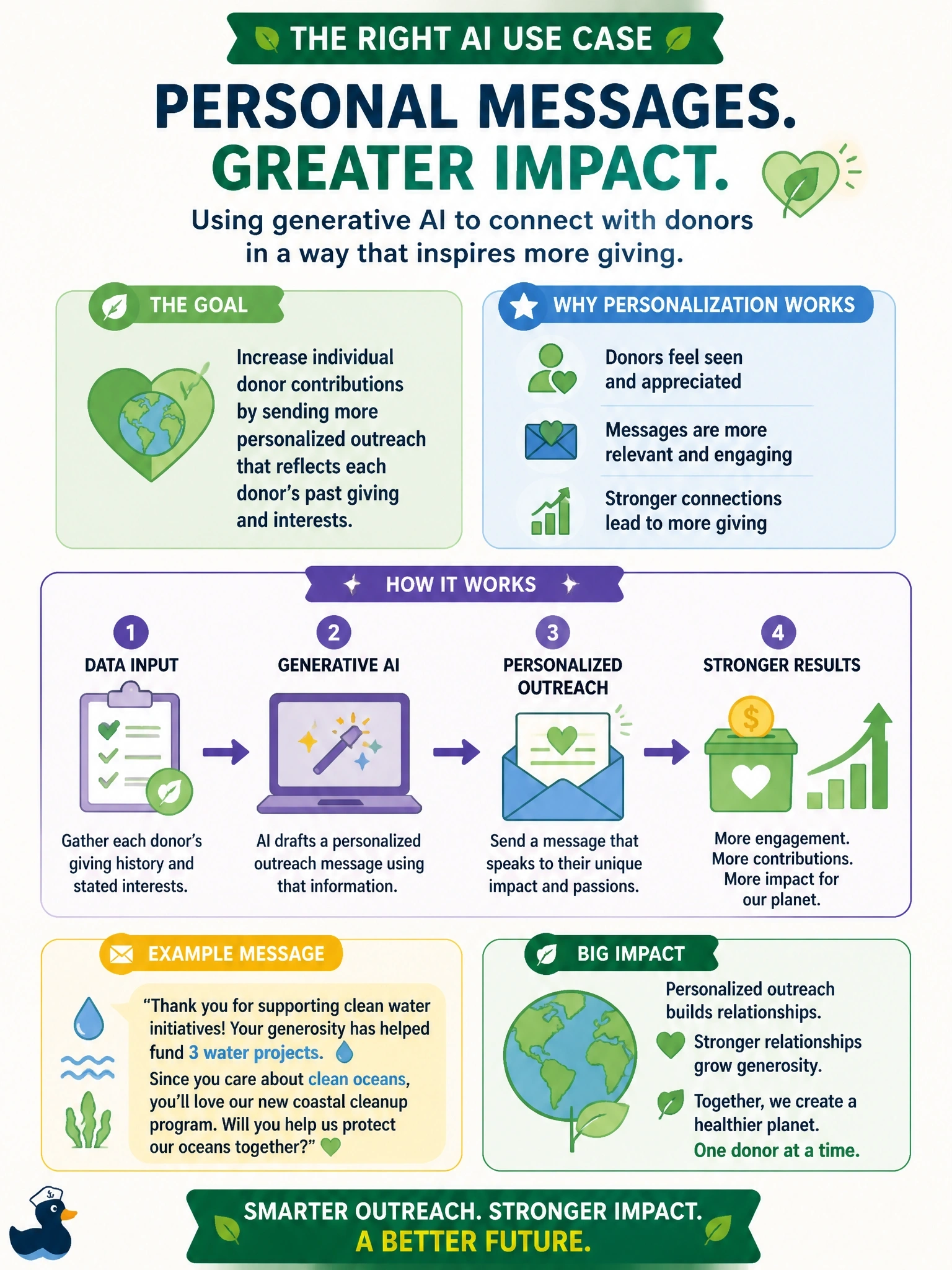
Think of it like this: you already have a donor's giving history and stated interests sitting in a database — that's raw material for personalization, and generative AI is built to turn structured facts into natural, individualized writing. Feed it each donor's record and it drafts outreach that reads like it was written just for them, which is exactly the growth lever the non-profit is pulling.
Full Explanation
The correct choice fits because it applies generative AI's strength, producing tailored natural-language content, directly to the stated goal of personalized outreach built from each donor's giving history and interests. That's a one-to-one match between capability and outcome. The volunteer-shift scheduling tool solves a real logistics problem, matching availability to weekend cleanup slots, but it has nothing to do with fundraising messages. The electricity-cost forecasting model is a legitimate predictive use case for facilities planning, yet it's a numeric forecast disconnected from donor communication entirely. The meeting-minutes transcription archive improves internal recordkeeping and searchability, which is useful housekeeping but doesn't touch how donors are contacted or what the messages say. Every distractor here is a defensible AI project somewhere in the organization; none of them produce personalized donor messages. The general check: when several use cases are all legitimate, pick the one whose output is literally the thing the scenario says it wants, not just any respectable AI application the non-profit could run.