
An industrial equipment manufacturer wants to reduce unplanned downtime on its assembly lines. Machines already generate continuous sensor data (vibration, temperature, cycle time), but the maintenance team only inspects equipment on a fixed monthly schedule. Which AI use case maps most directly to the business outcome of reduced downtime?
Select an answer to reveal the explanation.
Short Explanation
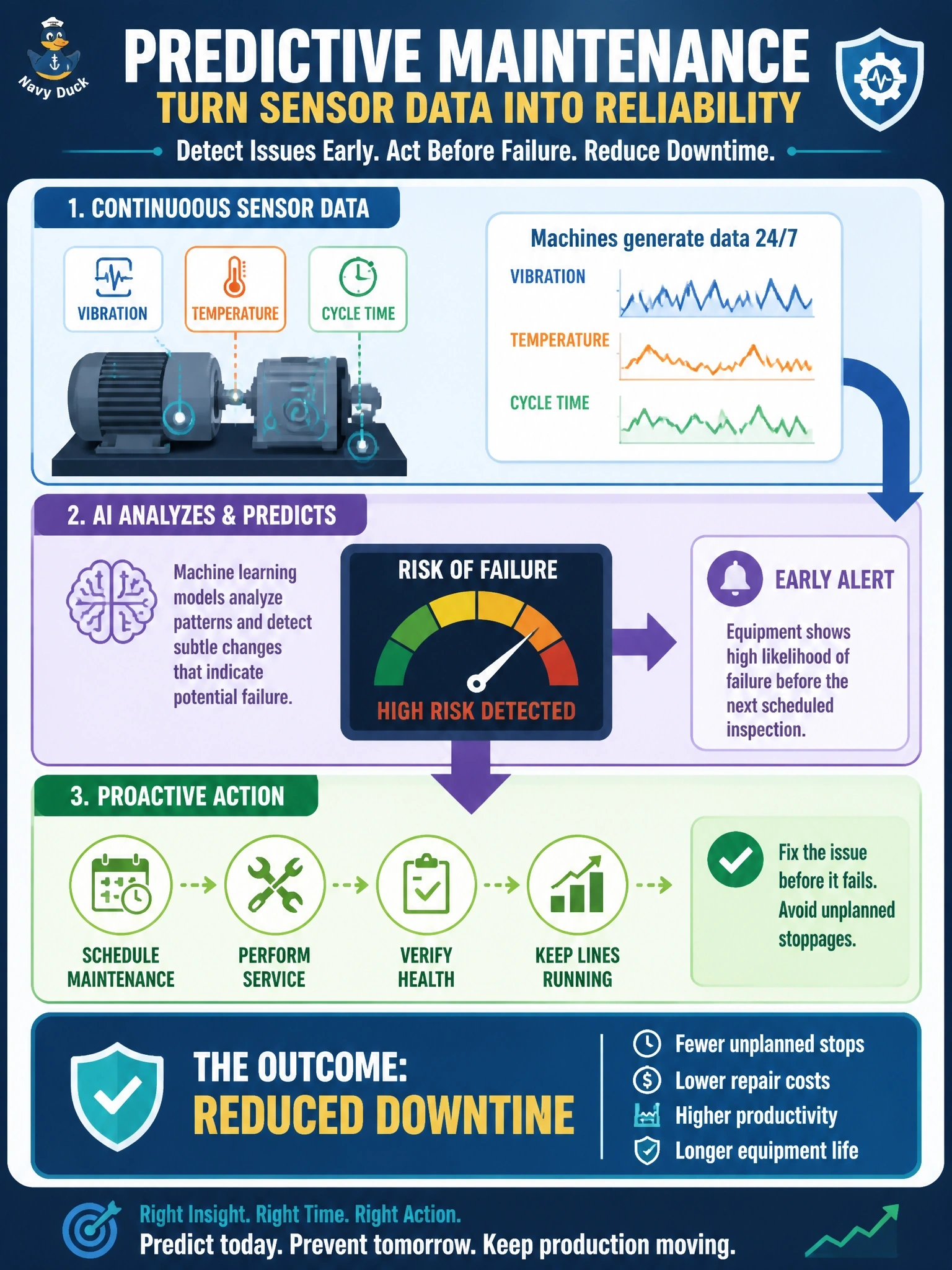
Think about the difference between reacting to a breakdown and seeing it coming. The plant already has a stream of vibration, temperature, and cycle-time data — predictive maintenance turns that stream into an early warning, flagging failing equipment before the next scheduled inspection even happens. That's the direct line from data you already have to downtime you actually prevent.
Full Explanation
Predictive maintenance directly uses the continuous sensor data already being collected to predict failures ahead of the fixed monthly schedule, tying the AI capability — pattern detection on sensor data — to the specific outcome named in the scenario: fewer unplanned stops. A chatbot that answers technicians' questions about repair manuals and part numbers is tempting because it does help technicians, but it addresses information retrieval, not failure prediction, so it doesn't move the downtime metric. An AI-generated monthly safety newsletter produces unrelated content with no connection to preventing failures. Scheduling software that assigns technicians to the existing fixed monthly rounds optimizes the existing reactive, fixed-interval process rather than shifting to the predictive approach that actually addresses the stated problem. The general principle: use-case selection should match a specific AI capability to the specific data available and the measurable outcome named, not any AI application that happens to touch the same department. Operationally, ask whether the use case changes when the failure is detected, not just how information flows around it.