
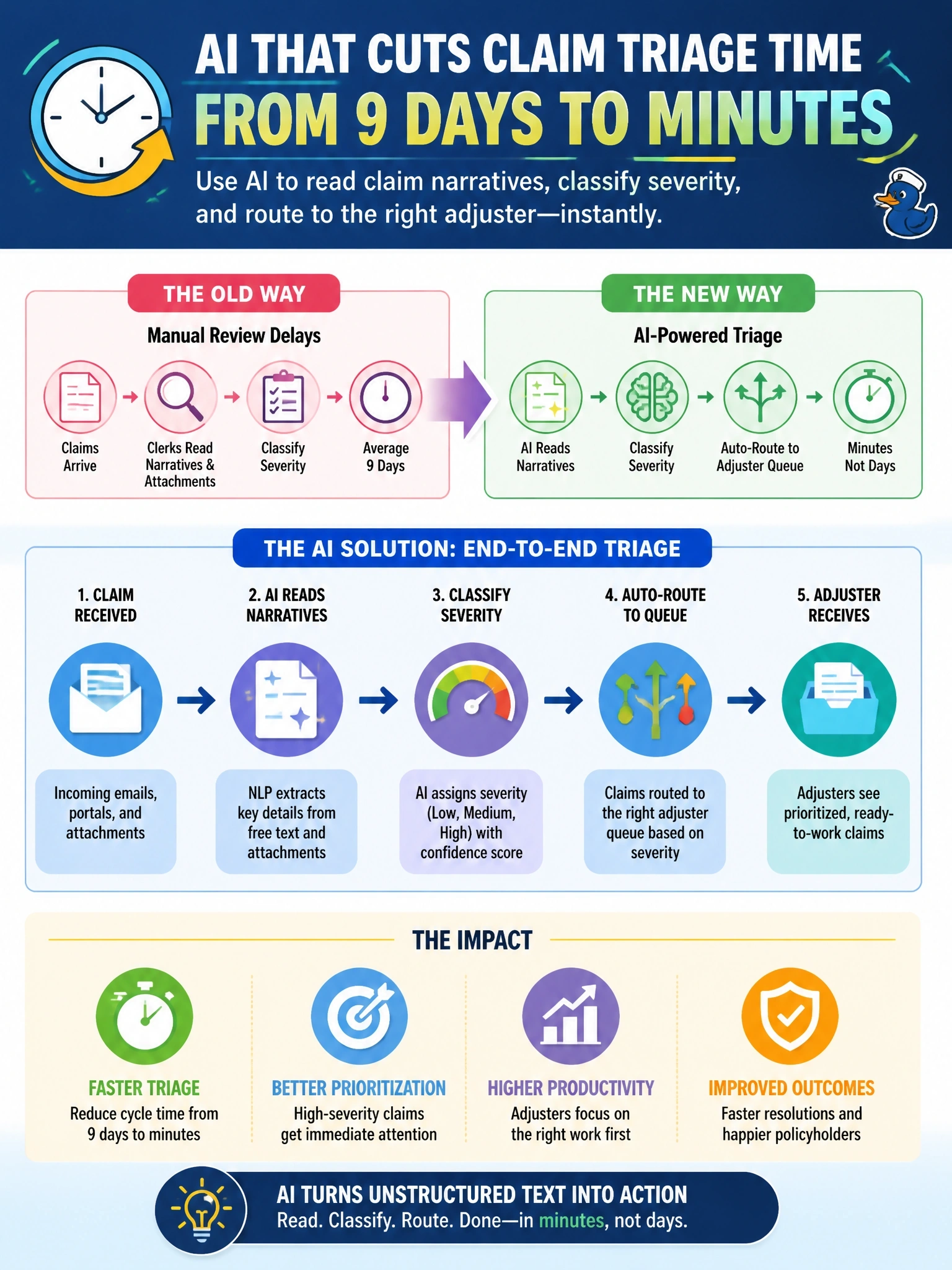
A property and casualty insurer's first-notice-of-loss claims take an average of nine days to triage because clerks manually read free-text loss descriptions and attachments to classify severity. Leadership wants the AI use case with the clearest, most direct link to reducing this cycle time. Which use case best fits?
Select an answer to reveal the explanation.
Short Explanation
Ask yourself where your nine days is actually going: clerks reading free text and deciding how serious each claim is. An AI model that reads incoming claim narratives and routes them straight to the right adjuster queue attacks that exact bottleneck for you — same step, same delay, now automated.
Full Explanation
An AI model that reads incoming claim narratives to classify severity and route each claim to an adjuster queue automates the exact bottleneck step driving the nine-day delay — manual reading and classification of free text — tying the AI capability directly to the stated outcome. Drafting marketing copy and promotional emails for new auto policies is a legitimate AI use case, but it sits in an unrelated function with no bearing on claims cycle time. Forecasting next quarter's overall claims volume for budgeting is useful for planning, but it doesn't touch triage speed at all. Summarizing individual adjuster performance reviews for managers is a downstream, HR-adjacent application with no connection to how quickly a claim reaches an adjuster in the first place. The general principle: mapping use cases to outcomes means tracing the AI capability to the specific process step causing the business pain named in the scenario, not any plausible use case within the same department or industry. Operationally, ask which step in the nine-day clock the AI actually shortens — if the answer is 'none,' it's the wrong use case.