
A resort chain's leadership is weighing the cost and effort of two options for improving its guest-facing GenAI assistant: connecting it to current property information, versus fine-tuning it on years of past guest-service transcripts. Which factor should most directly guide the choice between the two?
Select an answer to reveal the explanation.
Short Explanation
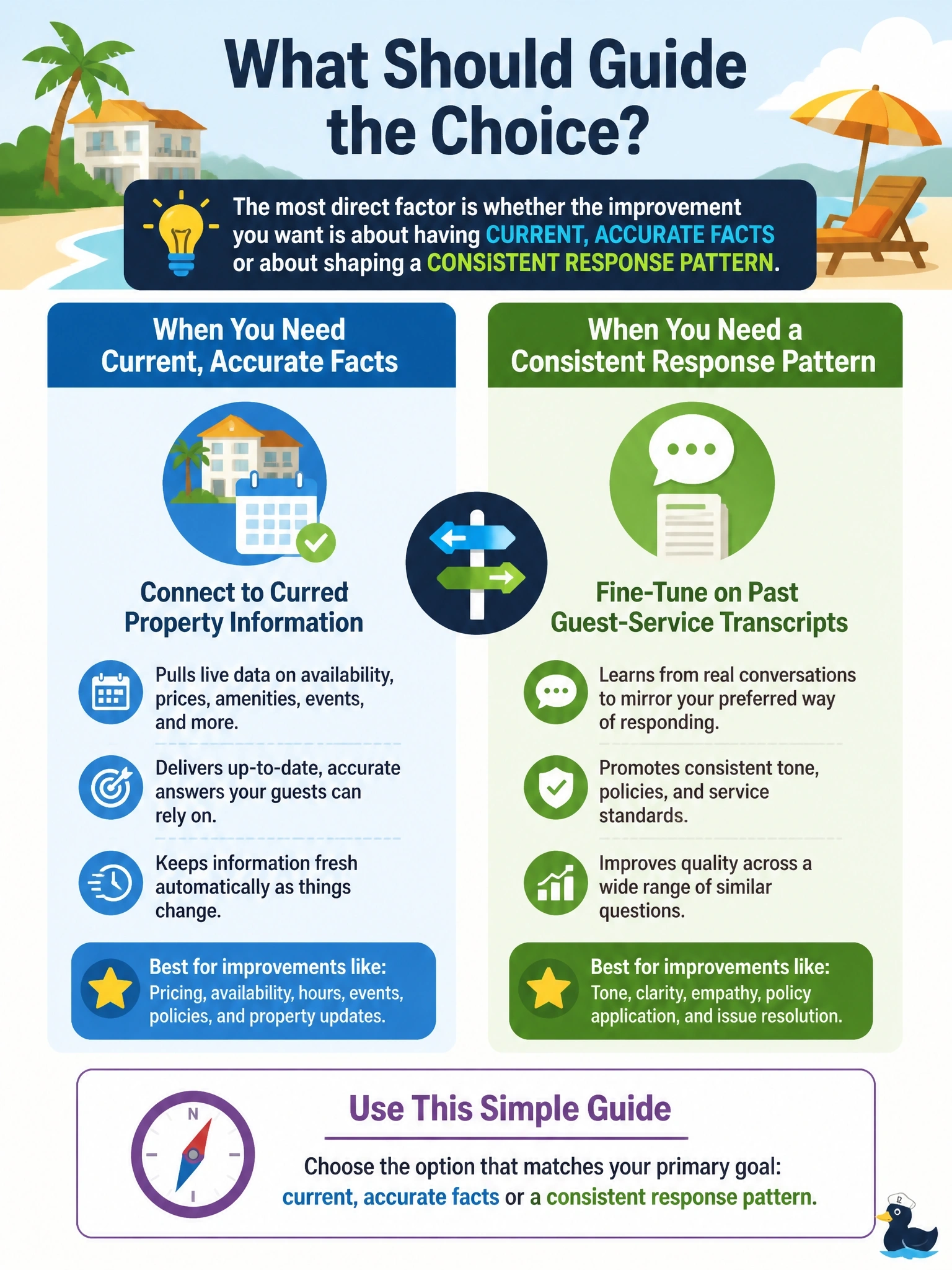
Think about it like choosing a tool for a job, not the cheapest tool on the shelf. Ask whether you need the assistant to know today's facts or to behave in a consistent way — that answer tells you whether you want retrieval or fine-tuning, not the price tag or what a rival hotel chain is doing.
Full Explanation
The deciding factor is the nature of the business need: if the goal is accurate, current facts — like room availability or amenities — retrieval-based approaches fit; if the goal is a consistent tone or response pattern learned from historical interactions, fine-tuning fits better. Choosing whichever option competitors have already adopted industry-wide substitutes competitive copying for an actual needs assessment, which could lead the resort to adopt an approach that doesn't match its own problem. Picking whichever option needs the smaller initial budget, regardless of whether it solves the actual problem, optimizes for the cheapest upfront cost without regard to value, which risks a low-cost solution that delivers little. Deferring to whatever the vendor recommends by default hands the decision to someone else instead of evaluating the resort's specific need, which is the core responsibility this question is testing. The generalizable principle: match the adaptation technique to the type of improvement needed — currency of facts versus consistency of behavior — rather than deciding on cost alone, industry precedent, or vendor defaults. Operationally: name the need first, then let that need pick the technique.