
A university's teaching-support team wants a GenAI tool to generate discussion questions from an entire semester-long course reading list submitted in a single request. The tool returns an error indicating the input is too large to process. What is the most appropriate business response?
Select an answer to reveal the explanation.
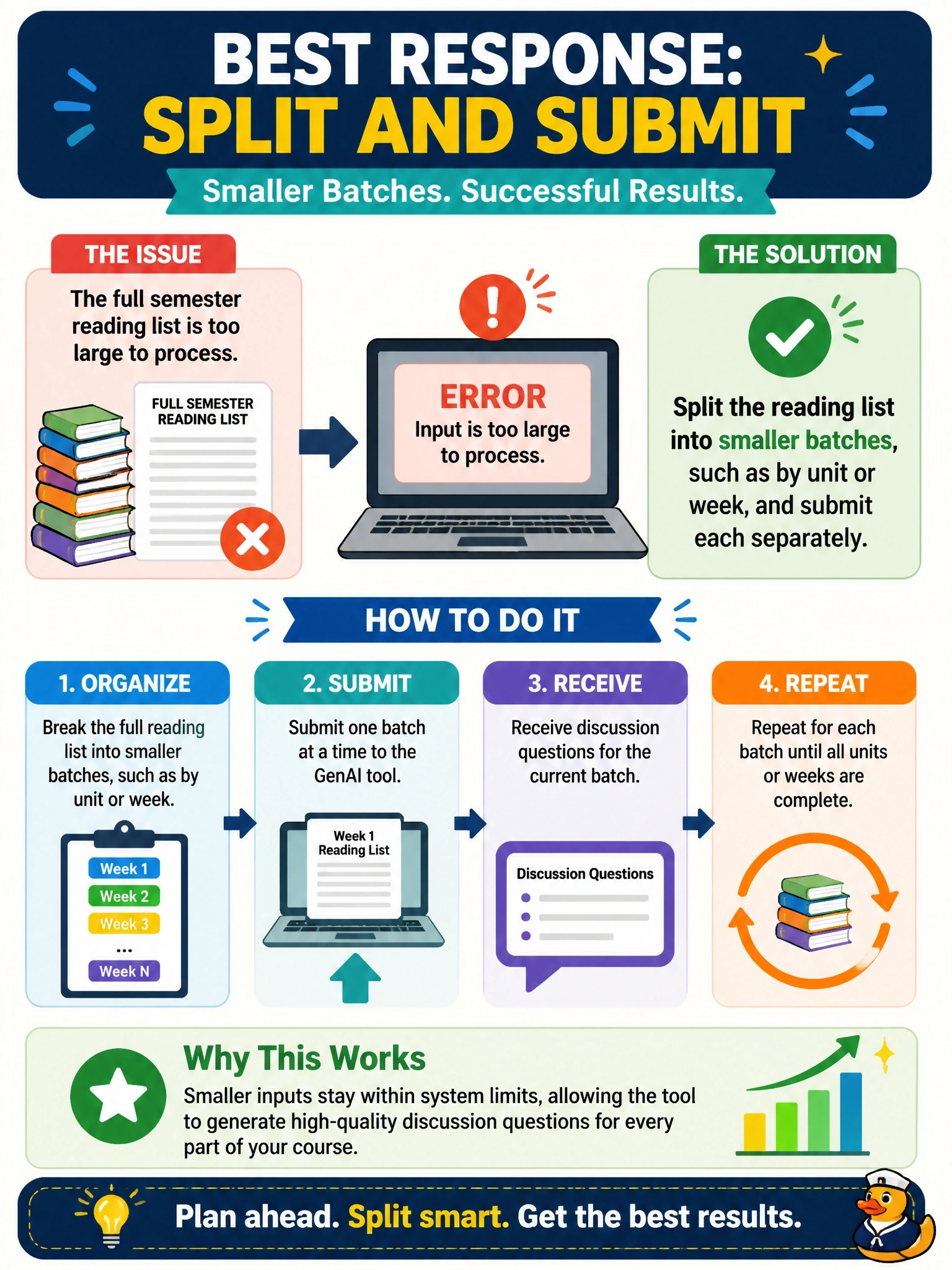
Short Explanation
Think of it like trying to mail a package that's too big for the box — you don't throw out the package, you split it into smaller boxes. Breaking the semester's reading list into batches by unit or week and submitting each separately gets the same content through without hitting the size limit.
Full Explanation
Splitting the input into batches that fit within the tool's limits is the direct, low-effort response to a too-large-input error, and it lets the team keep using the tool for exactly the purpose they wanted. Concluding that GenAI tools simply cannot handle course-related content overreacts to a single oversized-input error; the reading list's natural structure — organized by week or unit — makes batching an easy fix rather than a reason to abandon the approach. Manually rewriting the entire list into something shorter discards content the team actually wants questions generated from, when the real problem is submission size, not the list's content or length in absolute terms. Asking AWS to raise the model's token limit for one course puts a technical infrastructure decision in the hands of a business team with no ability or need to make it, when restructuring the request achieves the same outcome without any vendor involvement. The operational principle: when a task trips a size or token limit, restructure the work into smaller units first rather than escalating to infrastructure changes or giving up on the tool.