
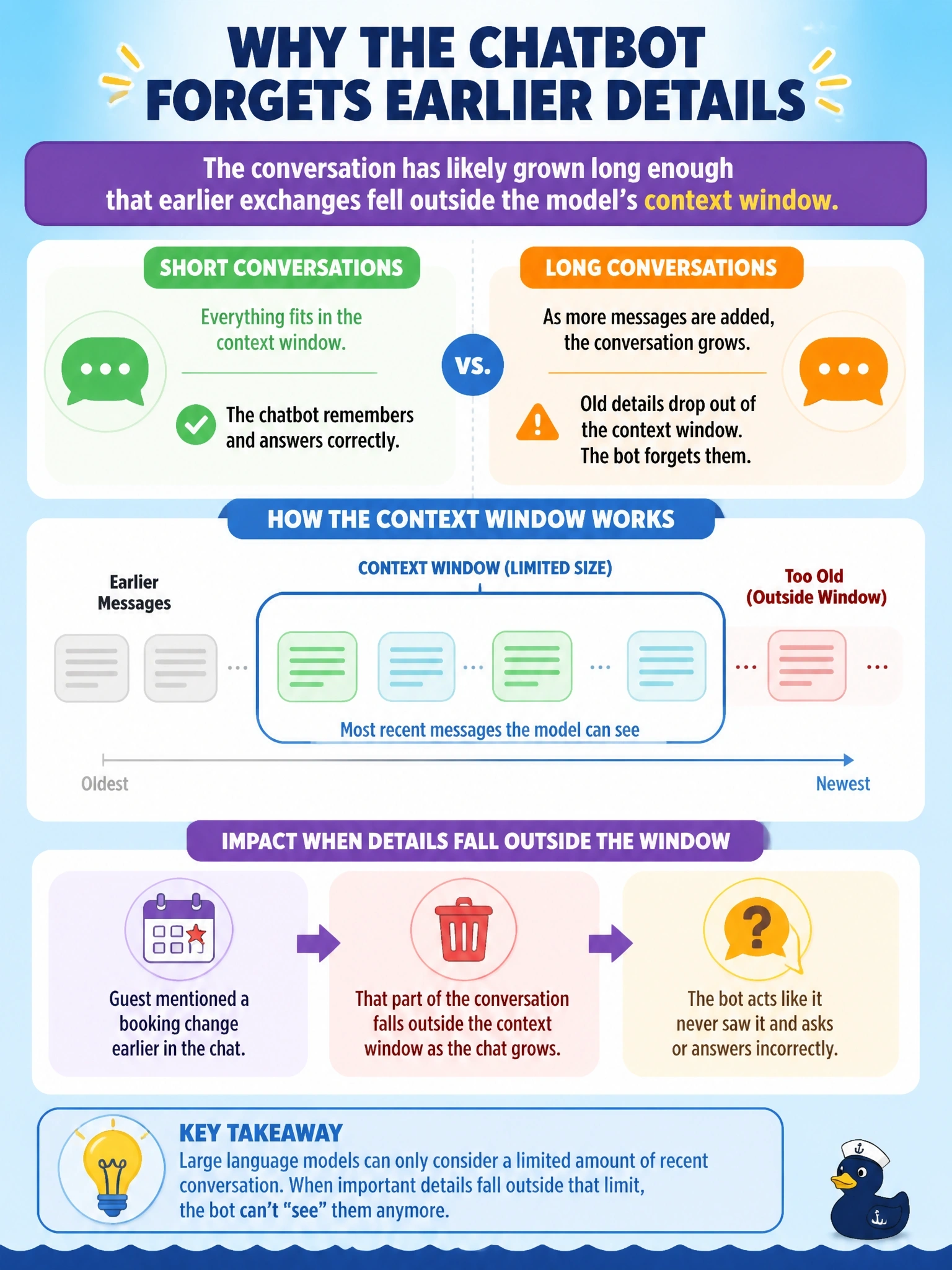
A hotel chain's GenAI chatbot handles guest conversations about booking changes. In short conversations it performs well, but in long conversations where a guest revisits earlier details after many exchanges, the chatbot sometimes responds as if it never saw that earlier information. What is the most likely business-relevant explanation?
Select an answer to reveal the explanation.
Short Explanation
A long conversation is like a scroll that keeps unrolling: once it gets long enough, the earliest parts fall off the far end and out of view. That's what's happening here — the chat has grown past the model's context window, so it genuinely isn't seeing those earlier details anymore, and you can fix it with a running summary rather than assuming something's broken.
Full Explanation
As a conversation lengthens, the full exchange history has to fit inside the model's context window, and once it doesn't, the oldest turns effectively drop out of what the model is working from — which is exactly why short conversations hold up fine while long ones lose track of earlier details. Assuming guests are intentionally trying to confuse the chatbot assigns motive that the scenario never supports and misses the real pattern, which tracks with conversation length, not guest behavior. Claiming the chatbot only forgets information tied to booking changes invents a topic-specific limitation with no basis here; the issue is how much conversation has accumulated, not what it's about. Writing this off as a permanent, unfixable memory failure overstates the problem — this is a well-understood, addressable constraint that teams manage by summarizing earlier turns or carrying forward key facts instead of the full transcript. The operational takeaway: when a chatbot "forgets" details specifically in long-running conversations, check conversation length against the context window before assuming a deeper malfunction, and consider building in a running summary to carry key facts forward.