
A streaming media company feeds a GenAI tool a full two-hour show transcript and asks for a scene-by-scene summary. The summary is accurate for the first third of the episode but becomes vague and starts omitting characters introduced later on. What most likely explains this pattern?
Select an answer to reveal the explanation.
Short Explanation
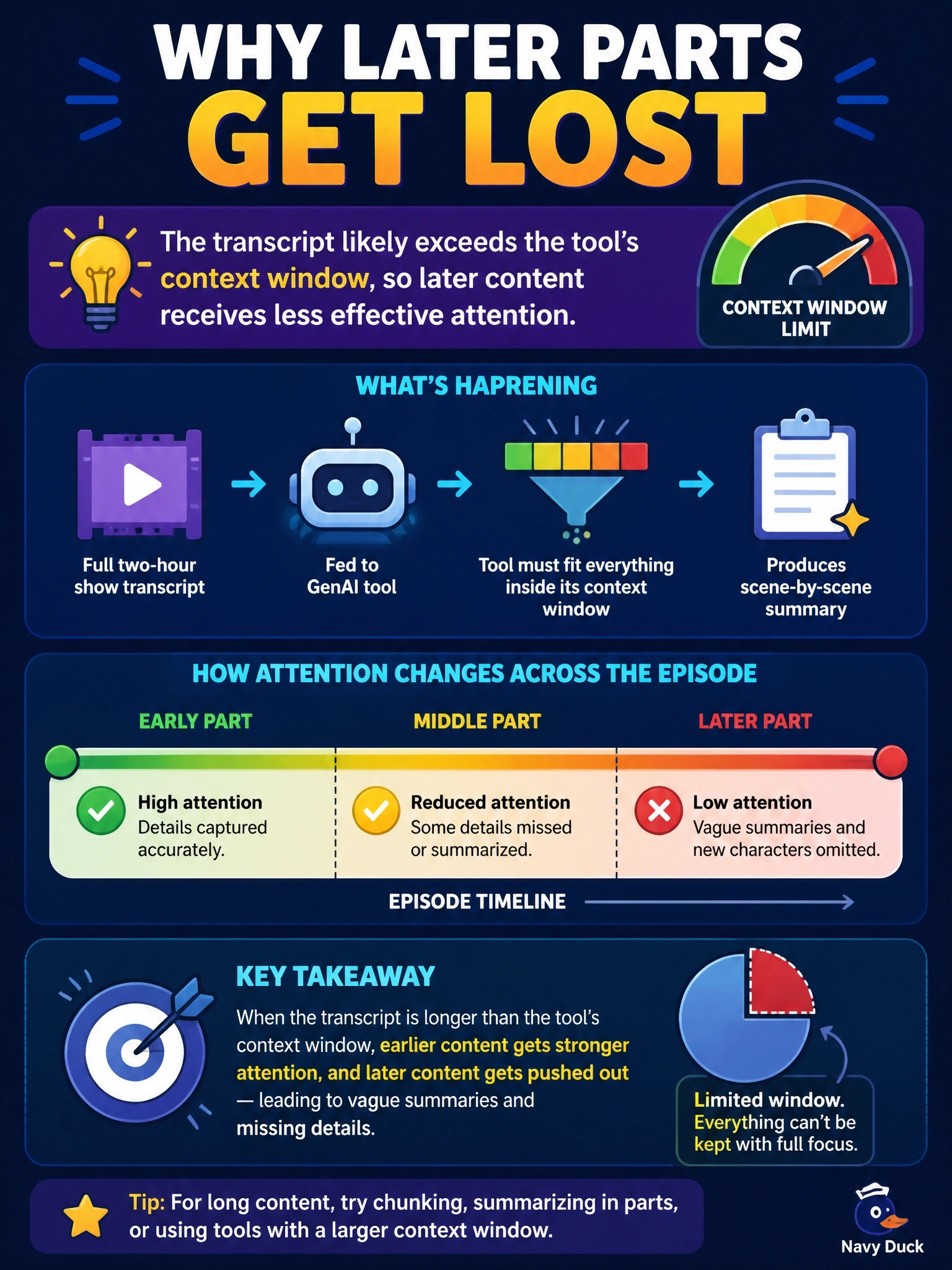
Imagine holding a huge stack of pages in your head all at once — past a certain point, the earlier pages start crowding out the later ones. That's a context window limit: the transcript likely ran past what the model can effectively track, so accuracy for later scenes and characters started slipping.
Full Explanation
Every model has a context window — a cap on how much text it can process with full attention at once — and a full two-hour transcript is exactly the kind of long input that can exceed it, which explains why accuracy holds for the first third and then degrades. The idea that later scenes are simply less interesting invents a content-based explanation the scenario gives no evidence for, and it doesn't match the actual pattern described, which tracks with position in the transcript rather than with subject matter. Concluding the tool is broken and needs replacing skips past the much more common and fixable cause — input length relative to the tool's limits — in favor of an expensive, unnecessary step. Chalking it up to quality naturally declining "after enough time has passed" isn't a real technical mechanism; it's a vague restatement of the symptom rather than an explanation, and it offers no actionable next step. The operational check: when summary quality degrades specifically as input length grows, suspect the context window first and test the fix by breaking the transcript into smaller chunks — say, by act or by scene block — before assuming the tool itself is at fault.