
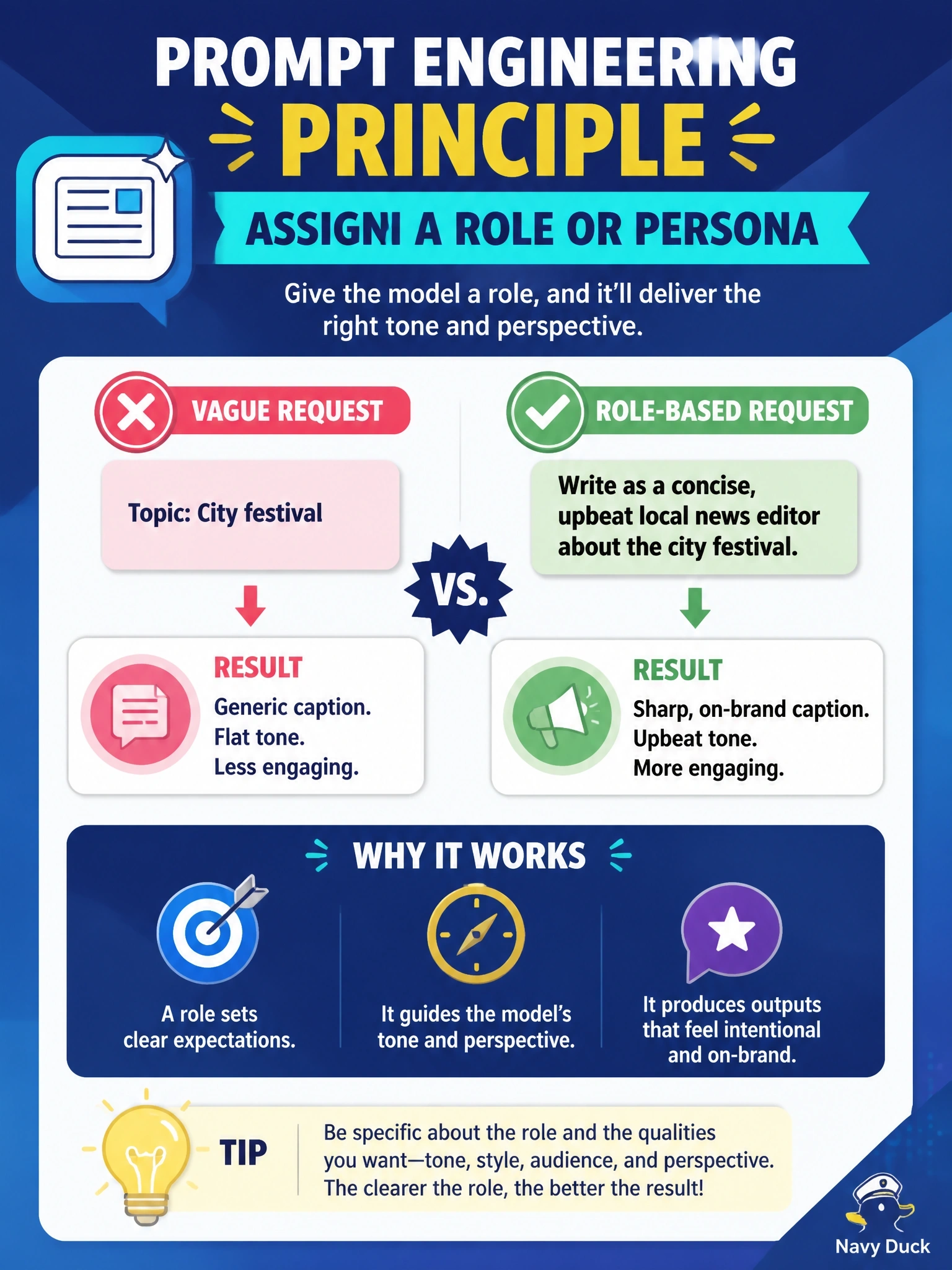
A regional broadcast news outlet uses a GenAI tool to draft social media captions. Producers get sharper, more on-brand captions when their request tells the tool to "write as a concise, upbeat local news editor" than when the request only lists the topic. Which prompt engineering principle explains the improvement?
Select an answer to reveal the explanation.
Short Explanation
Hand a writer a job title instead of a style memo: tell someone to write as 'a concise, upbeat local news editor' and they instantly know the tone, pace, and word choice to reach for. That's persona framing — assigning the model a role gives it a ready-made lens for voice, so your captions come out sharper without any extra instructions about the topic itself.
Full Explanation
Role or persona framing works because a job title carries a bundle of stylistic cues — pace, formality, vocabulary — that would otherwise take several sentences to spell out individually, and the model can draw on the patterns associated with that role. The idea that the tool secretly pulls from the outlet's internal style guide whenever a role is named invents a data-access mechanism that has no basis in how prompt wording actually works; the improvement comes from framing, not hidden retrieval. Claiming that only first-person phrasing ever produces usable captions overgeneralizes a single successful example into an absolute rule, when plenty of effective prompts — including third-person role assignments like this one — work just as well. Reaching for a separately trained, topic-specific model misdiagnoses the situation entirely: the existing tool already produced strong captions once the request was framed better, so no new model is needed. The operational check: when output reads flat or off-brand, try assigning a role before assuming the topic itself needs a different tool, and compare a plain topic request against one that opens with "write as a [role]."