
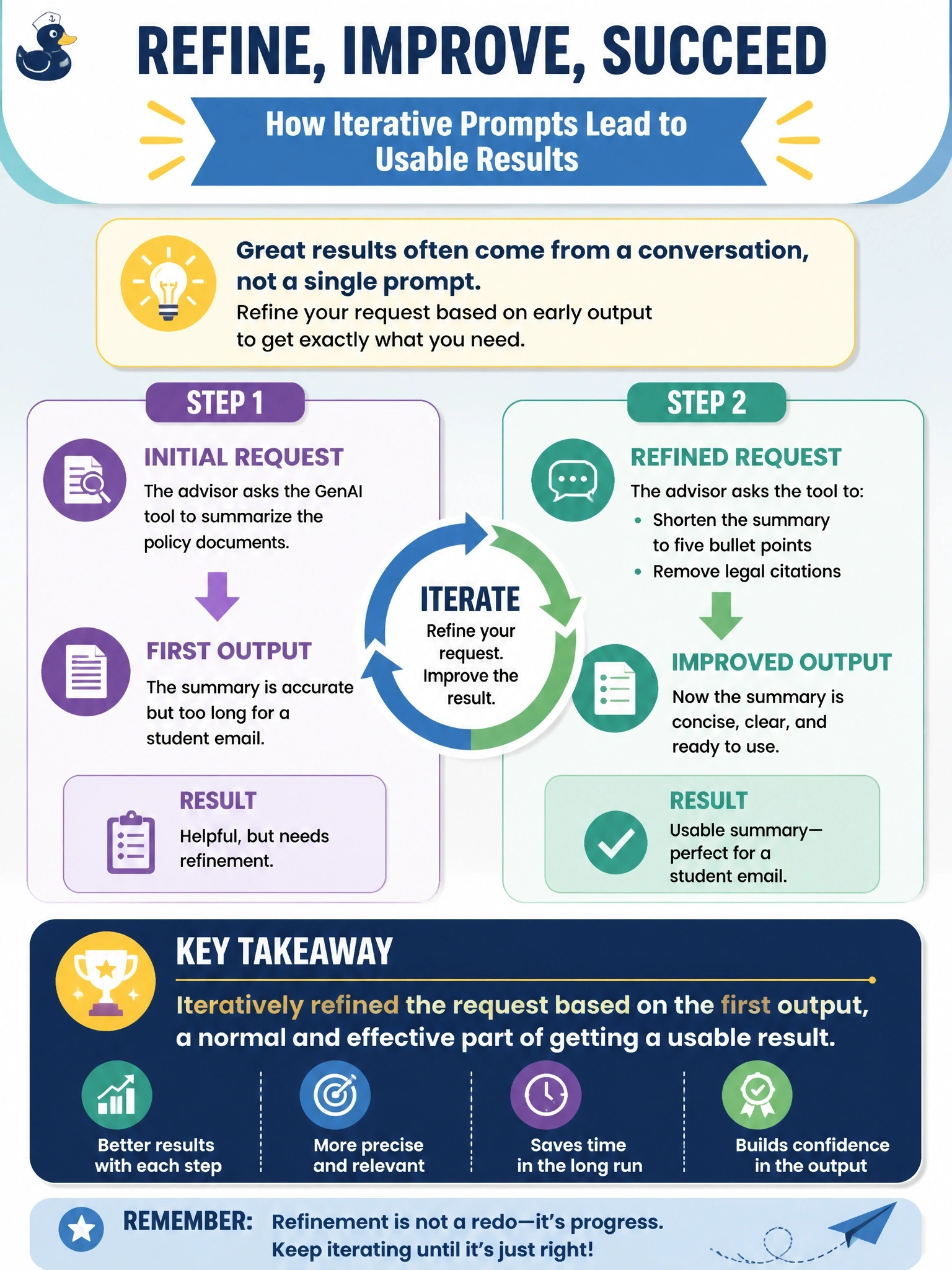
A university's advising office uses a GenAI tool to summarize policy documents for students. An advisor's first request produces a summary that is accurate but too long for a student email. The advisor then asks the tool to shorten the summary to five bullet points and remove legal citations, and the second draft is usable. What is the best way to characterize what the advisor did?
Select an answer to reveal the explanation.
Short Explanation
Briefing a human assistant rarely nails the exact format on the first ask—you glance at the draft and say 'shorter, no legal jargon.' That's exactly what the advisor did here: reviewed the first output and refined the request, which is iterative prompting working as intended, not a failure of anything.
Full Explanation
Iterative prompting is standard practice, not a workaround: complex writing tasks usually take a request, a look at the output, and a follow-up adjustment before the result matches what the reader actually needs. Expecting a single flawless request every time sets an unrealistic bar — it ignores how these tools are actually used well and would push advisors toward writing longer, over-engineered prompts instead of simply glancing at a draft and asking for a quick fix. Treating this pattern as a defect that IT needs to patch misreads a completely normal interaction as a malfunction; nothing about a summary needing a shorter, citation-free rewrite indicates the tool is broken. Handing the task to a dedicated data science or technical team also misplaces the work — drafting and trimming a student-facing summary is a business writing task an advisor is well positioned to finish themselves, and routing it elsewhere adds a handoff with no real benefit. The operational takeaway: build a quick review-and-refine step into the workflow by default — request, skim, tighten — rather than treating a second pass as evidence something went wrong.