
A hotel chain's guest-relations team uses a GenAI assistant to draft responses to written complaints. Agents who paste in an example of a well-received past response alongside the new complaint consistently get drafts closer to the brand voice than agents who describe the brand voice in words alone. What prompt engineering principle does this best demonstrate?
Select an answer to reveal the explanation.
Short Explanation
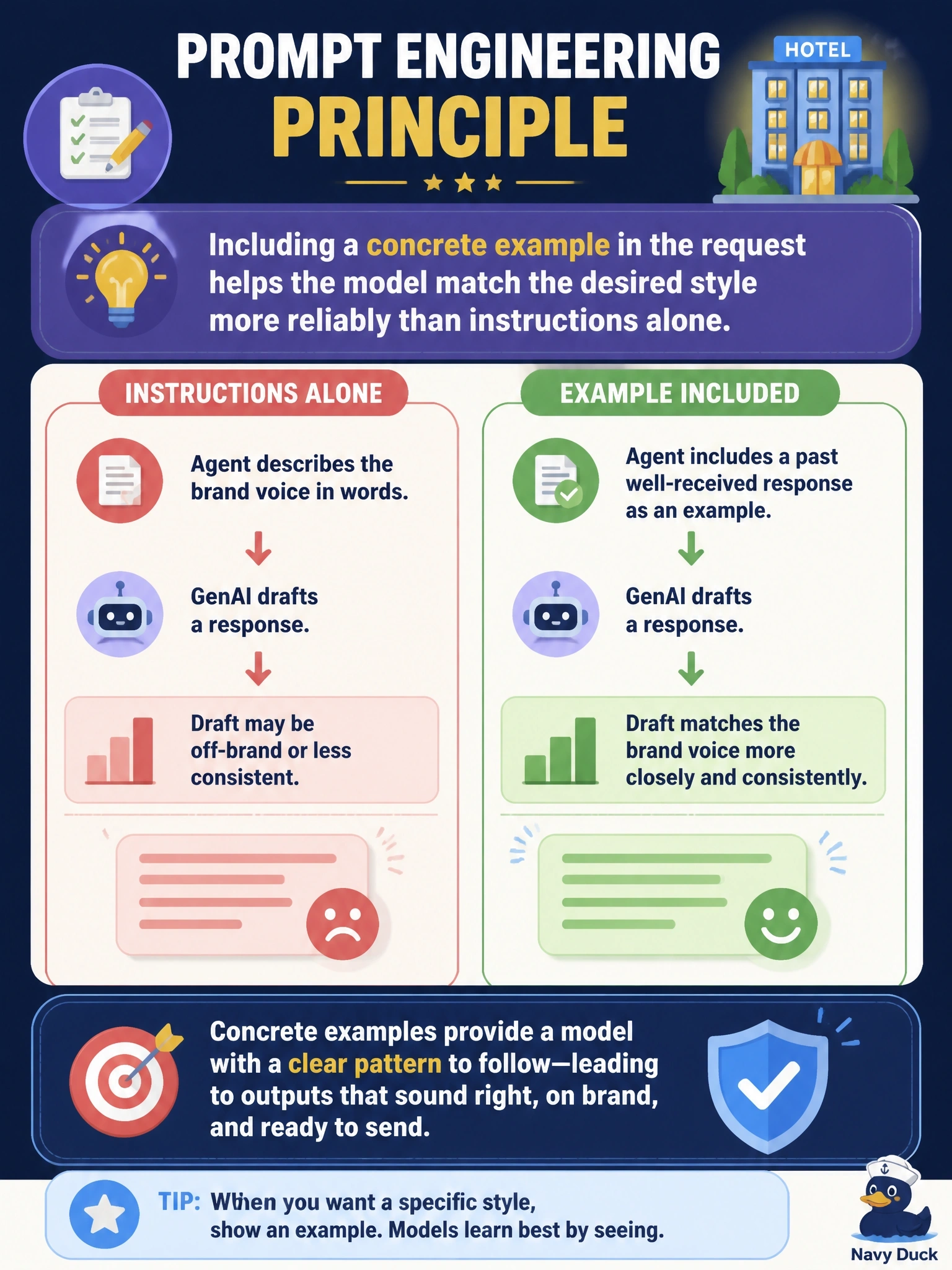
Think about teaching someone your style by showing them a sample instead of just describing it with adjectives — a real example carries way more information than "be warm and professional." That's why pasting in a great past response worked so well: the model can pattern-match against something concrete instead of guessing what abstract instructions mean. This is few-shot prompting, and it's one of the cheapest, most reliable tricks in the book.
Full Explanation
A concrete example works because it shows the model the pattern to match — word choice, sentence rhythm, level of formality — instead of asking it to reverse-engineer those qualities from adjectives like "warm" or "on-brand." This is the core idea behind few-shot prompting: examples transmit style information that instructions alone routinely fail to capture. The claim that longer requests always perform better misreads what happened here; the improvement came from relevance, not length, and a padded-out instruction with no example would likely perform worse, not better. The idea that complaint responses are simply easier for GenAI to draft than other guest-facing content has no support in the scenario — nothing suggests this content type behaves differently from any other kind of writing. Suggesting agents route the fix through IT to hardcode the brand voice misplaces where the actual lever sits; while permanent system-level configuration is a real option in some tools, it isn't what closed the gap here, and it distracts from a technique the agents already proved works on their own, with no engineering ticket required. Operationally, the check is simple: before escalating to IT, try pasting one strong past example alongside the new request and compare that draft against one produced from written instructions alone.