
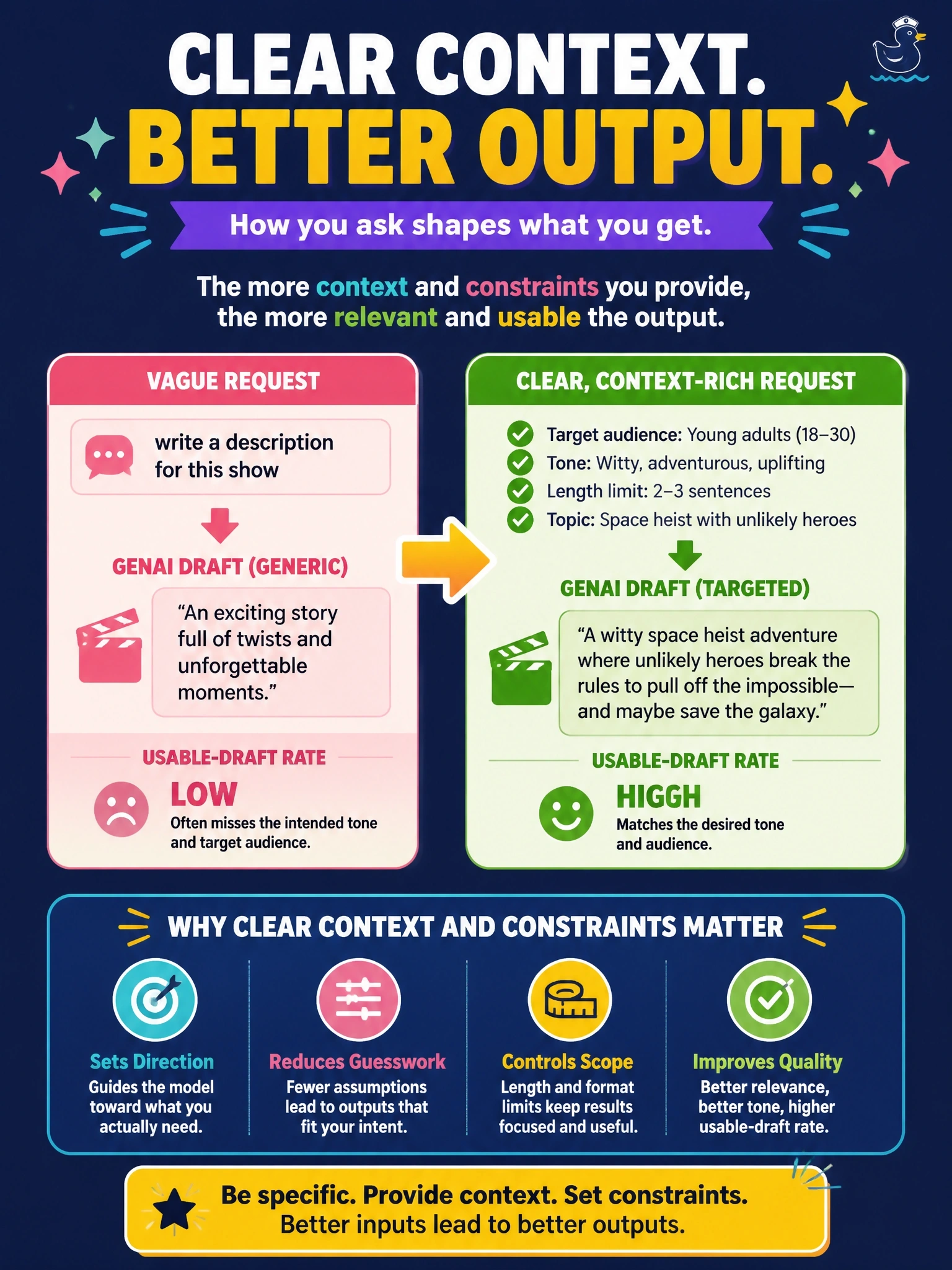
A streaming media company's marketing team uses a GenAI tool to draft show-description blurbs. When staff submit short requests like "write a description for this show," the drafts are generic and often miss the intended tone. When staff instead state the target audience, desired tone, and length limit in the request, the usable-draft rate rises sharply. What does this pattern illustrate about getting useful GenAI outputs?
Select an answer to reveal the explanation.
Short Explanation
Think about ordering coffee, "just coffee" gets you whatever's on the pot, but "a tall oat milk latte, extra hot" gets you exactly what you wanted. Same deal with GenAI: spelling out audience, tone, and length in your prompt gives the model the constraints it needs to hit the mark. Vague requests get vague drafts; specific requests get usable ones.
Full Explanation
This pattern is prompt engineering at work: giving the model the audience, tone, and length constraints narrows down what counts as a good answer, so the output stops being a generic guess and starts matching the actual need. The variable that changed here was the request, and that's the giveaway. Training data does shape a model's general capability, but it can't explain why the same model, with the same training, produced better drafts once staff changed how they asked; the model didn't get smarter between requests, the input got clearer. Retraining the model is a technical fix aimed at a problem that better prompting already solved, and reaching for it here treats a request-wording issue as if it were a capability gap, which wastes engineering effort a marketing team doesn't need to spend. Preferring shorter requests confuses brevity with efficiency: a vague two-word prompt that triggers a rewrite costs more staff time than a slightly longer, well-specified one saves. Operationally, before blaming the model or the vendor, check whether the request actually states who the output is for, what tone it needs, and how long it should be.