
A construction company discovers several project managers have been uploading confidential bid documents to an unapproved AI tool to summarize them. Which classification action addresses this immediate governance gap?
Select an answer to reveal the explanation.
Short Explanation
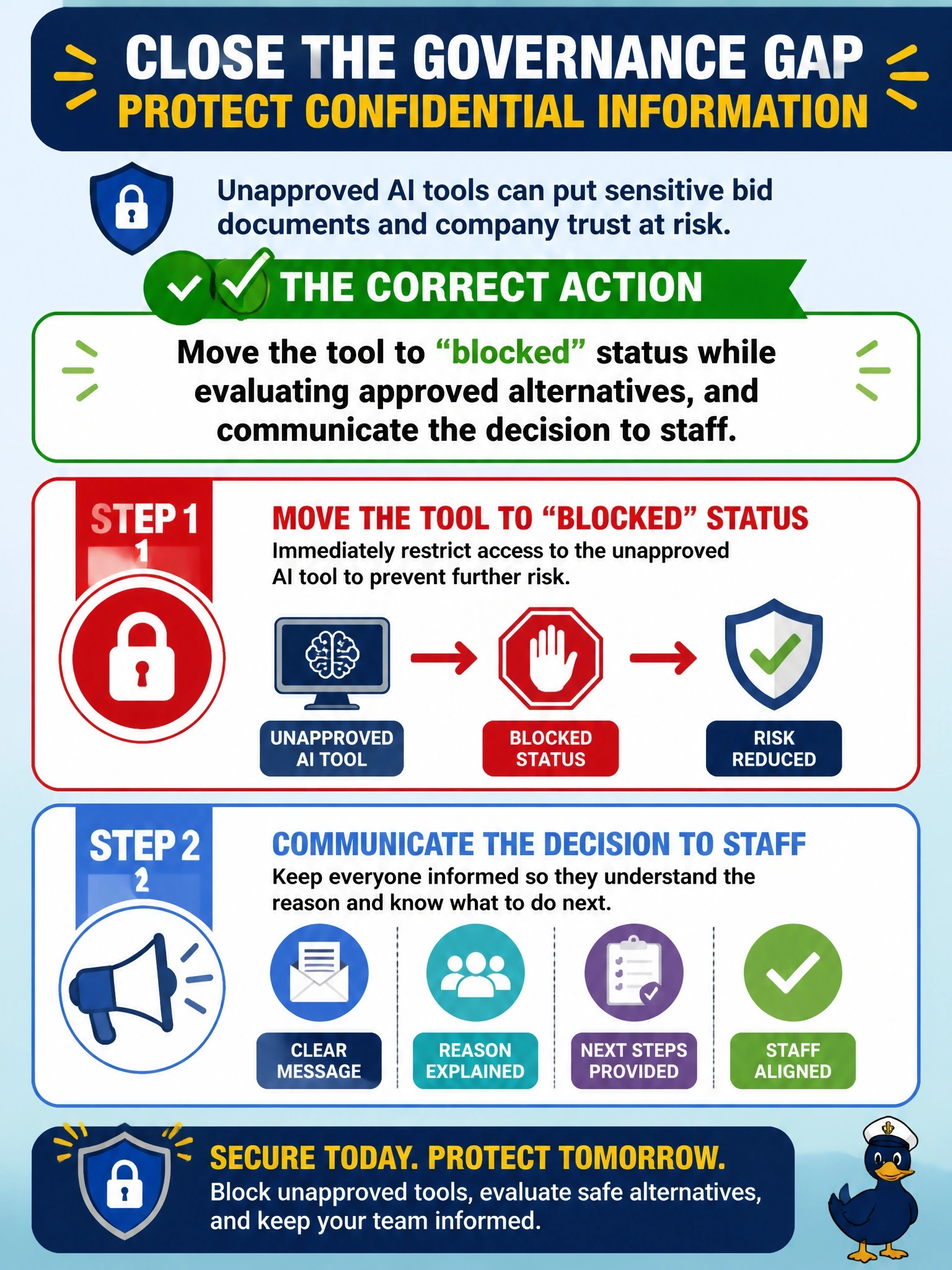
Think about pulling a leaky pipe out of service the moment you spot it, you don't wait for the flood to prove there's a problem. Confidential bid data already left the building through an unreviewed tool, so the move is to block it now, tell staff why, and line up an approved alternative. Waiting for an incident just guarantees you'll have one.
Full Explanation
Confidential bid documents flowing into an unreviewed tool is exactly the exposure a classification system exists to catch, so the appropriate response is to block the tool immediately, communicate that decision to staff, and evaluate reviewed alternatives that can meet the same need safely. The allow-it-to-continue option treats the absence of a known incident as evidence of safety, but confidential data has already left the company's control, and waiting for a visible incident before acting ignores the risk already present. The approve-it option skips due diligence entirely; approving a tool handling sensitive bid data without any evaluation defeats the purpose of a classification system meant to assess risk before granting approval. The ignore-it option dismisses a real data-exposure risk simply because the tool is efficient, prioritizing convenience over the governance the situation clearly calls for. The general principle: when an unapproved tool is found handling sensitive data, the classification system should be used to block it immediately while a proper evaluation of safer alternatives proceeds, not to retroactively approve or ignore the exposure.