
Which of the following best explains why an AI solution requires ongoing monitoring even after it performs well at initial deployment?
Select an answer to reveal the explanation.
Short Explanation
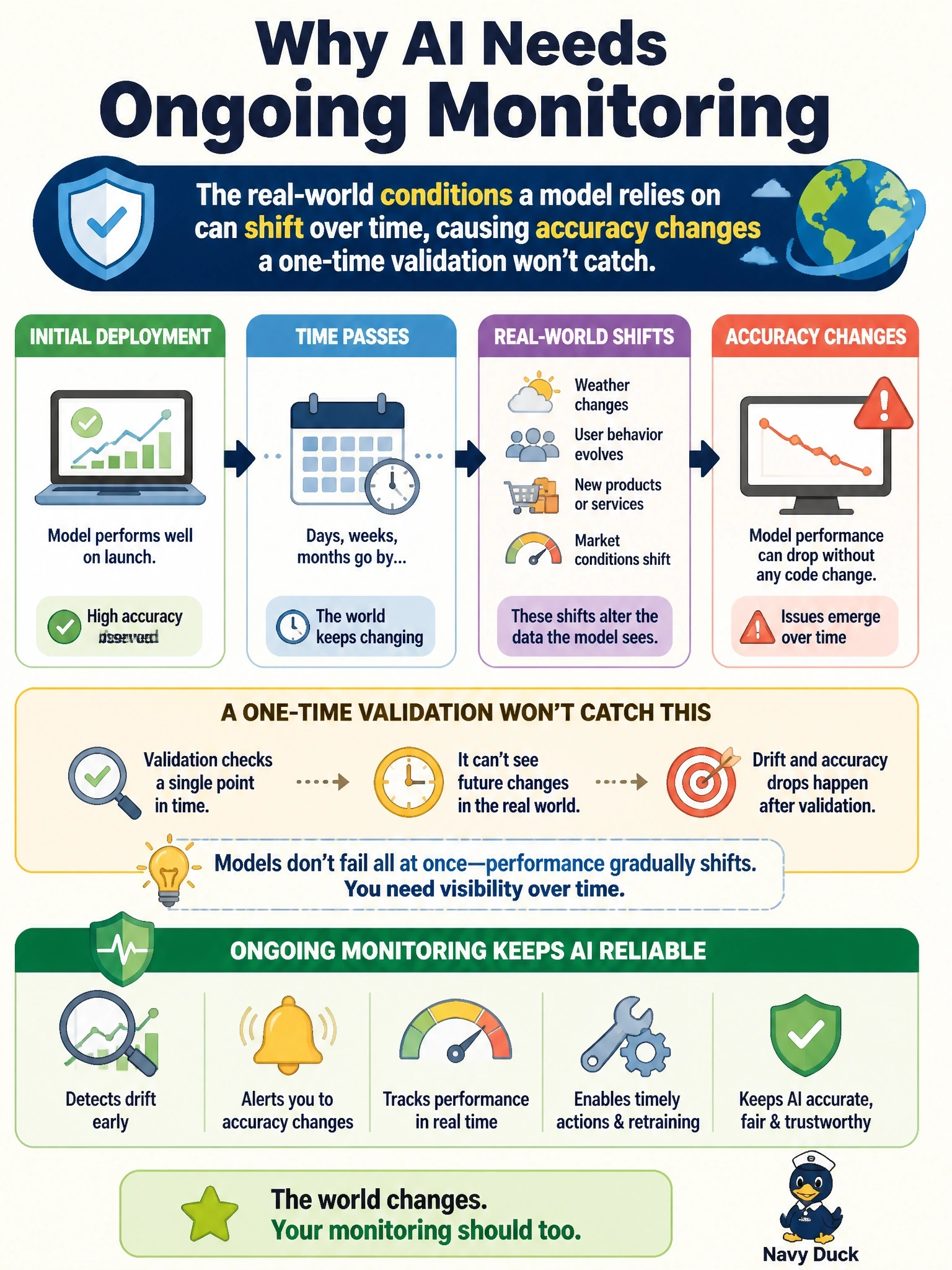
Think about a GPS app that was accurate the day you installed it, roads get rebuilt, and if it never updates, you end up in a ditch. A model's snapshot of the world goes stale the same way, which is why monitoring has to run continuously, not just at launch. One clean validation tells you the model worked once; it doesn't tell you it still works.
Full Explanation
A model's accuracy at launch reflects the conditions present at that moment, but customer behavior, market dynamics, and operational context continue to evolve, so ongoing monitoring is needed to catch the performance changes a one-time validation cannot anticipate. The build-versus-buy option wrongly ties the need for monitoring to how the model was acquired; drift can occur in a purchased model just as easily as an in-house one, since the cause is changing real-world conditions, not who built it. The vendor-billing option describes a usage-reporting concern unrelated to detecting performance changes and doesn't explain the business reason for monitoring. The recertification option references a regulatory requirement, which may apply in some contexts but isn't the general business rationale for monitoring; the core reason is protecting decision quality as conditions change, not satisfying a compliance calendar. The general principle: ongoing monitoring exists because AI models are trained on a snapshot of conditions that inevitably changes, and only continuous tracking can catch resulting performance shifts in time to act.