
A utility's leadership asks why the company should track an AI model's performance after it goes live instead of considering the project "done" once deployed. What is the best response?
Select an answer to reveal the explanation.
Short Explanation
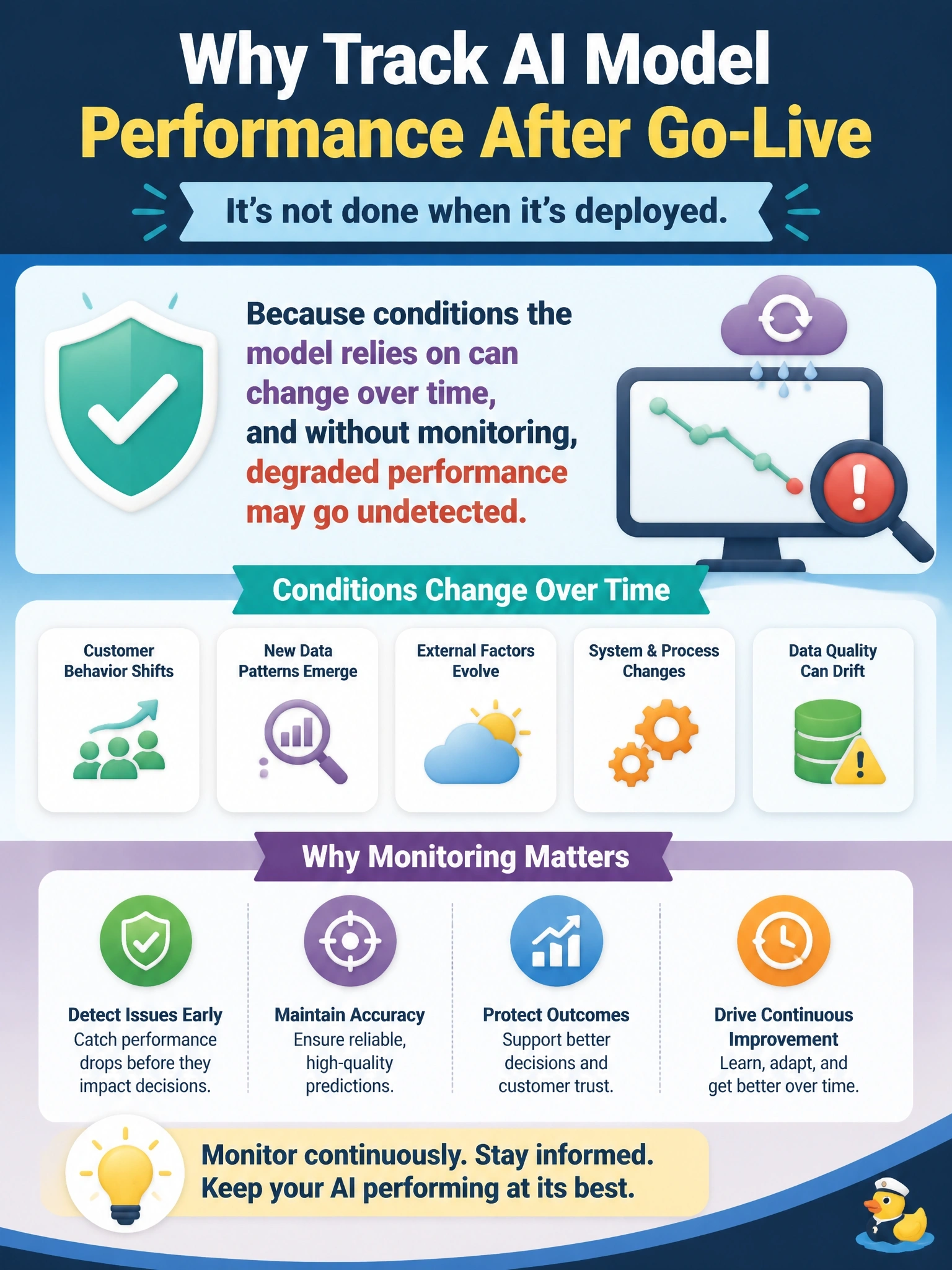
Think about changing the oil in your car, passing inspection once doesn't mean you stop checking. The world your model was trained on keeps moving, so without ongoing monitoring, degraded performance can quietly pile up before anyone notices. Deployment is the starting line, not the finish line.
Full Explanation
The best response ties directly to the reason ongoing monitoring matters: the conditions a model relies on, customer behavior, equipment, or market factors, can shift after deployment, and without monitoring the company has no way to know when performance has degraded until the damage is already done. The infrastructure-cost option raises a generic budgeting concern that doesn't explain why performance tracking specifically is necessary after deployment. The legal-formality option dismisses monitoring as a mere formality, which contradicts the real operational value of catching problems early and undercuts the premise that ongoing oversight protects decision quality. The constant-intervention option mischaracterizes how AI models work; a well-functioning model doesn't need constant human intervention to produce output, but it does need periodic oversight to confirm that output remains accurate. The general principle: deployment is the start, not the end, of an AI model's lifecycle, and ongoing monitoring is what allows an organization to detect and remediate performance changes before they cause business harm.