
An energy company's AI model that predicts equipment failure was validated a year ago and hasn't been reviewed since, even though new sensor types and maintenance practices have since been introduced. What is the greatest risk of leaving this model unmonitored?
Select an answer to reveal the explanation.
Short Explanation
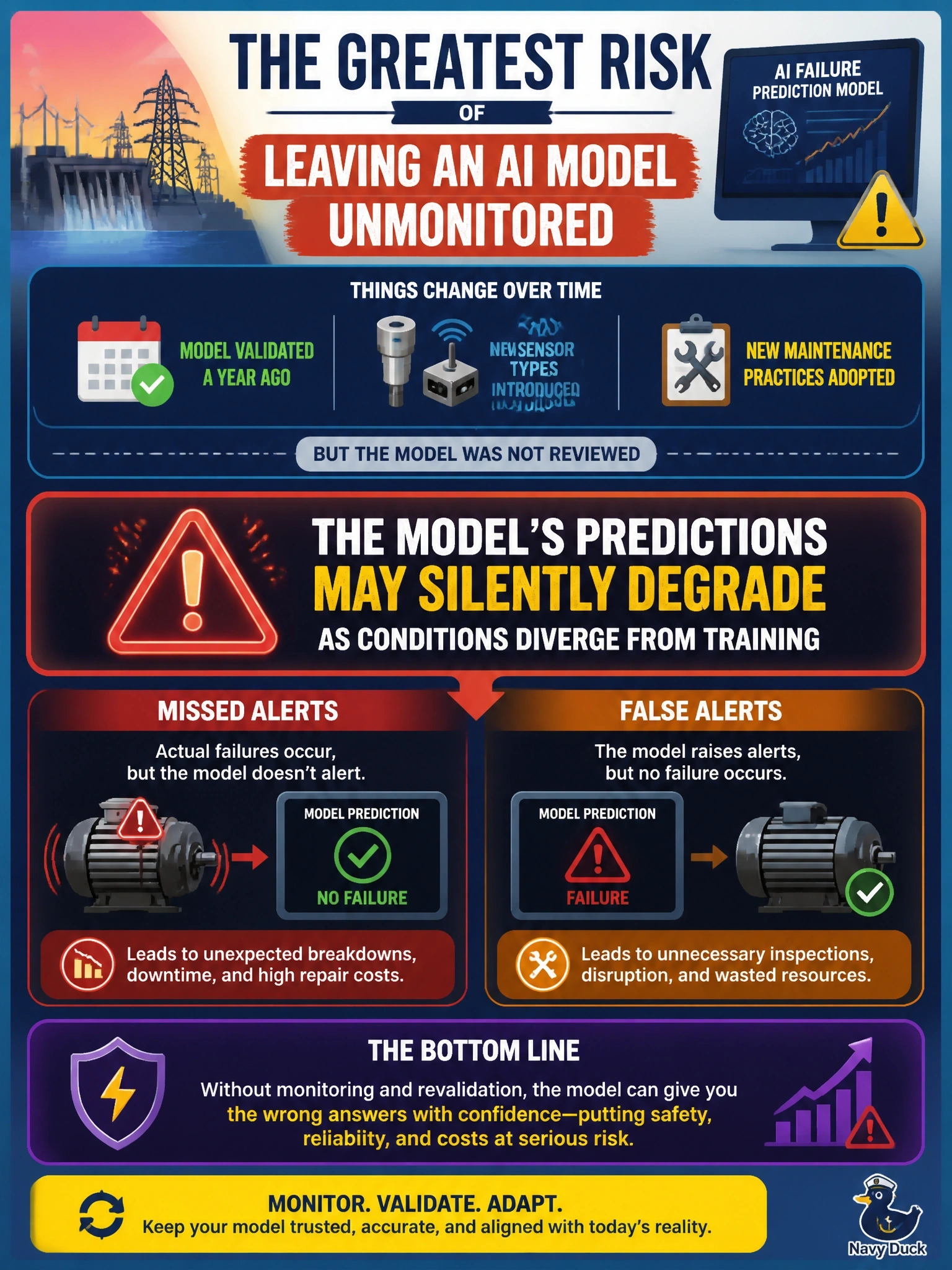
An unmonitored model doesn't send up a flare when it starts getting things wrong — it just keeps making confident predictions while quietly drifting further from reality. New sensors and new maintenance practices change the patterns the model was trained on, so without monitoring, you won't know it's failing until missed or false alerts start costing you. That silent decay is the real risk, not storage costs or licensing.
Full Explanation
Without monitoring, changes such as new sensor types and updated maintenance practices can cause the model's predictions to quietly diverge from reality, and because no one is tracking performance, the company risks missing genuine failures or acting on false alerts before anyone notices the problem. The storage-cost option raises a concern that is unrelated to the accuracy risk posed by unmonitored drift and isn't the direct consequence described in the scenario. The licensing option shifts the risk to a contractual issue, which is a separate business concern from whether the model's predictions remain accurate. The self-retraining option assumes models self-correct, but AI models do not automatically retrain or improve without a deliberate monitoring and retraining process put in place by the organization. The general principle: the central danger of unmonitored AI models is silent performance degradation as real-world conditions change, which can lead to costly operational errors that go undetected until monitoring processes surface them.