
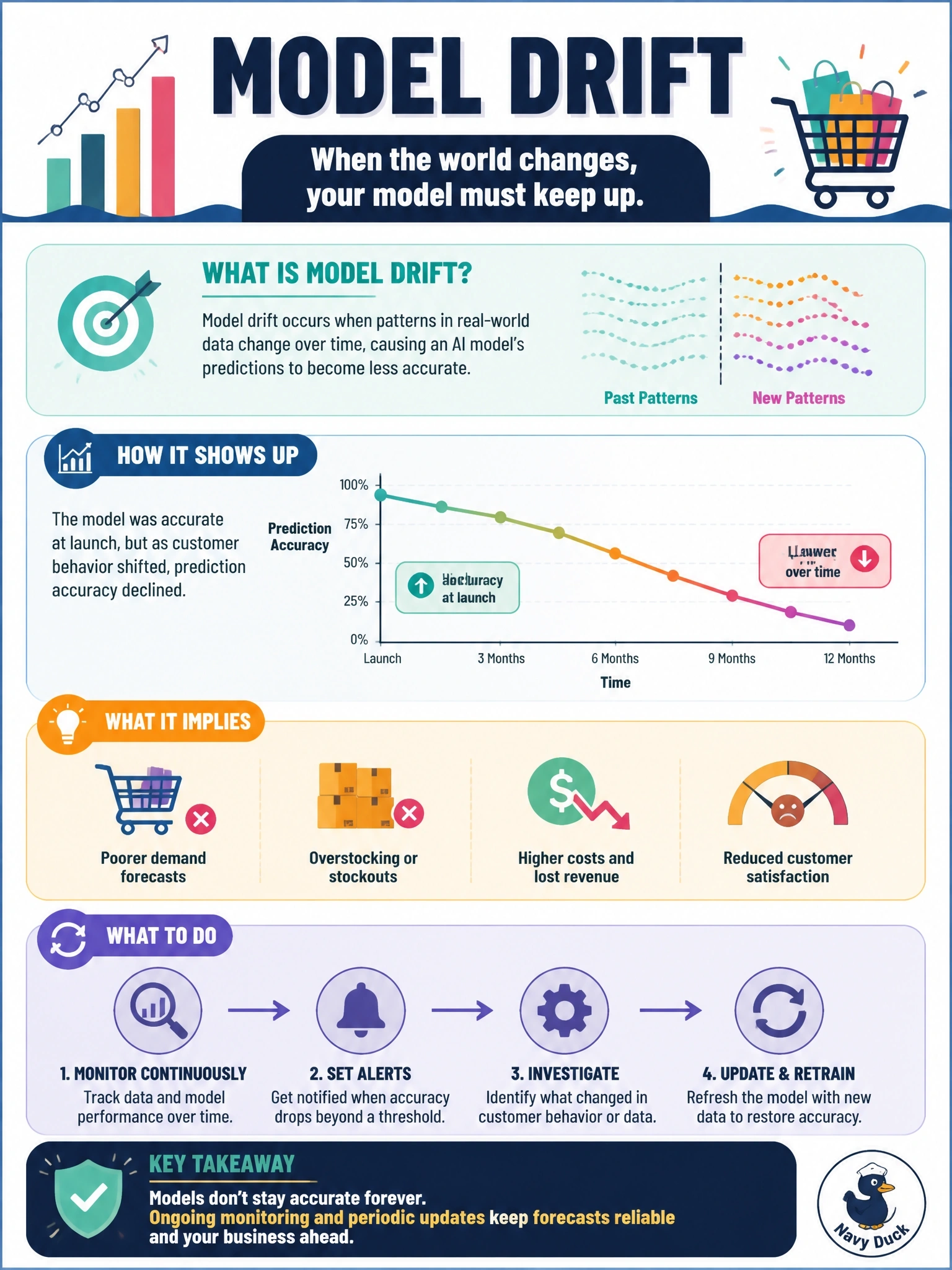
A retailer's AI-based demand forecasting model was highly accurate at launch but its predictions have grown steadily less reliable over the past year as customer shopping patterns shifted. What is this phenomenon called, and what does it imply for the business?
Select an answer to reveal the explanation.
Short Explanation
A GPS trained on last year's road map still gives directions confidently — it's just wrong more and more often as the roads change. That's model drift: the world moved on from what your model learned, and accuracy quietly erodes until someone monitors and retrains it.
Full Explanation
The gradual decline in accuracy as real-world shopping patterns diverge from what the model was trained on is the definition of model drift, and it implies the business needs an ongoing monitoring and update process rather than treating deployment as a one-time event. The shadow-AI option confuses drift with tools used without approval, a governance issue unrelated to a previously approved model's declining accuracy. The overfitting option misapplies a training-time concept where a model is too simple or too complex relative to its data, which does not describe accuracy that degrades gradually after a period of good performance. The data-breach option assumes a security incident, but nothing in the scenario suggests unauthorized access or tampering, only a natural shift in customer behavior over time. The general principle: when an AI model's real-world conditions diverge from its training data over time, performance degrades in a pattern called model drift, and this is precisely why AI solutions require ongoing monitoring and periodic retraining or updates.