
Which of the following is NOT typically a core capability associated with AI agents?
Select an answer to reveal the explanation.
Short Explanation
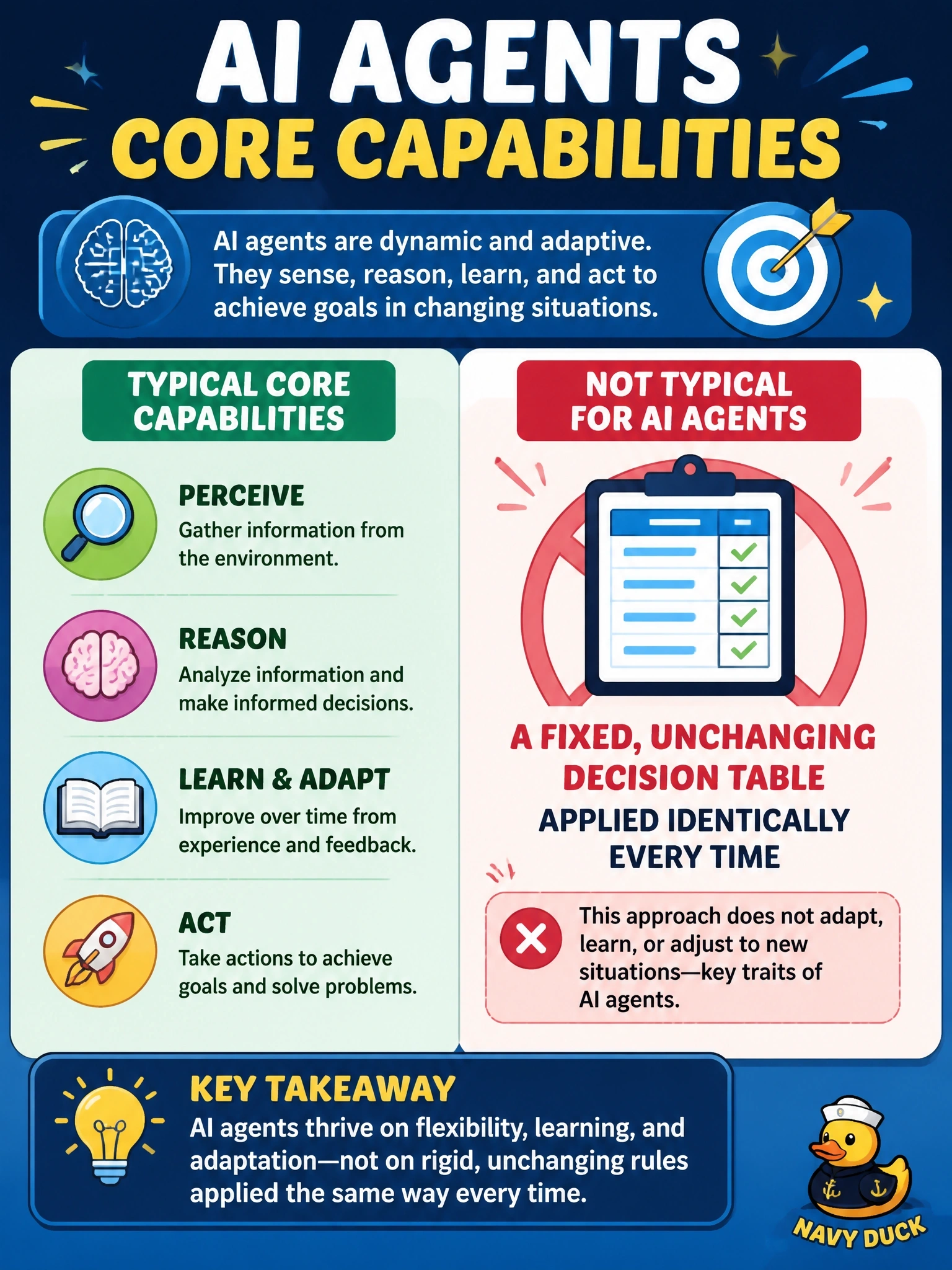
A fixed decision table that runs the exact same way every single time isn't reasoning about anything you'd call intelligent — it's just following a script, which is rule-based automation, not an agent. AI agents, by contrast, adapt: they call tools, coordinate with each other, and act autonomously toward a goal.
Full Explanation
A fixed, unchanging decision table applied identically every time describes rule-based automation, because it involves no independent judgment, no adaptation to new information, and no decision-making beyond matching a predefined condition to a predefined output. That's fundamentally different from an AI agent, which adjusts its behavior based on context. Calling external tools or systems is a genuine core agent capability, tool use, since it's how an agent reaches beyond text generation to take real action in other systems. Coordinating with other AI agents is likewise a recognized core capability, agent-to-agent communication, letting one autonomous system delegate or exchange information with another rather than working alone. Acting toward a goal without step-by-step human approval is autonomy, arguably the most foundational agent trait, since it's what separates an agent from a tool that waits for a person to greenlight every move. All three of those are genuine, well-established agent capabilities. A static rule table sits outside that list entirely because it can't adapt, coordinate, or exercise judgment — it just executes the same lookup every time, which is why it belongs to rule-based automation rather than the agent category. The check: if the described behavior would produce a different outcome for different situations, that's agentic; if it always produces the same outcome for the same input, that's a rule.