
A retail operations leader is evaluating a proposed AI solution described as able to "decide which of several tools to call, and in what order, to resolve a customer complaint end to end, escalating to a human only when confidence is low." Which core AI agent capability does deciding which tools to call, and in what order, most directly represent?
Select an answer to reveal the explanation.
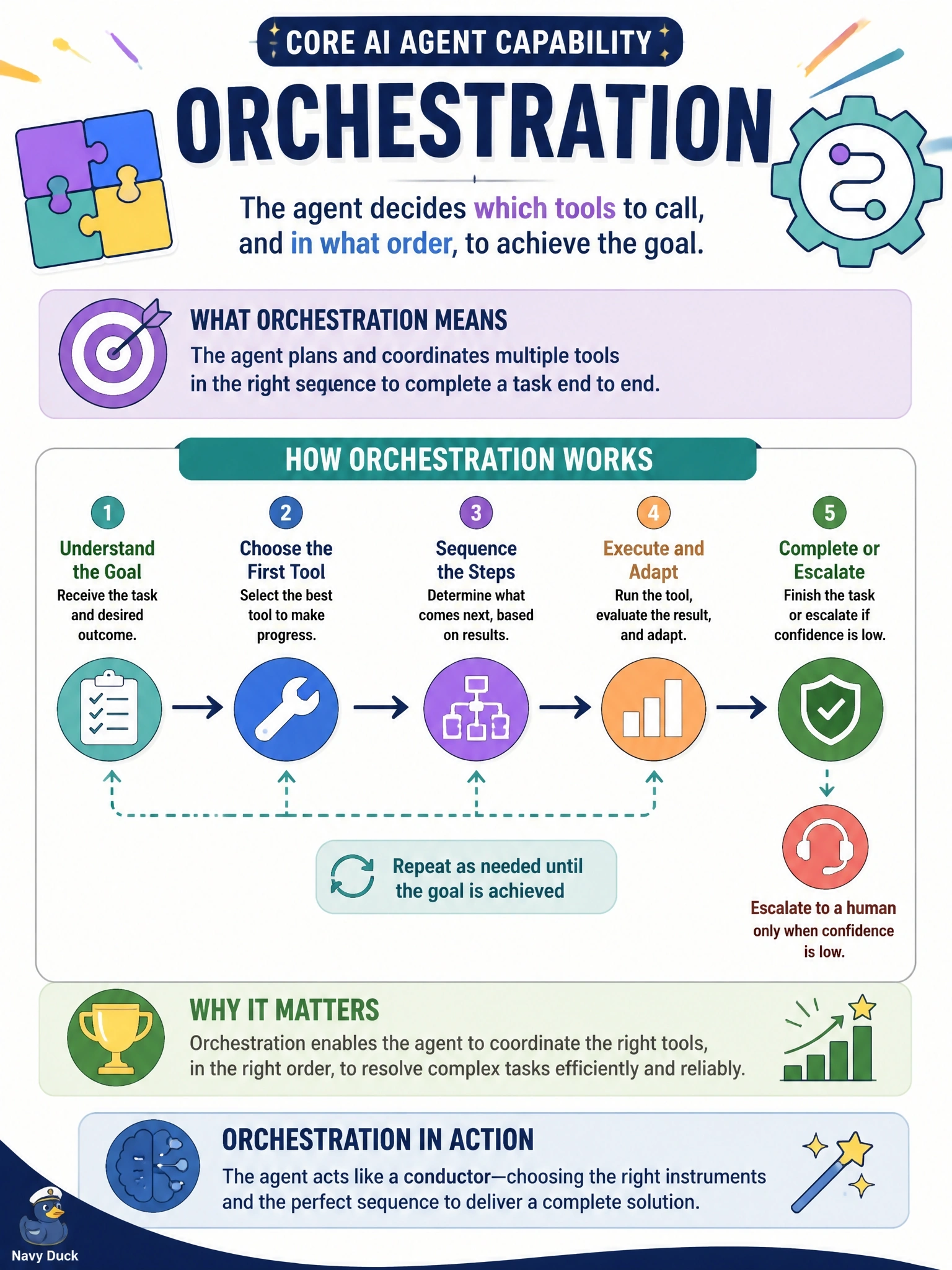
Short Explanation
A project manager choosing which specialist to call, and in what order, to close out a complaint—that's orchestration in a nutshell. It's the capability that plans and sequences multiple tools toward one end-to-end goal, not just firing off a single action, which is exactly what you're seeing when the system picks the right tool and the right order.
Full Explanation
Choosing which of several tools to invoke and in what sequence to resolve a complaint end to end is a planning-and-sequencing task, and that coordination across multiple steps and resources is what orchestration specifically means. Tool use, by contrast, describes the narrower act of invoking a single tool to get one job done; it's a building block the orchestrating logic draws on, but it doesn't by itself explain how the system decides the right order or combination of tools. Agent-to-agent communication doesn't fit here because the scenario describes calling tools, not exchanging information with another independent AI system — there's no second agent in the picture. Autonomy is present in the sense that the system acts without step-by-step approval, but autonomy is the general freedom to act independently; it doesn't explain the specific sequencing and tool-selection behavior the question is asking about. The distinction matters operationally: if you're evaluating whether a system can plan a multi-step path through several tools and adapt the order based on the situation, you're evaluating its orchestration capability, and that's a different design concern than whether it can call one tool correctly or act without oversight.