
A construction firm's leadership wants to know which capability distinguishes a proposed AI agent that manages permitting delays from a simpler GenAI drafting assistant. What should they point to?
Select an answer to reveal the explanation.
Short Explanation
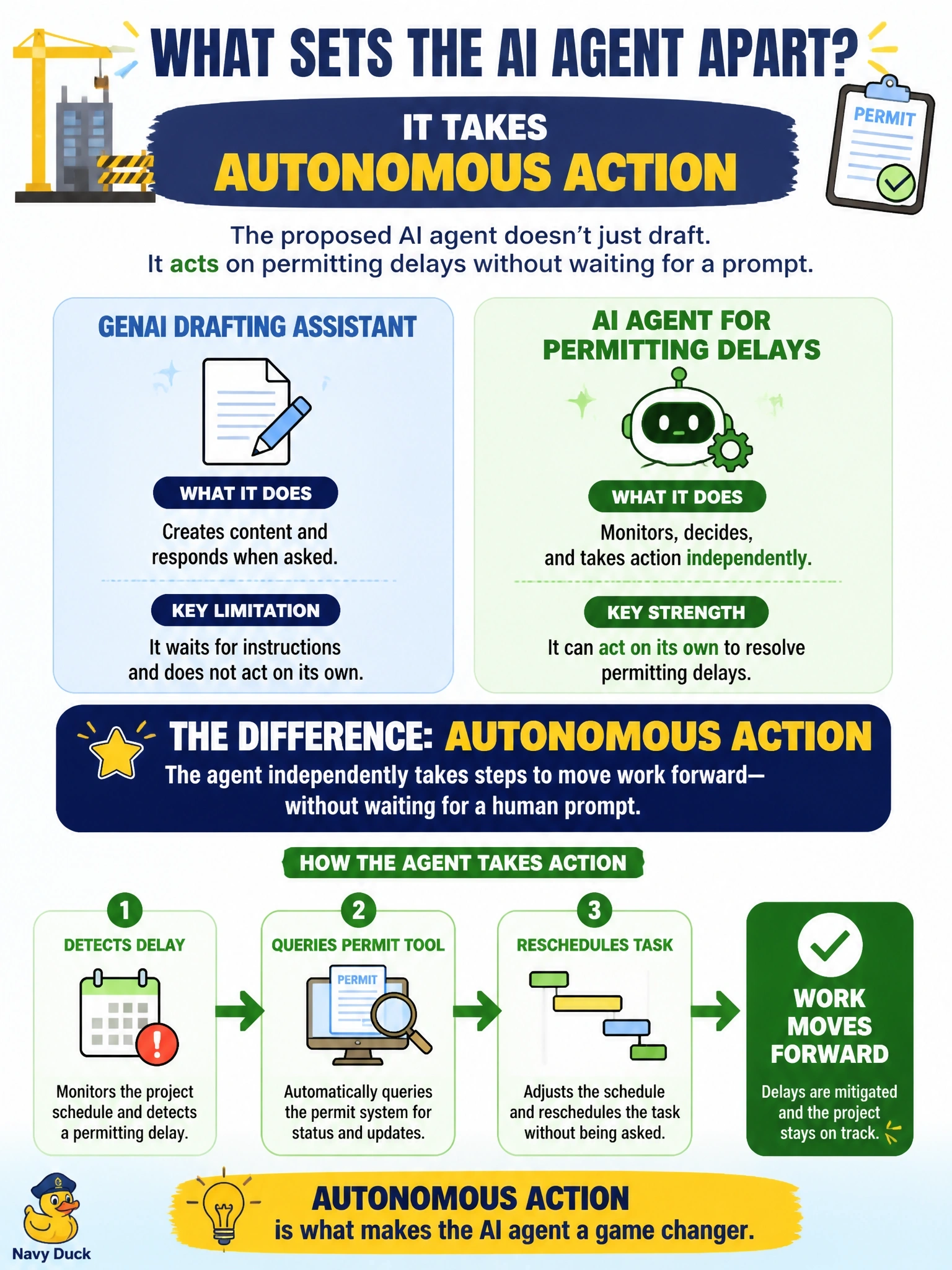
Polished writing, natural phrasing, a tight summary — a drafting assistant can hand you all of that and never leave the chat window. What flips a system into an agent is taking action out in the world on its own, like checking a permit tool and rescheduling a task without you having to ask.
Full Explanation
The defining difference between an AI agent and a drafting assistant is that the agent takes independent action in the world, such as checking a permit-status tool and rescheduling a task on its own, rather than only responding to a prompt with text. The response-length option focuses on producing longer or more polished text, which has no bearing on whether a system is agentic; more polished text is still just text output. The historical-data option describes using past data to phrase responses more naturally, a characteristic shared by many AI/ML systems, including non-agentic ones, so it doesn't specifically distinguish an agent. The summarization option is a common GenAI capability available in many tools that never take independent action, so it also fails to mark the distinction leadership is asking about. The general principle: what separates an AI agent from other GenAI solutions is autonomous action and tool use toward a goal, not output length, data usage, or content-generation skill, which many non-agentic tools share.