
Which scenario is the best fit for rule-based automation rather than an AI-based solution?
Select an answer to reveal the explanation.
Short Explanation
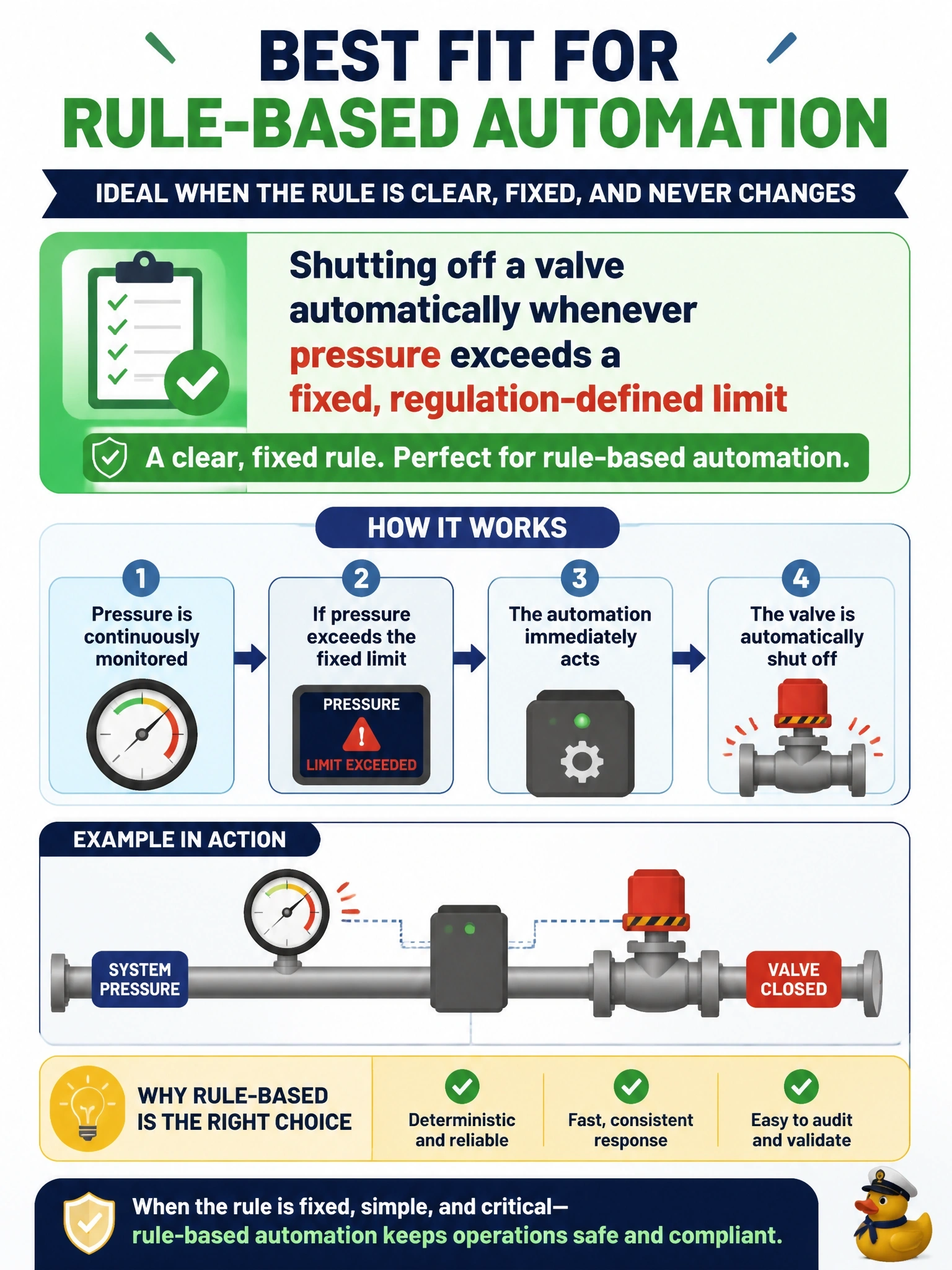
Think about it like this: if you can write the entire decision in one sentence — pressure above X, close the valve — you don't need AI, you need a rule. Rule-based automation shines exactly there: a single fixed threshold with a clear, deterministic trigger and zero ambiguity. The other scenarios all ask a system to weigh messy, shifting signals — churn behavior, weather-driven demand, natural language — and that kind of judgment call is where AI earns its keep.
Full Explanation
Rule-based automation fits the valve scenario because the trigger is a single deterministic threshold set by regulation: pressure crosses a fixed number, the valve closes, every time, with no interpretation needed. That's a textbook if-then rule, not a prediction problem, so building or training a model would add cost and complexity without adding value. Forecasting energy demand from years of variable consumption and weather data is the opposite case: the relationships between temperature, season, and usage shift constantly and interact in ways no fixed rule table can capture, which is exactly the pattern-recognition strength of a machine learning model. Predicting which industrial customers are likely to churn works the same way — it depends on many interacting behavioral signals and produces a probabilistic judgment, not a single knowable trigger, so it needs a model trained on historical outcomes rather than a static rule. Drafting varied, context-appropriate customer explanations of a rate change is a content-generation task, and producing natural, non-repetitive language for different audiences is a strength of generative AI, not something a fixed rule set can do well. The general principle: reach for rule-based automation when a decision has one clear, static, regulation- or policy-defined trigger, and reach for AI when the task involves forecasting, behavioral prediction, or flexible language generation — situations with variability or complexity that rules can't economically encode.