
A retail chain deploys a system that independently decides to check inventory levels, place a reorder with a supplier, and notify a manager only if the order fails, all without a human approving each step. What type of AI solution does this describe?
Select an answer to reveal the explanation.
Short Explanation
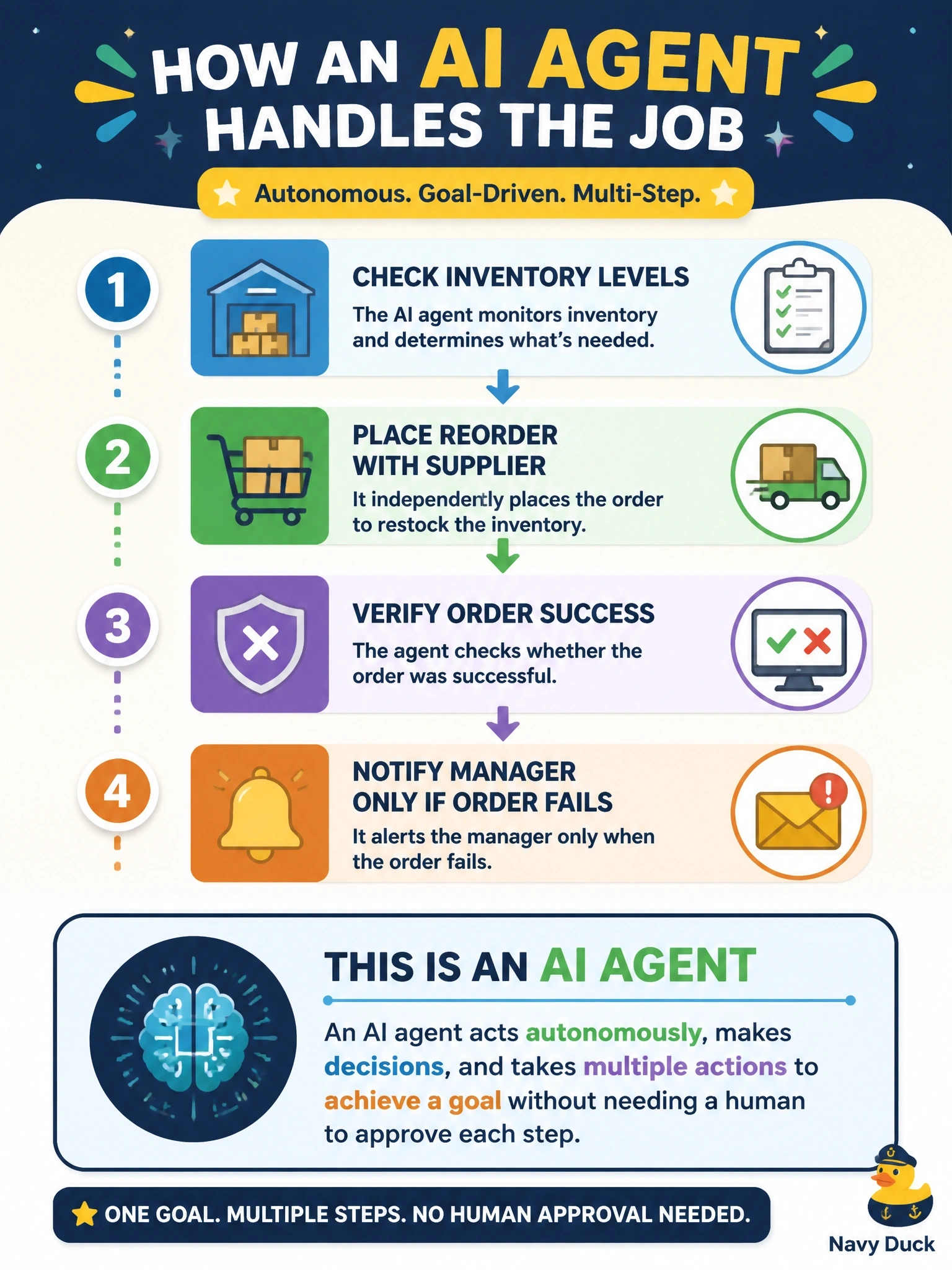
Notice what this system is actually doing: it checks inventory, decides on its own to reorder, talks to a supplier, and only loops you in when something breaks. That's a chain of independent decisions toward a goal, not one prediction or one canned script — and autonomous, multi-step action like that is exactly what makes something an AI agent.
Full Explanation
The system independently checks inventory, decides to reorder, interacts with a supplier system, and escalates conditionally, a sequence of autonomous, multi-step actions taken toward a goal without step-by-step human approval, which is the defining behavior of an AI agent. The rule-based-workflow option mislabels the behavior as a fixed script; rule-based workflows don't independently decide when to escalate or how to respond to a failed order, they simply execute predetermined steps. The ML-model option understates the system's scope: a traditional ML model produces a single prediction or output, not a chain of actions across multiple systems. The chatbot option also understates the system's capability, since it takes real-world action, placing an order and notifying a person, well beyond generating text. The general principle: what distinguishes an AI agent from other AI solutions is autonomous, multi-step action toward a goal, often involving tool use and conditional decisions, rather than a single prediction, a fixed script, or text generation alone.