
A retailer's inventory team currently sets reorder quantities using static reorder points adjusted by gut feel for seasonality, promotions, and shifting supplier lead times. Leadership wants a scalable approach. What is the most important consideration when choosing between rule-based automation and an AI-based solution here?
Select an answer to reveal the explanation.
Short Explanation
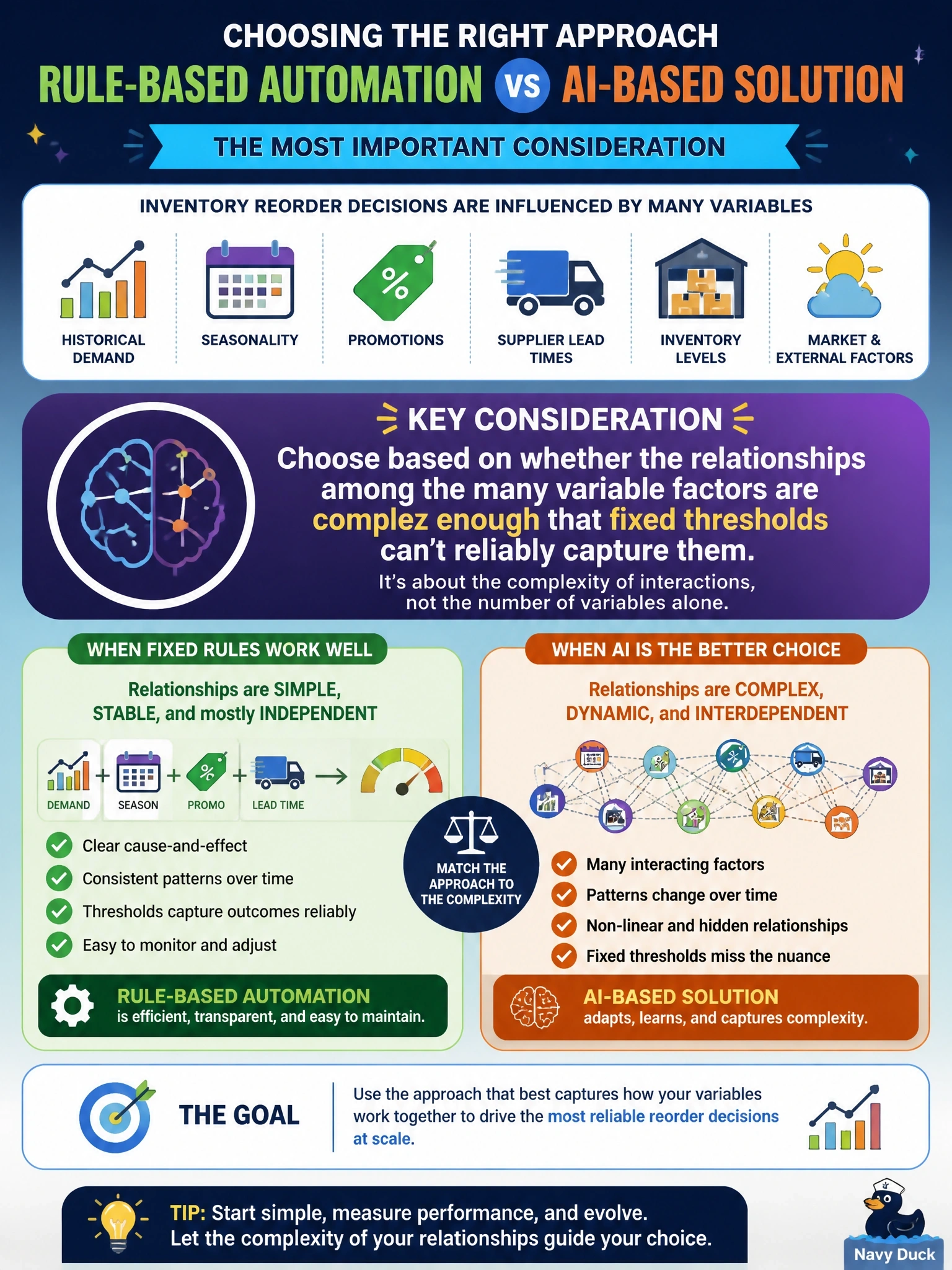
Think of the rule-based-versus-AI question the way you'd size up a recipe: if a handful of fixed thresholds can capture the logic, you don't need a learned model. Here, seasonality, promotions, and shifting lead times interact in ways fixed reorder points can't reliably track — that's the signal for AI. Price, tooling format, and staff preference are all secondary once you've answered that core complexity question.
Full Explanation
The deciding factor in choosing between rule-based automation and an AI-based solution is whether the decision logic can be fully captured in fixed, explainable criteria or whether it depends on interacting, shifting variables that only a learned model can approximate well. In this scenario, seasonality, promotions, and variable supplier lead times interact with each other rather than acting independently, which is exactly the signal that static reorder points and gut-feel adjustments will keep falling short as the business scales — pointing toward an AI-based approach. Whether the current process runs through spreadsheets, dedicated software, or informal notes says nothing about whether the underlying decision logic is deterministic or pattern-based; that's a tooling detail, not a driver of which technique fits the problem. Vendor pricing is a real consideration eventually, but comparing costs is premature before the team has even established that AI is the right category of solution for this particular decision. Similarly, whether staff would prefer more autonomy in daily adjustments reflects a preference, not a property of the problem itself — what employees want doesn't determine whether the relationships driving reorder decisions are simple enough for fixed rules or complex enough to need a learned model. The operational check: name the interacting variables, ask whether a fixed threshold could reliably capture their combined effect, and let that answer — not cost, tooling, or preference — drive the choice.