
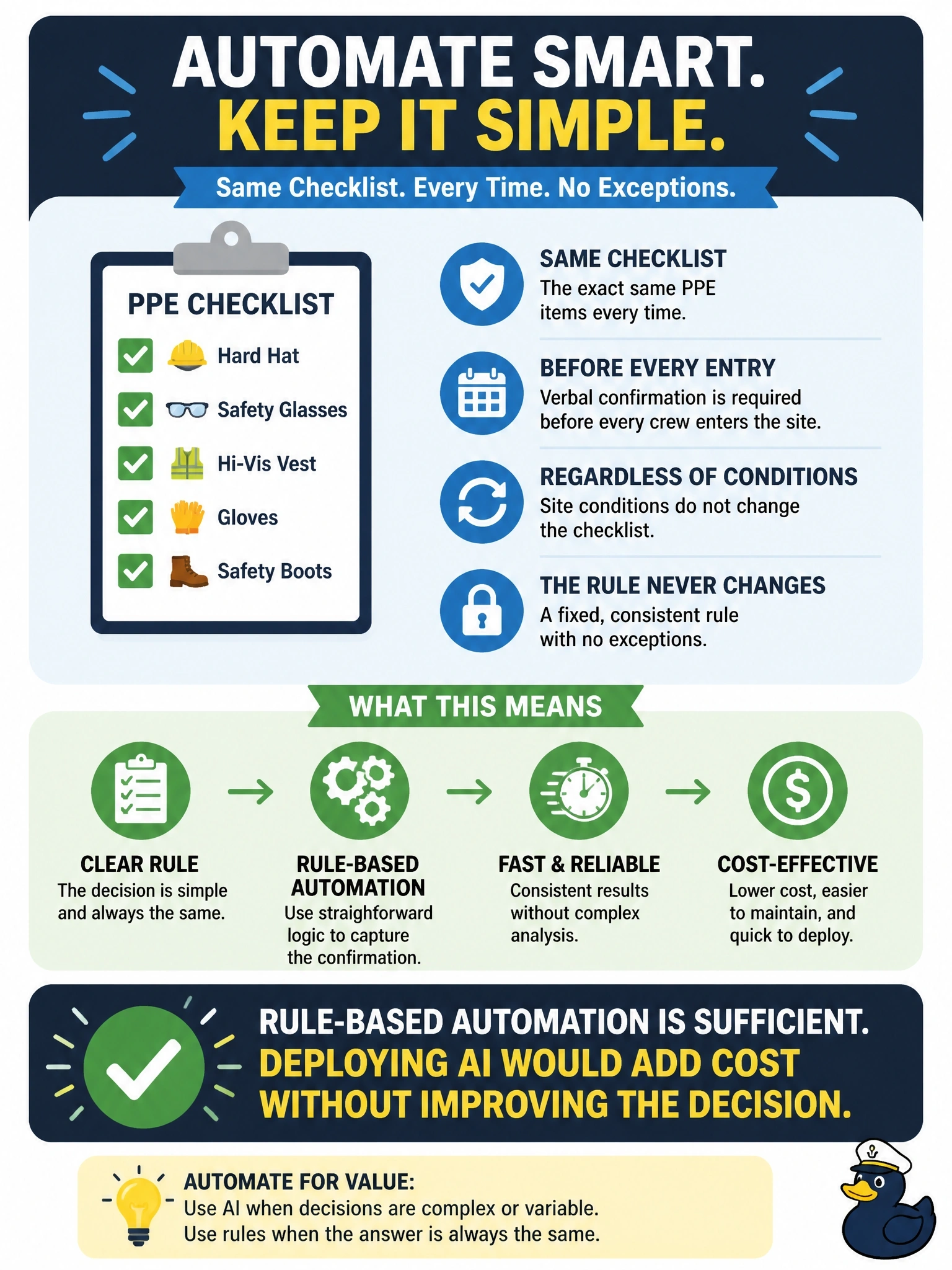
A construction firm's safety office requires the same PPE checklist to be verbally confirmed before every crew enters a site, regardless of site conditions, and the rule never changes. What should leadership conclude about automating this check?
Select an answer to reveal the explanation.
Short Explanation
A stop sign doesn't need to reason about traffic; it just needs to always say the same thing. When your rule never changes and applies identically everywhere, rule-based automation already does the job at minimum cost — layering AI reasoning, prediction, or generated wording on top just adds expense without making the checklist any safer.
Full Explanation
The PPE check is static, binary, and identical across every site, which is precisely the profile rule-based automation handles well: confirm the same fixed items every time, with full reliability and no added cost. Deploying an AI agent to reason about site-specific risk in real time solves a problem this scenario doesn't present — the checklist doesn't vary by site condition here, so there's no ambiguity for an agent to interpret. Having generative AI produce differently worded checklists per site actively works against the goal: a safety-critical, standardized confirmation benefits from uniform wording, and introducing variation risks confusion or missed items rather than adding value. Using a machine learning model to predict which crews are statistically less likely to comply reframes the task as forecasting behavior rather than verifying PPE before entry — knowing a compliance likelihood doesn't substitute for the actual pre-entry confirmation, and it adds an inferential step where the process needs certainty, not probability. The operational principle: when a process is deterministic, uniform, and doesn't require interpreting ambiguous or shifting information, rule-based automation delivers the needed reliability more efficiently than any AI-based alternative, no matter how capable that alternative is.