
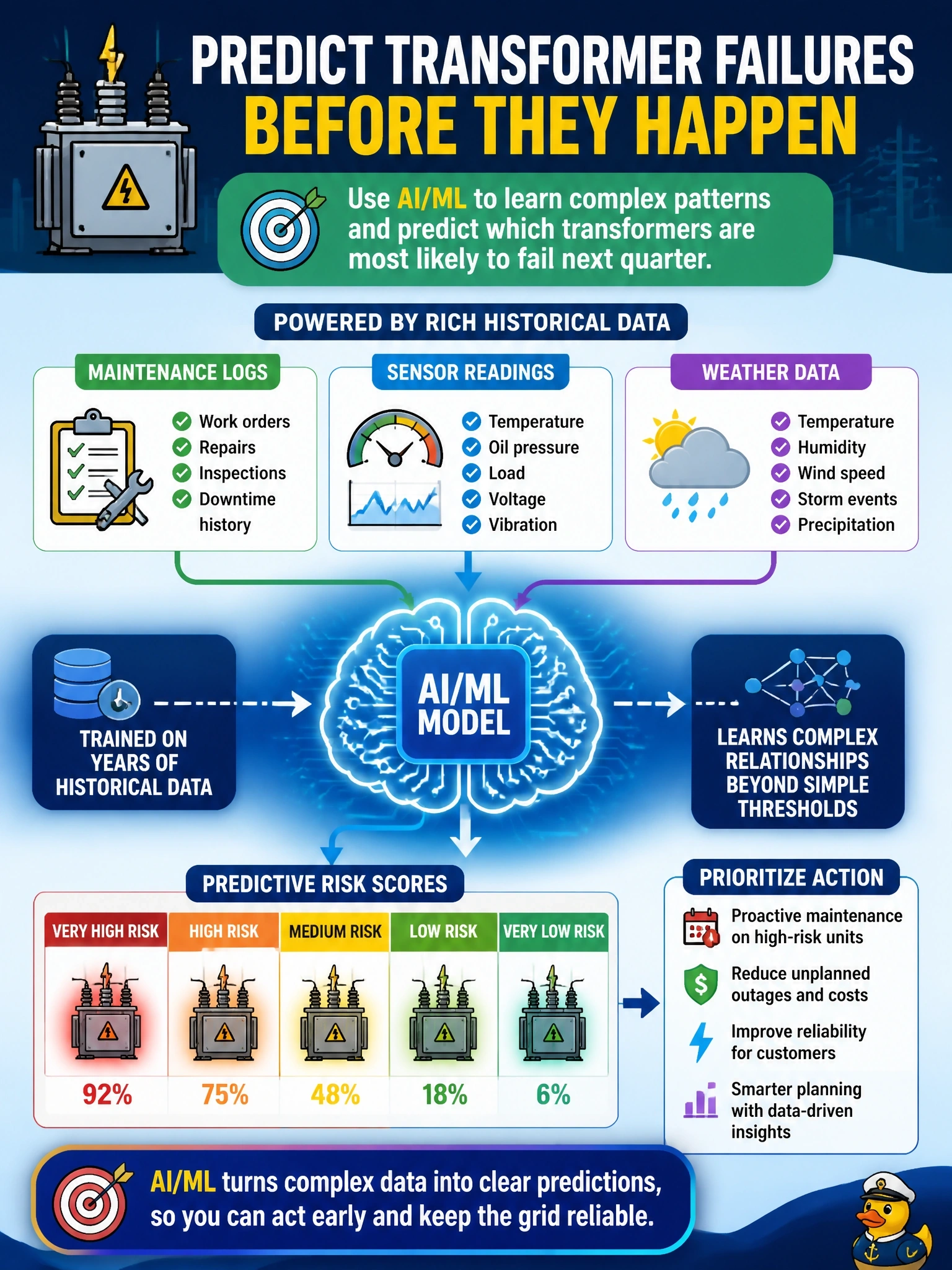
A utility company wants to predict which distribution transformers are most likely to fail next quarter, drawing on years of maintenance logs, sensor readings, and weather data whose interrelationships aren't captured by simple thresholds. What should leadership select?
Select an answer to reveal the explanation.
Short Explanation
Think of transformer failure like weather forecasting — age alone won't tell you much, but combine years of sensor readings, maintenance history, and weather patterns and real patterns emerge that no simple threshold could capture. That's a job for machine learning, trained on exactly the historical data the utility already has. A rule, a checklist, or a chatbot can't learn those interactions the way a trained model can.
Full Explanation
The scenario is a textbook case for AI/ML: many interacting variables — maintenance logs, sensor readings, weather data — with relationships too complex for a fixed threshold to capture, plus years of historical data rich enough to train a model on. That combination is what lets a machine learning model surface failure patterns a human-written rule could never encode. Flagging any transformer over 20 years old collapses the decision to a single variable, ignoring the sensor and weather signals the utility already collects, which would likely produce both missed high-risk transformers and unnecessary flags on old-but-healthy units. Requiring manual inspection of every transformer every quarter scales poorly across a large distribution network and wastes the predictive value already sitting in the historical dataset — it substitutes labor for pattern recognition the data supports. A generative AI chatbot for field technicians solves a different problem entirely: it can help someone ask about status, but it doesn't perform the underlying predictive task of ranking failure risk that leadership actually needs. The operational check: when outcomes depend on many interacting factors best learned from history rather than expressed as clean, fixed rules, that's the signal to reach for an AI/ML solution rather than a simple rule or a conversational tool.