
A retail chain's returns desk applies a fixed policy: full refund within 30 days with a receipt, store credit within 90 days, and no refund after that. Which approach is most appropriate for automating this decision?
Select an answer to reveal the explanation.
Short Explanation
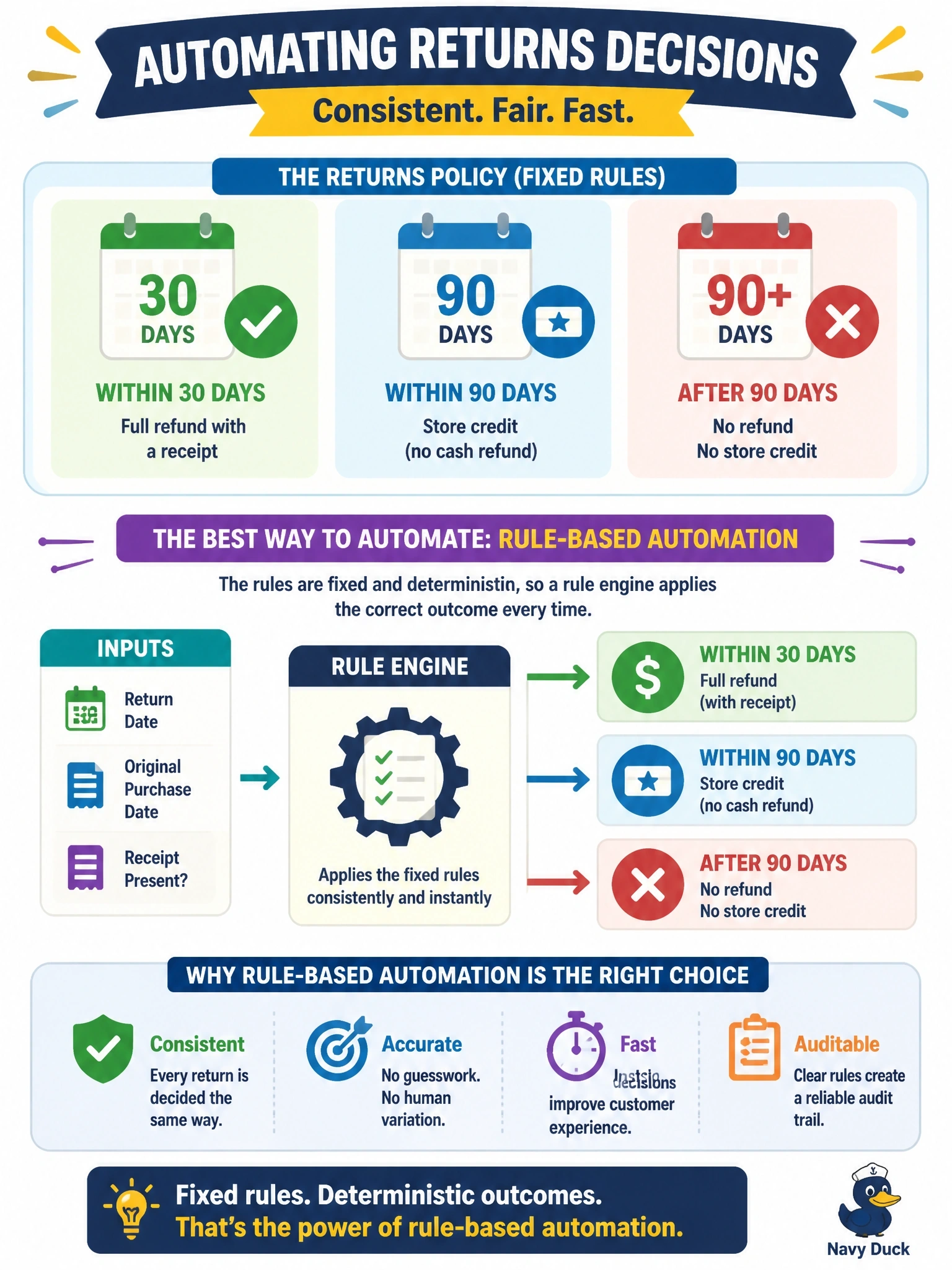
Here's the thing about this refund policy: feed in the right inputs — receipt, days elapsed — and you always get the same output, with no ambiguity left to weigh. That's exactly the profile rule-based automation is built for; anything smarter, like a model or an autonomous agent, would be solving a problem you don't actually have.
Full Explanation
The refund policy is fully determined by two known inputs — receipt status and days elapsed — with no ambiguity left to resolve, which is exactly the profile rule-based automation is built for: transparent, auditable, and consistent every time. Training a machine learning model on historical return data would add probabilistic uncertainty to a decision that policy already answers with certainty, and it would make the outcome harder to explain to a customer or auditor than a simple rule would. Deploying an AI agent with autonomy to negotiate exceptions goes even further in the wrong direction: it introduces inconsistency into what's supposed to be a uniform, predictable policy and creates governance risk the retailer didn't ask for. A generative AI assistant that explains policy nuances addresses a different problem — communication quality — rather than the underlying eligibility decision, which still doesn't require any interpretation once the receipt and date are known. The general principle worth applying elsewhere: when a decision can be written out completely as fixed, unchanging criteria, rule-based automation beats any AI-based approach on transparency, auditability, and cost, and AI is better saved for decisions that genuinely involve pattern recognition or judgment under uncertainty.