
A telecom executive asks why the company's AI governance team references international standards like ISO/IEC 23053 when developing internal AI terminology and processes. What is the best reason for doing so?
Select an answer to reveal the explanation.
Short Explanation
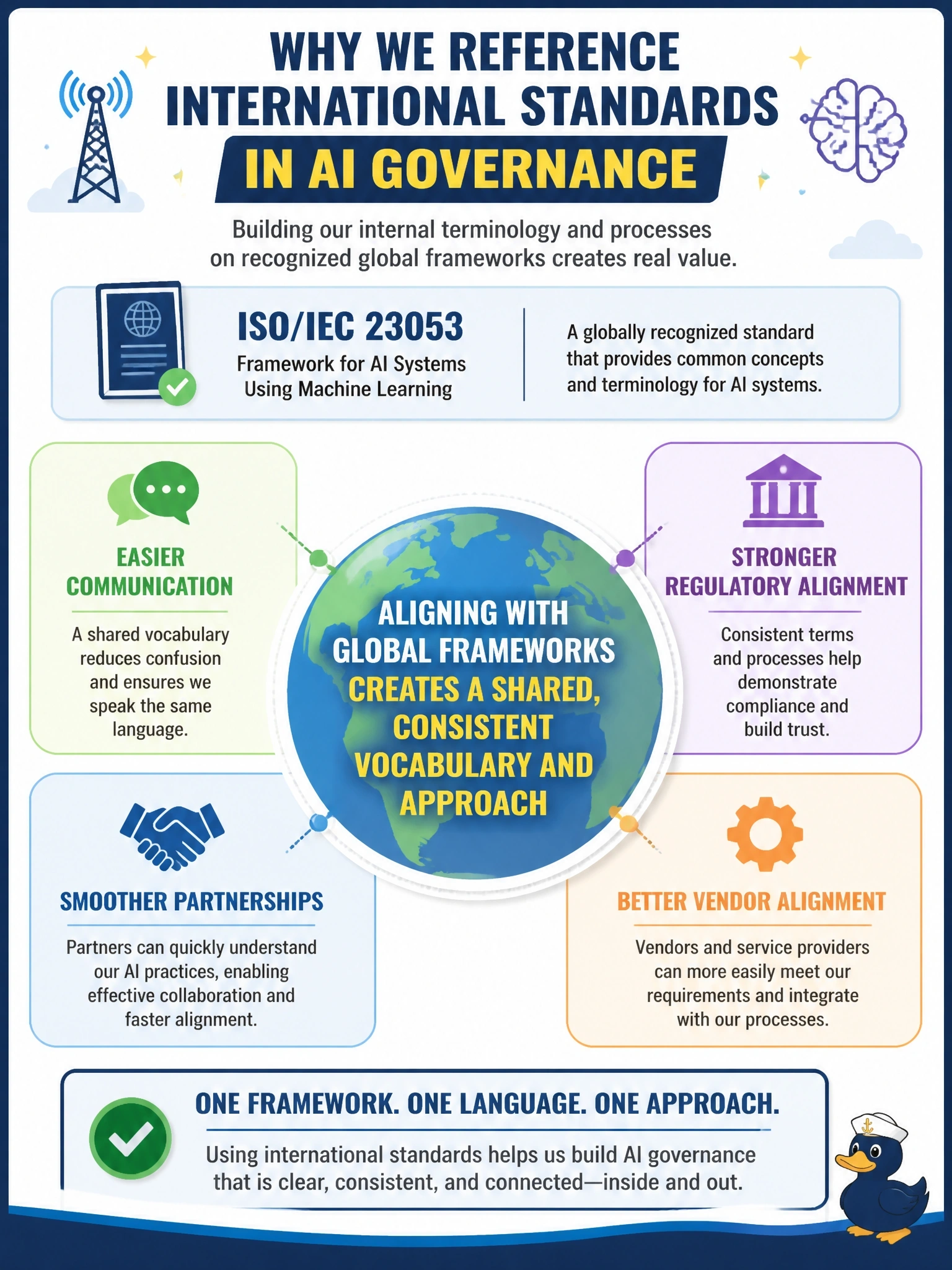
Think of ISO/IEC 23053 and its sibling standards as a shared dictionary — when your team, a regulator, and a vendor all mean the same thing by the same term, conversations get a lot shorter. That's the real payoff: consistency with partners who are already speaking that language, not a legal mandate. Referencing the standard doesn't replace your own governance work; it just gives it a common vocabulary to build on.
Full Explanation
The core benefit of referencing a recognized international framework like ISO/IEC 23053 is shared vocabulary: when the governance team, outside partners, regulators, and vendors all draw on the same defined terms and concepts, communication gets faster and misunderstandings shrink. That benefit has nothing to do with geography — these are international standards meant for organizations anywhere, not frameworks reserved for companies operating solely outside the United States. It's also important not to overstate their legal weight: ISO standards are voluntary reference frameworks an organization chooses to align with, not binding requirements that automatically override internal company policy the way a law or regulation might. And referencing an external standard doesn't let the company skip building its own internal governance — the standard supplies common terminology and structure, but the telecom still has to define its own policies, roles, and processes around that vocabulary. The practical test for the executive: if someone claims a standard is legally binding, geographically restricted, or a substitute for internal governance, that's a red flag — the accurate framing is that shared standards ease communication and support, rather than replace, the organization's own governance program.