
A cooperative's compliance lead mentions that the organization is reviewing ISO/IEC 42001 as part of its AI governance planning. What is the most accurate description of this standard's purpose?
Select an answer to reveal the explanation.
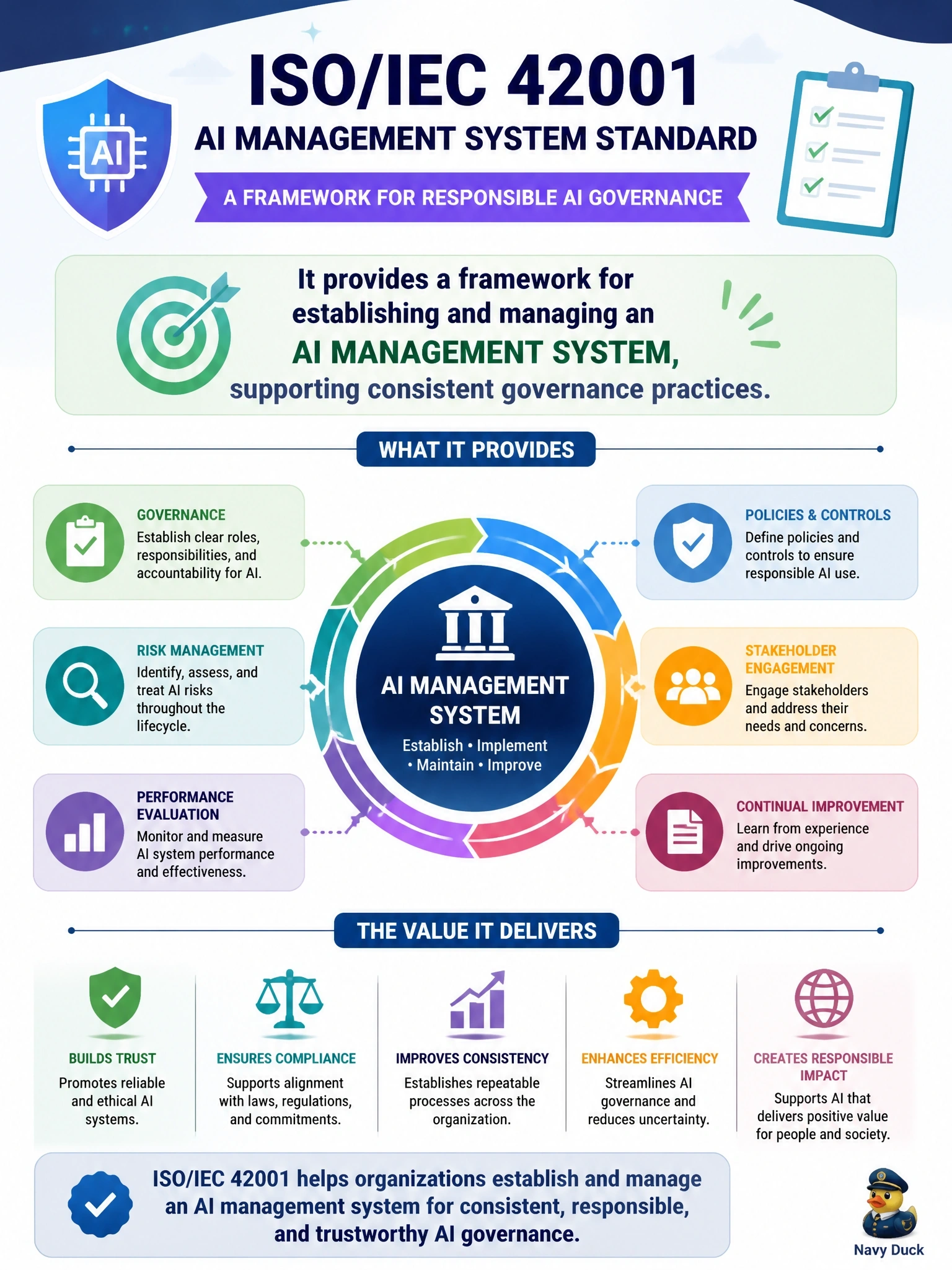
Short Explanation
Think of ISO/IEC 42001 like a blueprint for how an organization runs its AI oversight — not a coding manual and not a permission slip to stop doing your own governance work. It tells you what a well-run AI management system looks like: policies, roles, risk reviews, continual improvement. The standard shapes how you govern AI, not how you code it or which industry you're in.
Full Explanation
ISO/IEC 42001 sets requirements for an organization's AI management system — the policies, roles, risk assessments, and continual-improvement cycle that keep AI initiatives governed consistently across teams. That's a very different thing from a step-by-step coding specification: the standard says nothing about algorithm architecture or how to build a model from scratch, so treating it as a technical build guide misreads its scope entirely. It's also not industry-locked to agriculture or any single sector — it's written as a general-purpose management-system standard any organization can adopt, the same way ISO 9001 applies broadly to quality management. And adopting it doesn't let a cooperative outsource its governance responsibilities: a management-system framework gives structure and a common language for policies, audits, and roles, but the organization still has to build, staff, and operate that governance itself — the standard guides the work, it doesn't do the work. For a compliance lead, the operational check is simple: if a colleague describes ISO/IEC 42001 as telling engineers how to code models, restricting it to one industry, or replacing the need for internal governance, correct the framing — its real job is providing the organizational scaffolding for consistent AI oversight.