
A hospital system's AI program lead is asked to explain, to a group of department heads, what ISO/IEC 23053 addresses in contrast to ISO/IEC 42001. Which description best distinguishes the two?
Select an answer to reveal the explanation.
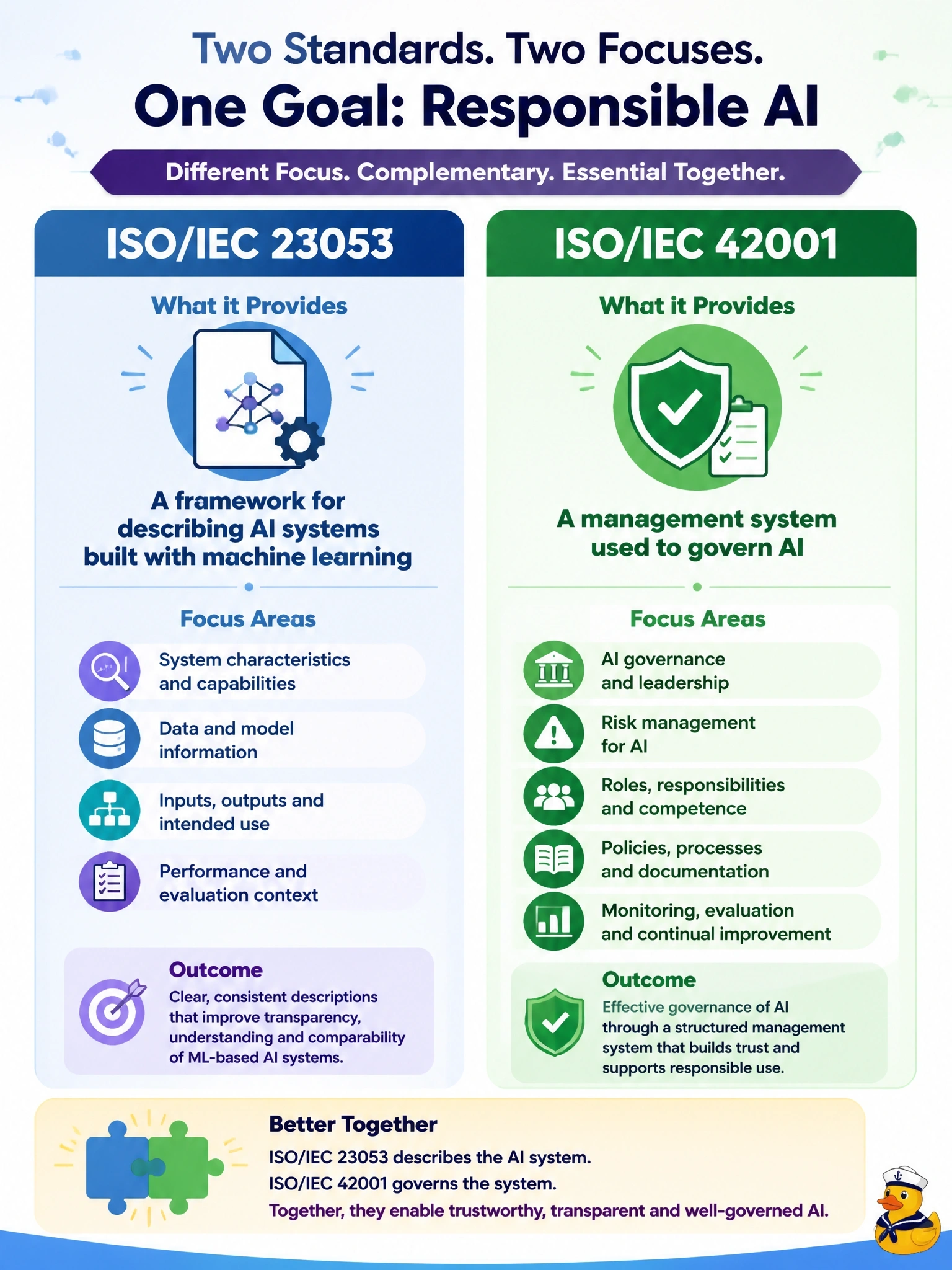
Short Explanation
ISO/IEC 23053 and ISO/IEC 42001 answer two different questions about AI: what is this system, technically, versus how do you run and govern it as an organization? 23053 gives you a common way to describe machine-learning-based systems; 42001 sets up the management system that governs AI overall — complementary, not interchangeable.
Full Explanation
ISO/IEC 23053 provides a framework and vocabulary for describing AI systems built using machine learning — what the system is and how its components fit together. ISO/IEC 42001 operates at a different altitude entirely: it's a management-system standard covering the policies, roles, and processes an organization uses to govern AI activity overall. Because they address different layers — technical description versus organizational governance — treating them as fully interchangeable is wrong; a hospital audit team would reach for 23053 when characterizing a specific ML system and for 42001 when assessing governance maturity, and the two documents wouldn't substitute for each other. Neither standard is a pricing or licensing framework, and neither is a data-labeling specification — those are unrelated technical and commercial concerns that ISO/IEC 23053 and 42001 simply don't cover. Nor is the distinction about AI category, such as generative versus rule-based systems; 42001's governance scope isn't limited to production generative AI, and 23053's descriptive scope isn't limited to traditional automation. The operational check for the program lead: ask whether the conversation is about what a system technically is (23053) or about how the organization manages and oversees AI as a whole (42001) — that question, not AI type or cost, determines which standard applies.