
A hospital's AI vendor explains that their sepsis-risk model was "trained on historical patient outcomes" and now "infers risk on new admissions." A board member asks how these two steps relate. Which explanation is most accurate?
Select an answer to reveal the explanation.
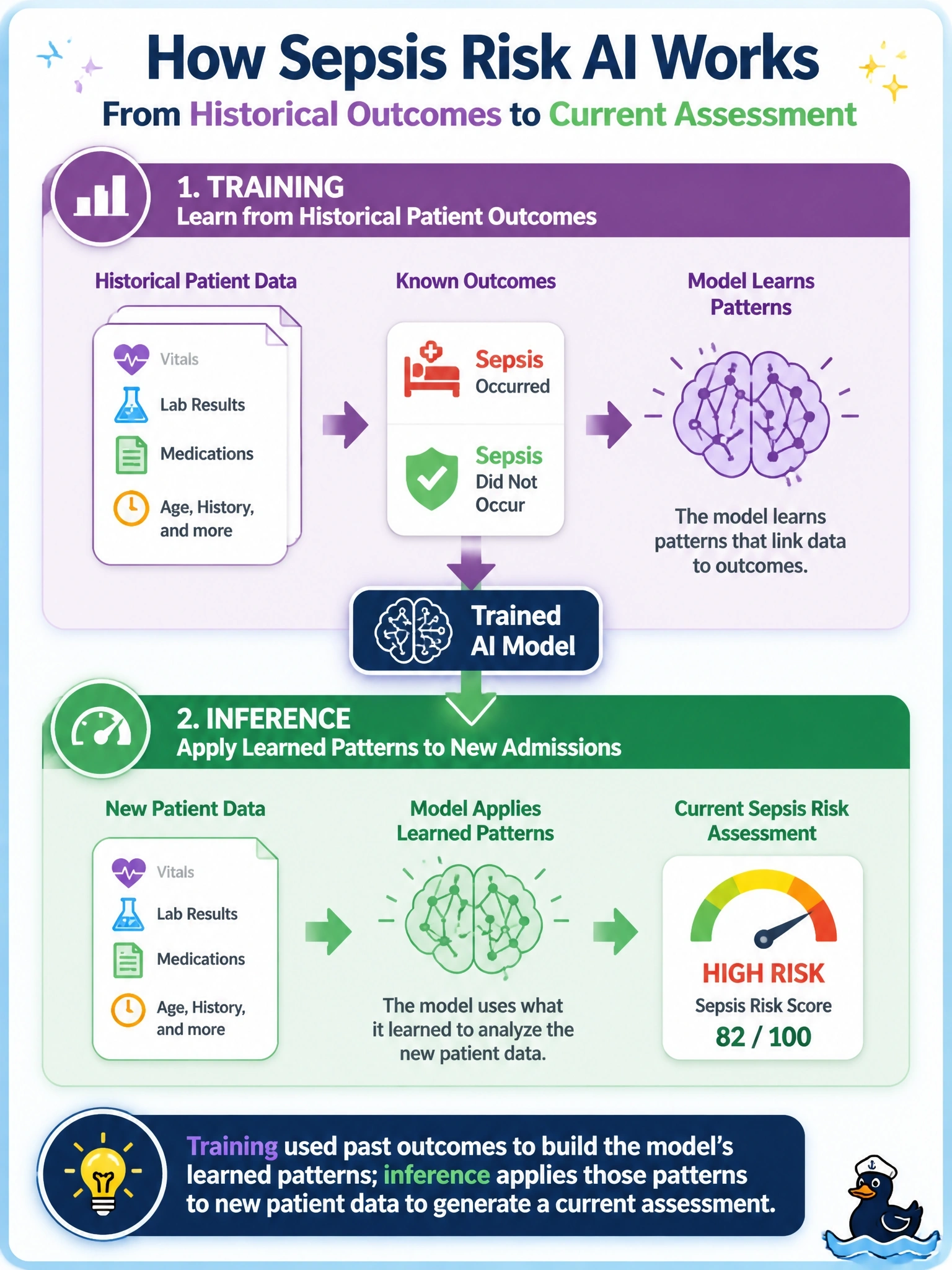
Short Explanation
You spend years in school before you ever treat a real patient, and that order never reverses — the sepsis model works the same way. It learned its patterns once from historical outcomes, and now applies that same learning every time it assesses a new admission for you. Training builds the knowledge; inference puts it to work.
Full Explanation
Training used historical patient outcomes to build the model's learned patterns, and inference is the separate, ongoing step where those learned patterns are applied to a new admission's data to produce a current risk assessment. Treating training and inference as the same simultaneous step obscures why the model can be trained once and then used repeatedly for many different patients over time. Claiming inference happened first reverses the logical order — inference requires an already-trained model to apply, so it cannot happen before training, and it certainly cannot use data that does not yet exist. Claiming training becomes optional based on marketing language is a misconception; every functioning AI model requires a training phase to learn patterns, regardless of how a vendor markets the product, since without training there would be no learned patterns to apply during inference. This two-step structure — learn first, then apply — is foundational to understanding how any predictive AI tool operates.