
Why do AI teams typically need a substantial amount of relevant historical data before training a model intended to predict customer churn?
Select an answer to reveal the explanation.
Short Explanation
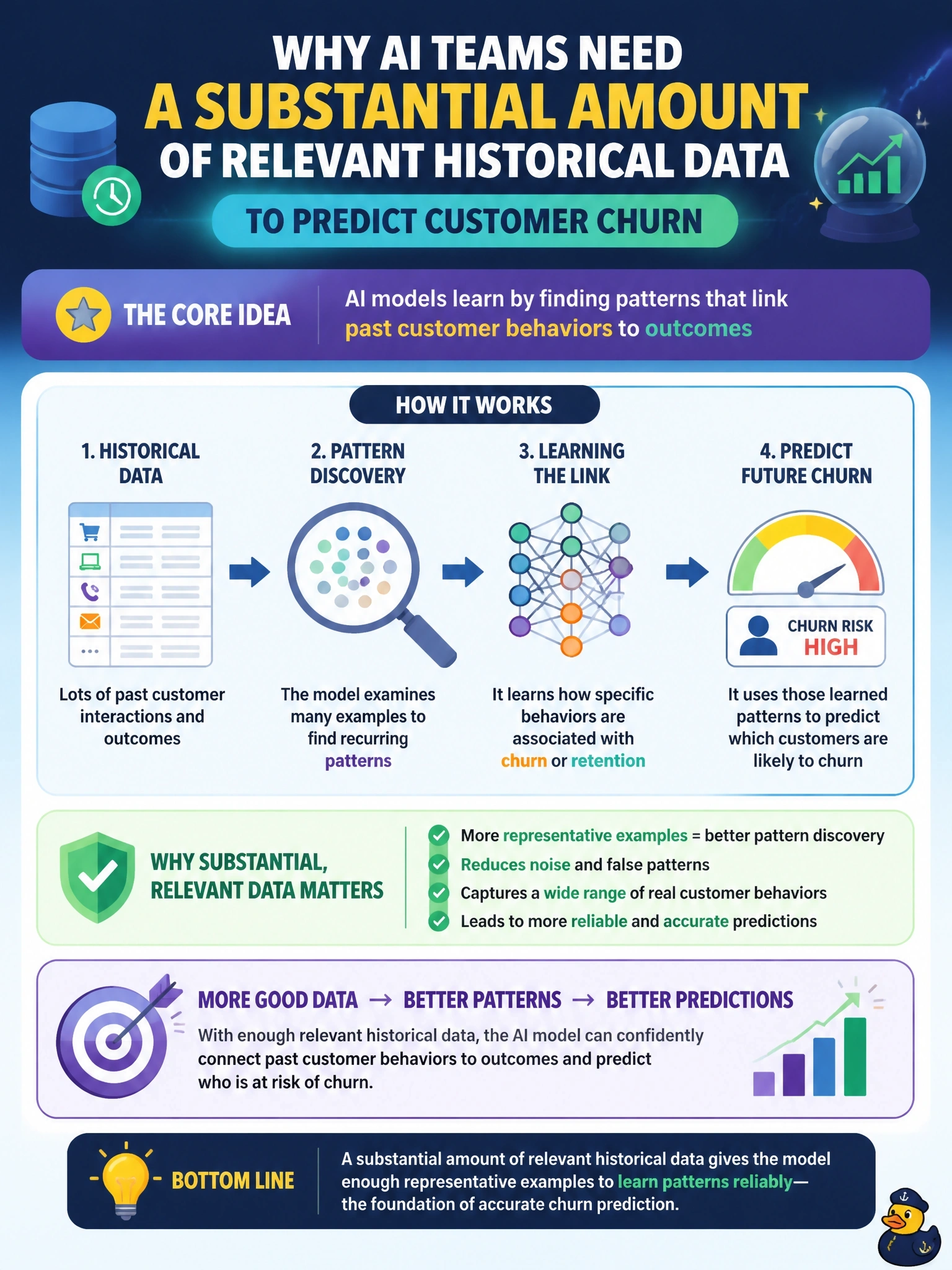
Think of it like learning to spot spoiled fruit — you can't tell from seeing one rotten apple; you need dozens of good and bad examples before the pattern clicks. A churn model works the same way: it needs enough representative examples of past customer behavior and outcomes to reliably learn what separates a customer who stays from one who leaves. One example, or none at all, just isn't enough signal to learn from.
Full Explanation
A churn-prediction model learns by comparing many past customers' behaviors against whether they ultimately churned, looking for the statistical relationships that separate the two groups. A single past example can't reveal a reliable pattern — one customer's story could be a fluke, a coincidence, or an outlier, and the model needs enough varied, representative cases to tell genuine signal from noise. The idea that historical data is only useful for marketing reports and plays no role in building the model gets the relationship backwards: that historical data is the actual foundation the model is trained on, not a side artifact produced afterward. The claim that historical data stops mattering once the model starts predicting on new customers also misses the point — every prediction the model makes on a new customer is still an application of the patterns it learned from that historical foundation, so the two remain connected throughout the model's use. The operational check: before trusting a churn model's predictions, ask how much historical data it was trained on and whether that data covers enough varied customer scenarios to represent the population the model will now be applied to — thin or narrow training data is a red flag regardless of how sophisticated the model's algorithm is.