
A cooperative's leadership is debating whether to retrain its yield-prediction model annually or every five years. Given that historical training data underlies the model's learned patterns, which consideration should most heavily influence this decision?
Select an answer to reveal the explanation.
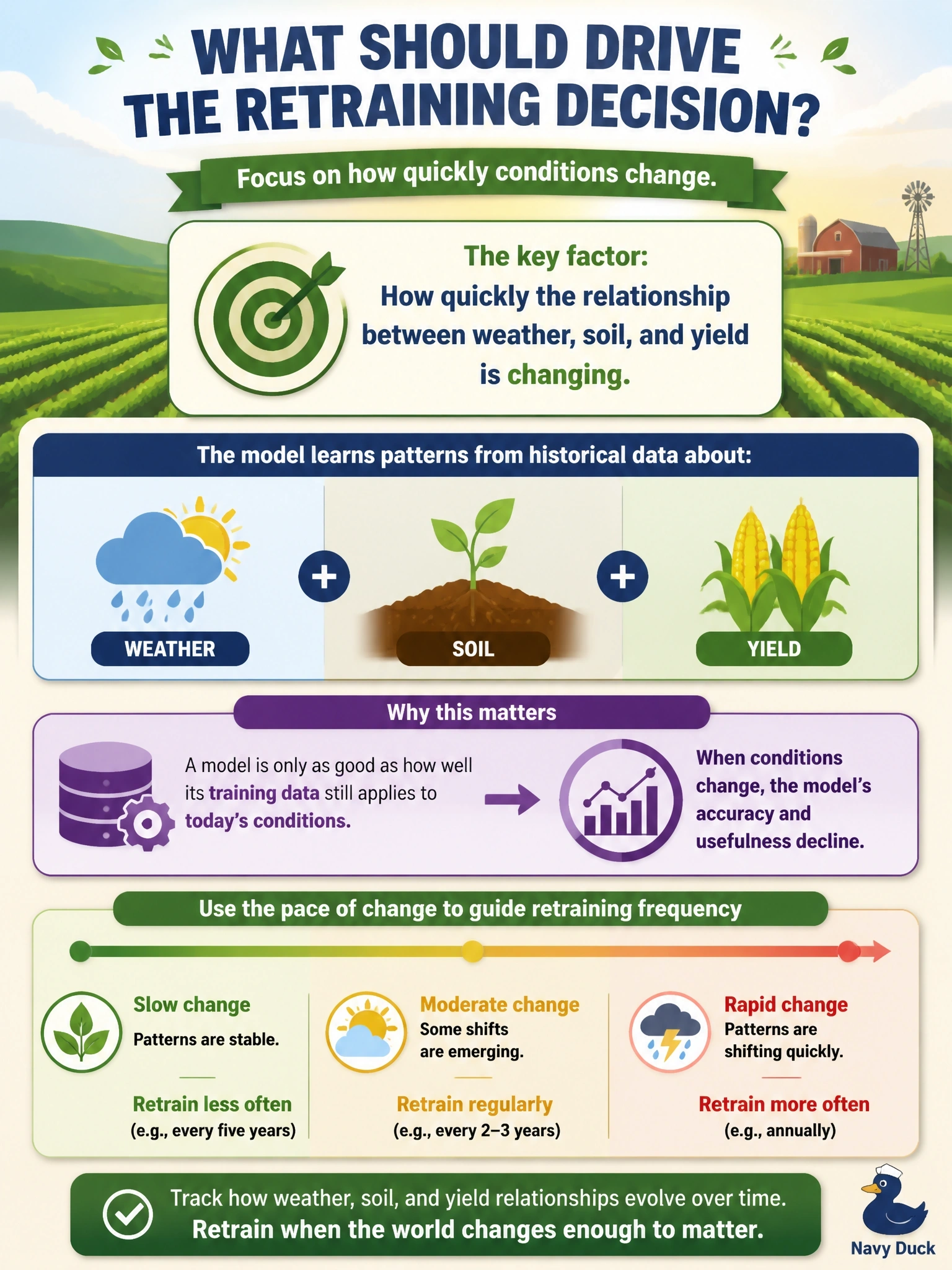
Short Explanation
Training data works a lot like a photograph, not a fact — useful only as long as the scene hasn't changed much since it was taken. If the relationship between weather, soil, and yield is shifting fast, that photo goes stale quickly, so your retraining cadence should follow how fast reality is moving, not administrative convenience.
Full Explanation
Because a model's predictions are shaped by the historical data it was trained on, the key factor in choosing a retraining cadence is how quickly the real-world relationships it learned (between weather, soil, and yield) are shifting — a fast-changing environment argues for more frequent retraining to keep the model's patterns relevant. Focusing on staff travel logistics addresses convenience, not whether the model's learned patterns remain accurate over time. Suggesting the algorithm be renamed is a cosmetic change with no bearing on whether the model's training data still reflects current conditions. Focusing on the original storage format of the historical data has no effect on how quickly real-world conditions are changing or on the model's ongoing accuracy. The underlying principle is that retraining decisions should be driven by how well historical training data continues to represent the present, not by unrelated operational or administrative factors.