
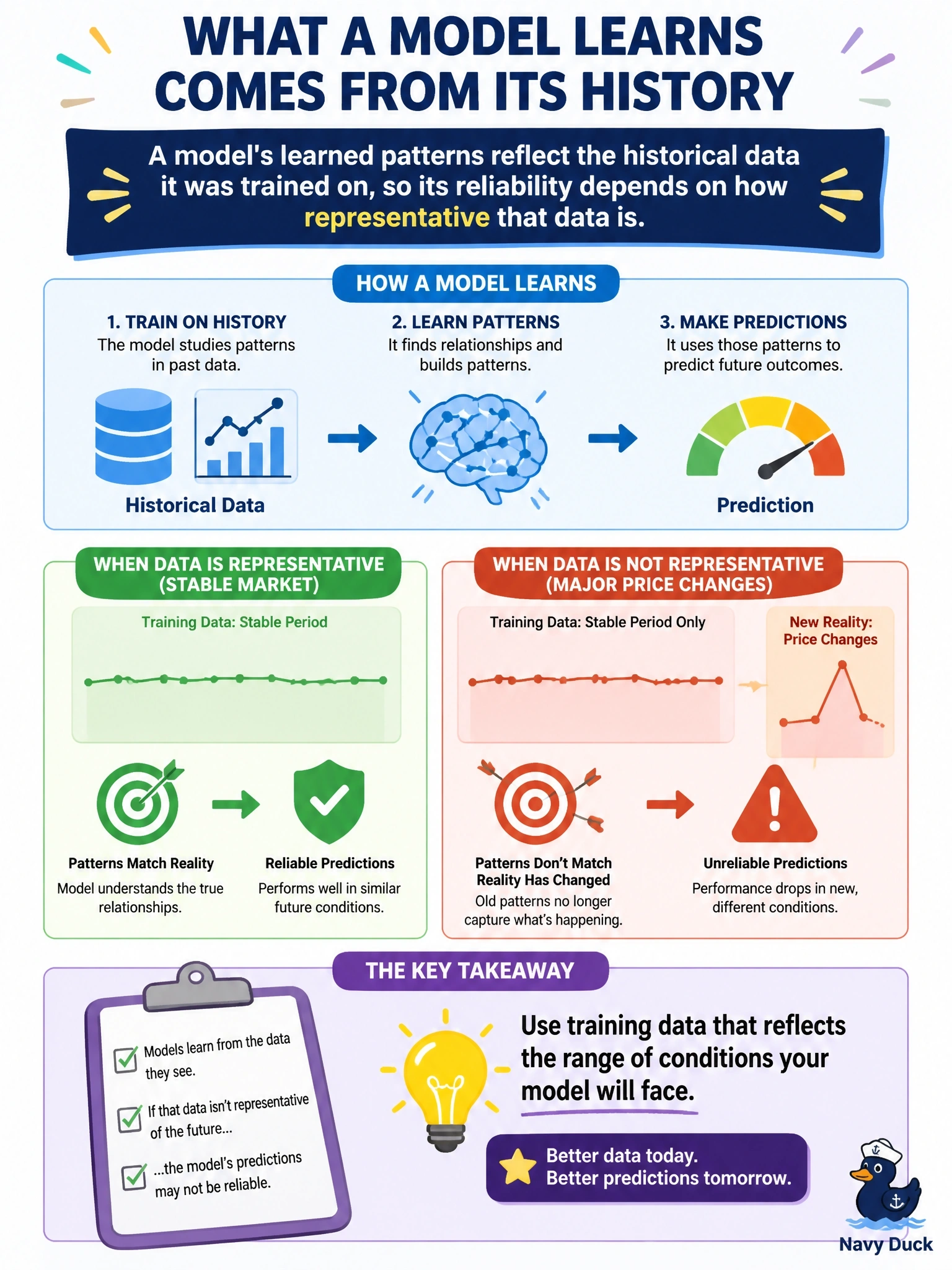
A telecom analytics lead cautions that a churn-prediction model trained only on customer data from the last three months of an unusually stable market may not perform well during a period of major price changes. What underlying training concept does this caution reflect?
Select an answer to reveal the explanation.
Short Explanation
A model trained on three unusually calm months is like a student who only studied during an easy exam season — great at that test, but hand them a curveball topic and the prepared answers stop fitting. What you're actually betting on isn't how recent the training data is, it's how representative it is of what's coming, and a stable sliver of history doesn't guarantee that.
Full Explanation
The analytics lead's caution reflects the principle that a model learns patterns specific to the conditions present in its training data, so if that data does not represent a coming period of major change, the model's predictions for that period may be less reliable. Claiming perfect generalization overstates model capability, asserting a guarantee that does not hold; models are limited by how representative their training data is of new conditions. Dismissing recency as irrelevant contradicts the very concern raised in the scenario, where an unusually stable three-month window is precisely the issue. Introducing a fixed ten-year minimum is an arbitrary and unfounded rule; there is no set time span that guarantees validity — what matters is whether the training data reflects the conditions the model will encounter. This concept helps business leaders ask better questions about the recency and representativeness of a vendor's training data.