
A cooperative's data team explains that its yield-prediction tool was built by "training the model on five years of harvest and weather records." What does this process most accurately describe?
Select an answer to reveal the explanation.
Short Explanation
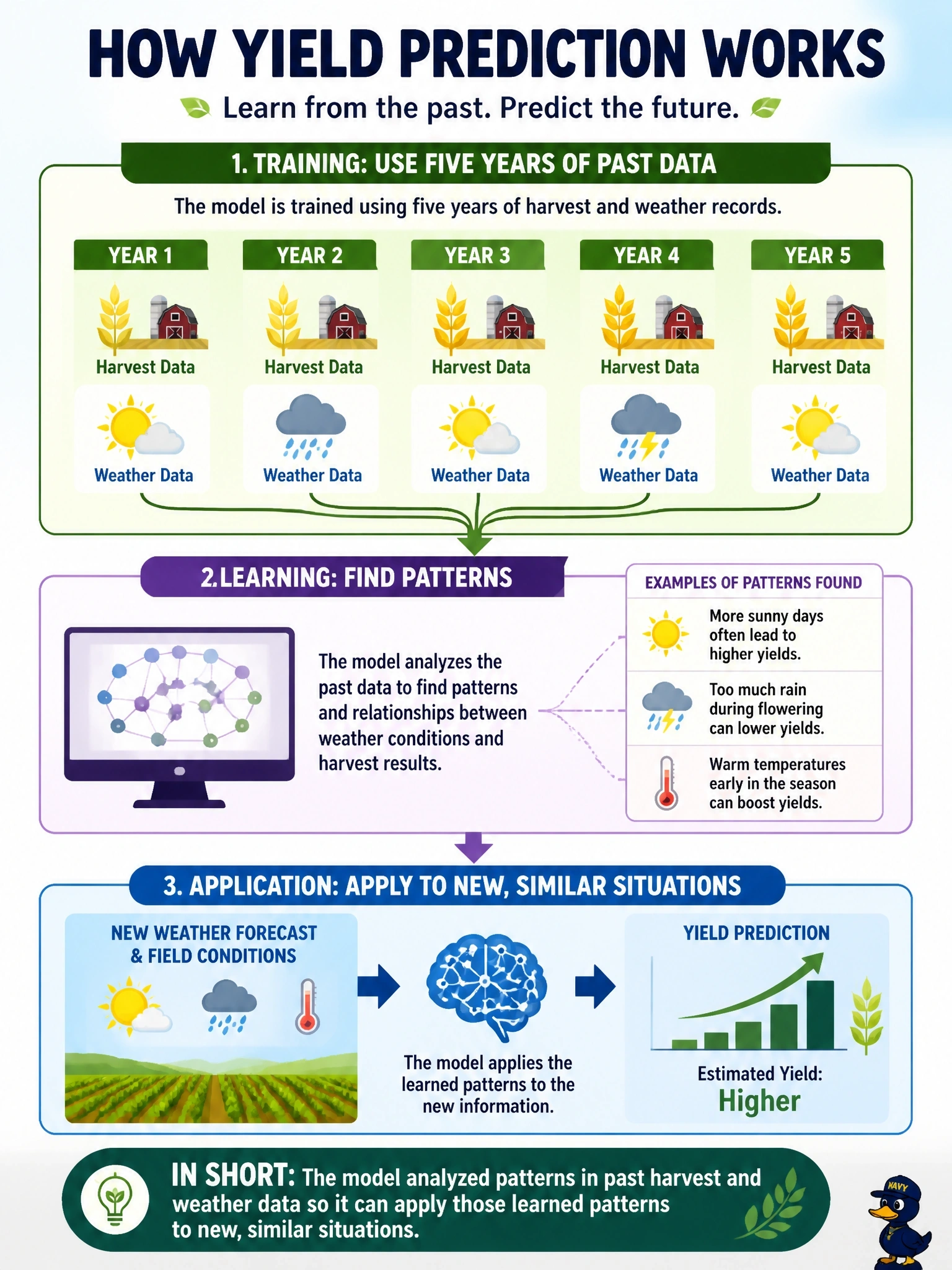
Imagine studying five years of old weather logs before you plant — you're not memorizing last year's exact yield, you're spotting which conditions tend to lead to a good harvest. Training does the same thing: the model learns those patterns from history, then applies them to new seasons it's never seen, instead of just reciting the past.
Full Explanation
Training on five years of harvest and weather data means the model works through that history looking for statistical relationships — how rainfall, temperature, and soil conditions tend to relate to yield — and encodes those relationships as learned patterns it can apply to new, unseen situations. That's fundamentally different from memorizing the exact harvest numbers from each of the five years; a model that only reproduced past figures verbatim would be useless for predicting anything it hadn't already seen, and would fail the moment conditions differed even slightly from history. It's also not about what happens to the training records afterward — whether those five years of data get archived, retained, or deleted is a data-retention decision entirely separate from what training itself accomplishes, and nothing in the scenario suggests deletion occurred or matters here. And it's certainly not staff manually computing forecasts from old records by hand; that would be traditional analysis, not an AI model generating predictions from learned patterns. The operational check: when someone says a model was "trained" on historical data, ask what patterns it learned and how well those patterns are expected to generalize to new, not-yet-seen conditions — that's the real test of a training process, not whether it can recite the past.