
A hospital administrator asks why a new AI-based readmission-risk tool should not be deployed until the underlying patient records are reviewed for completeness and accuracy. What is the best justification for this requirement?
Select an answer to reveal the explanation.
Short Explanation
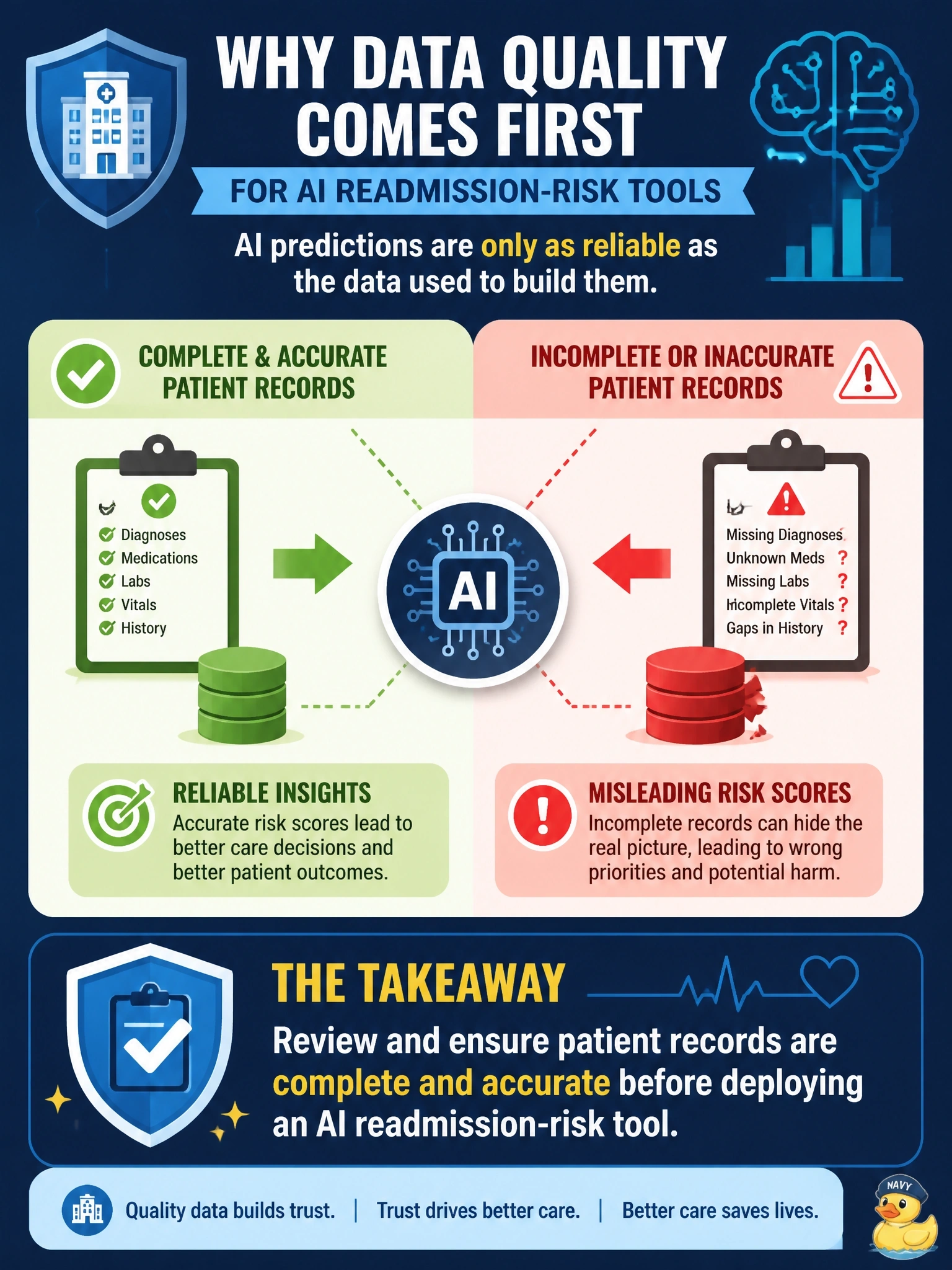
A weather forecast built from broken sensors can run on the best model in the world and still spit out garbage—garbled readings in, garbled predictions out. A readmission-risk tool trained on incomplete or inaccurate patient records inherits those same flaws, which is why you review the records before the tool ever touches a real clinical decision.
Full Explanation
Because an AI model's predictions are shaped by patterns learned from its training data, incomplete or inaccurate patient records risk producing misleading readmission-risk scores that could affect real clinical decisions — this is why a quality review before deployment is warranted. Framing the review as merely a paperwork requirement mischaracterizes it, missing that data quality has a direct, functional effect on how well the tool actually performs. Claiming larger data volume compensates for weak accuracy reflects a common misconception; more data does not compensate for records that are wrong or incomplete, and can in fact reinforce flawed patterns at scale. Limiting the concern to unstructured data is also incorrect; structured records, like the ones described here, are just as susceptible to completeness and accuracy problems that affect model reliability. The underlying principle is that data quality review is a substantive safeguard for outcome reliability, not a procedural formality.