
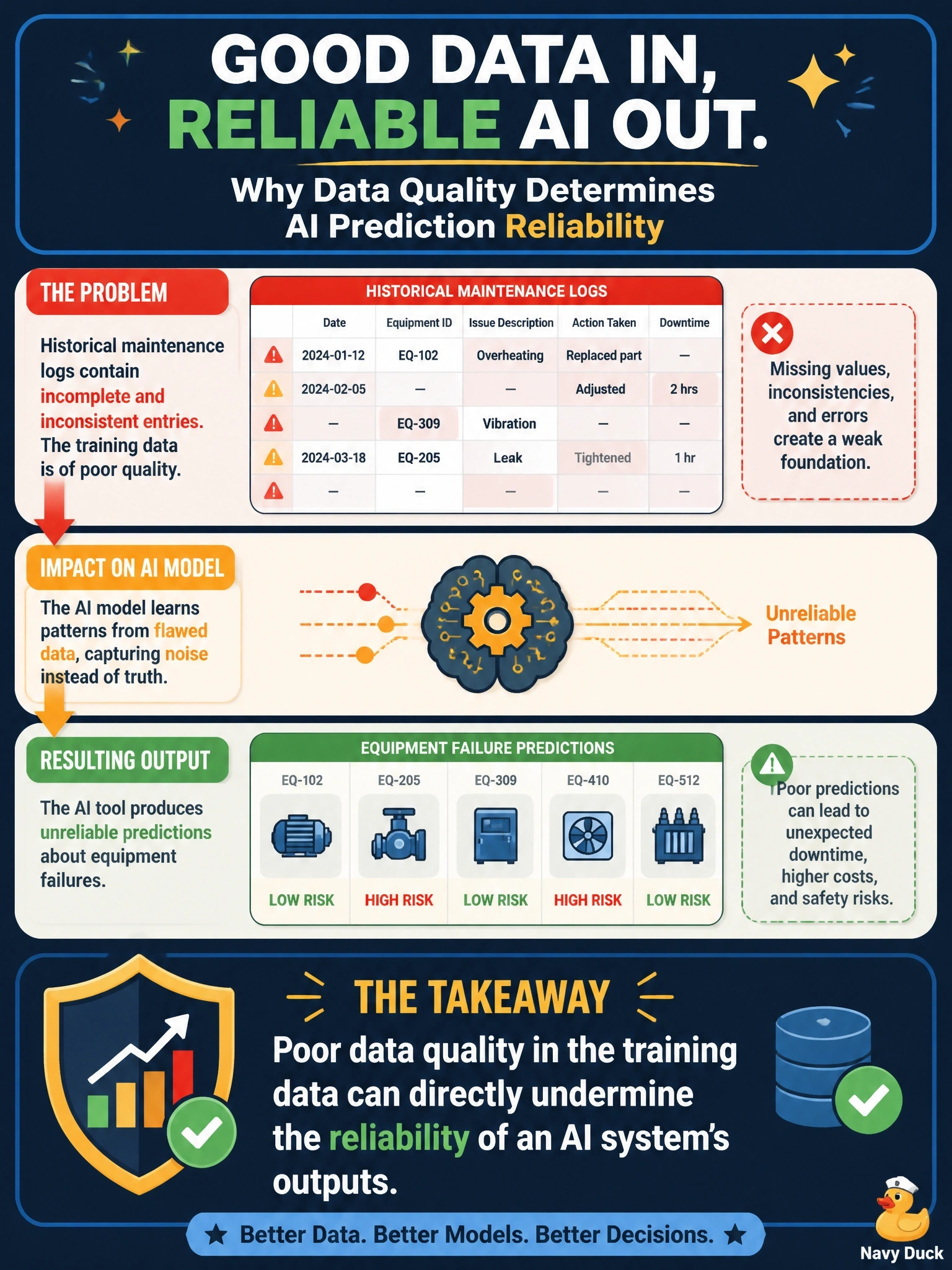
A telecom operations director learns that an AI tool meant to predict equipment failures is producing unreliable results. An investigation finds the historical maintenance logs used to build the tool contain many incomplete and inconsistent entries. What does this scenario most directly illustrate?
Select an answer to reveal the explanation.
Short Explanation
Bake with spoiled eggs, and it doesn't matter how good your recipe or your oven is — the cake comes out bad regardless. The maintenance logs here are your ingredients: incomplete and inconsistent entries gave the model a distorted picture of how maintenance relates to failures, so its predictions came out just as unreliable.
Full Explanation
This scenario is a direct illustration of the principle that an AI system's output reliability is tied to the quality of the data it was trained on — incomplete and inconsistent maintenance logs gave the model a distorted view of the patterns linking maintenance activity to failures, so its failure predictions inherited that distortion. That's the mechanism worth remembering: a model doesn't reason its way around bad inputs, it learns whatever pattern the data actually shows, flawed or not.
The claim that AI systems automatically detect and correct data quality issues in their own training data is false; spotting incomplete or inconsistent records and fixing them requires deliberate data governance and human review, not some built-in self-correction the model performs on its own. The claim that data quality only matters after deployment misplaces the timing — quality is critical throughout the AI lifecycle, and it's especially consequential during development, since flawed training data shapes what the model learns from the very start. The claim that prediction quality is unaffected by record quality directly contradicts the outcome described in the scenario itself, where messy logs are shown causing unreliable predictions.
An operational check worth applying anywhere a model underperforms: before questioning the algorithm or technique, audit the training data for completeness and consistency first, since unreliable inputs reliably produce unreliable outputs.