
Why is it important for a business leader to understand the difference between structured and unstructured data when scoping an AI initiative?
Select an answer to reveal the explanation.
Short Explanation
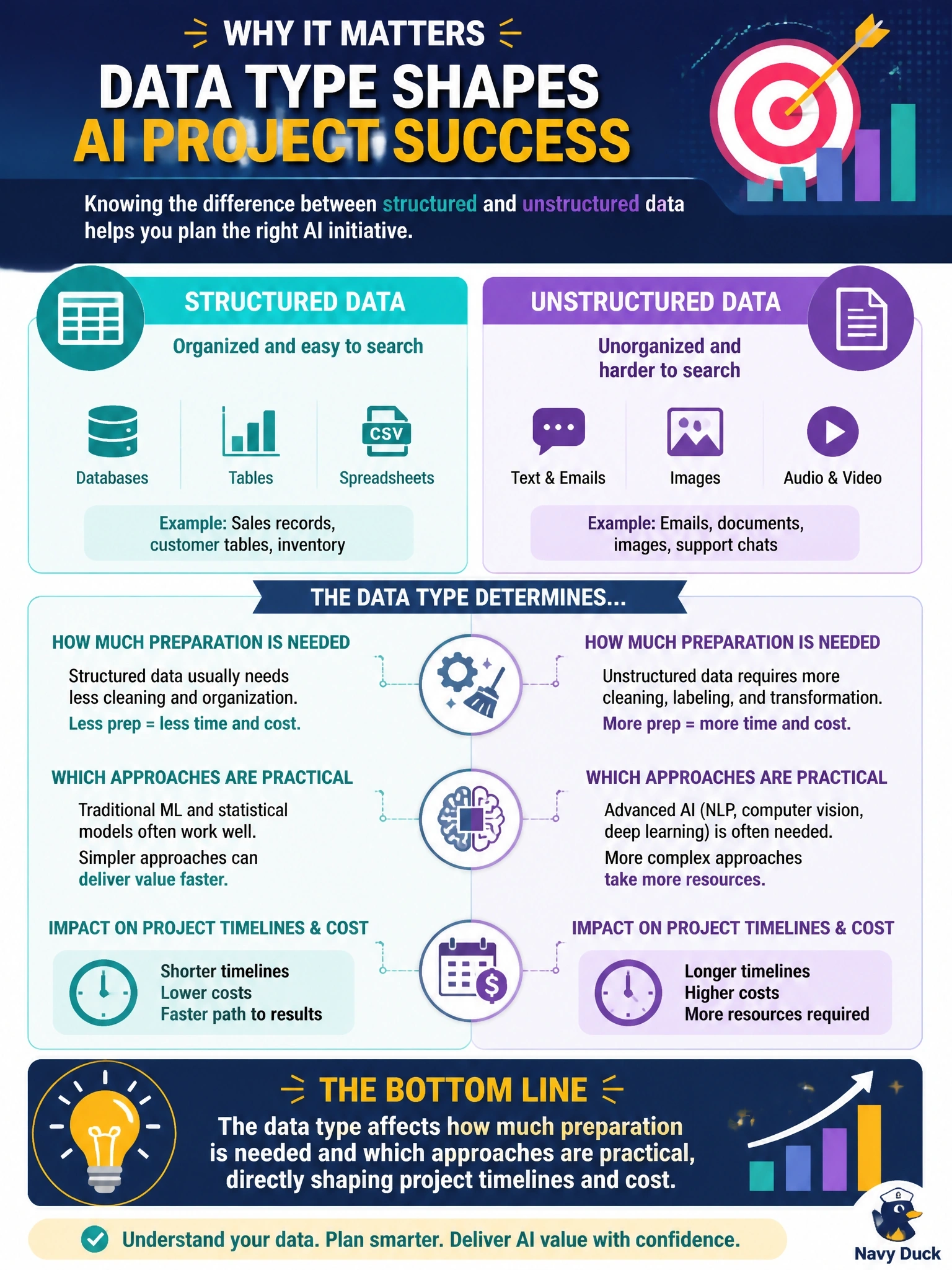
Think of it like estimating a renovation: knowing whether you're dealing with a room that just needs paint or one that needs the walls torn out changes your whole bid. Structured data is closer to "just needs paint," while unstructured data usually needs real preparation work first — and that difference is exactly what shapes a realistic timeline and budget.
Full Explanation
The core mechanism is that data type predicts effort: structured data arrives in predefined fields ready for many tools to use directly, while unstructured data — text, images, audio — typically needs extraction, labeling, or other processing before a model can learn from it. That difference in required effort is precisely why it belongs in a business leader's scoping conversation, not just a technical one.
The claim that this distinction only matters to technical staff misses how directly it feeds budget, staffing, and schedule decisions; a leader who ignores it risks approving a timeline that doesn't account for real preparation work. The claim that unstructured data can never legally be used is simply false — text, images, and audio are routinely and lawfully used in AI systems across industries, provided they're handled with appropriate privacy and consent safeguards. And the claim that structured data is always inaccurate confuses structure with accuracy; being organized into fields says nothing about whether the values in those fields are correct; a well-maintained structured dataset can be highly reliable, while a neglected one can still be riddled with errors.
A practical check for any leader scoping a project: ask what format the data currently sits in, then ask what has to happen to it before a model can use it. That second question is where realistic timelines and budgets actually come from.