
A telecom customer-experience director must describe, in board materials, a new tool that flags network anomalies using pattern recognition from historical performance data, with no content generation involved. Which classification is most accurate?
Select an answer to reveal the explanation.
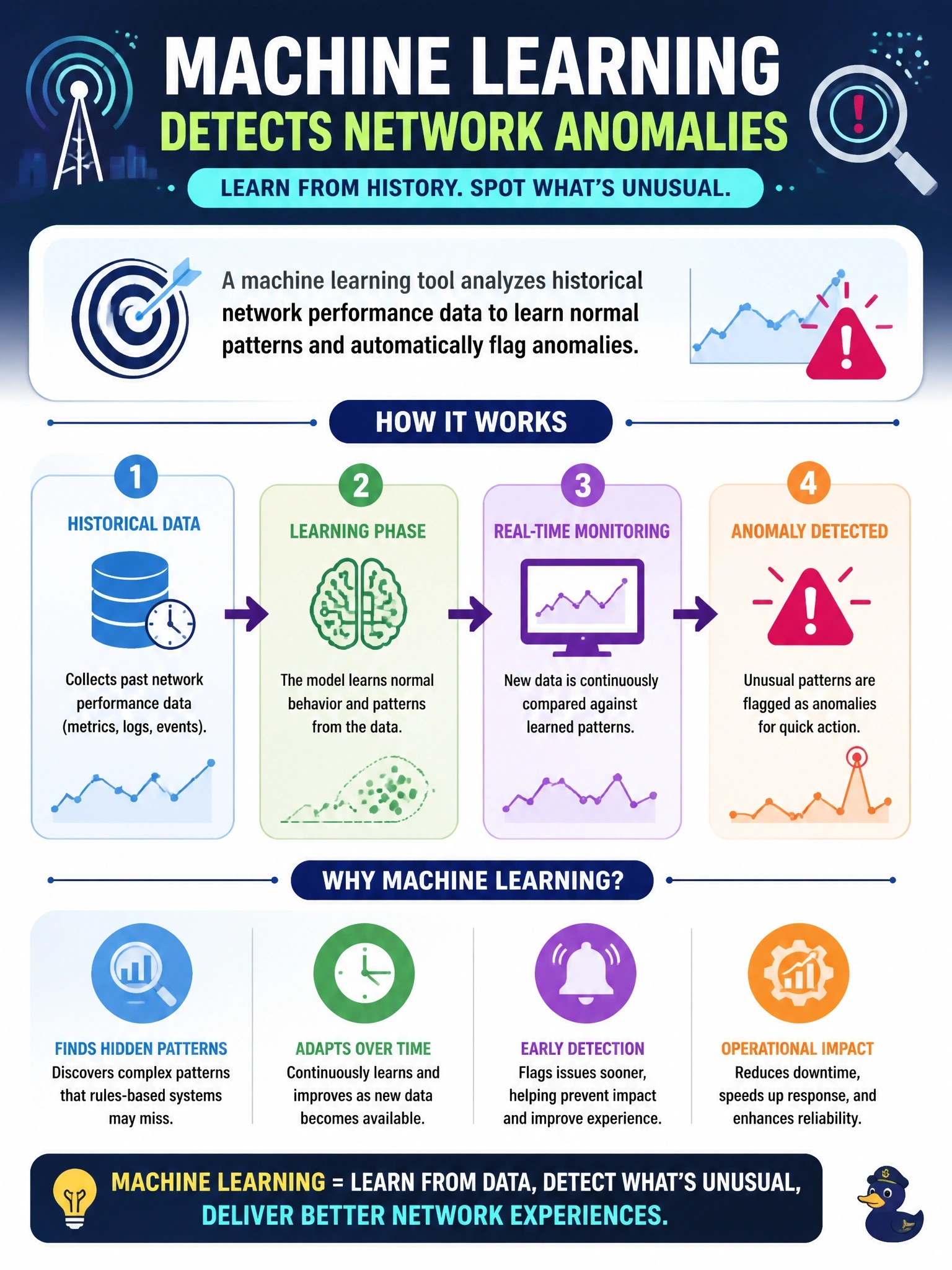
Short Explanation
This tool is a pattern-spotter, not a content-maker: it studies years of network performance history to learn what normal looks like, then flags anything that drifts from it. That learning-from-history behavior is the textbook definition of machine learning — and since it never produces new text or images, you can rule out generative AI.
Full Explanation
The classification hinges on two questions: does the system learn from data, and does it generate new content? This tool learns patterns from historical performance data to detect anomalies — that learning-from-data behavior is exactly what defines machine learning. It never produces new content, so it cannot be generative AI, no matter how much data it churns through.
Mistaking data volume for the defining trait of generative AI is a common confusion: processing large datasets doesn't make a system generative, since generation specifically means producing new content, which this tool never does. Reaching for "rule-based automation" is also a mismatch — that term describes systems following fixed, explicitly programmed rules, whereas this tool's anomaly detection comes from learned statistical patterns, not hand-coded if-then logic. And invoking artificial general intelligence confuses breadth of coverage with breadth of capability; AGI is an aspirational concept describing human-level, cross-domain reasoning, and has nothing to do with how many network segments a tool monitors.
A useful operational check for board materials: ask whether the system was trained on historical examples to recognize patterns (machine learning), and separately whether it outputs new content such as text or images (generative AI). This tool answers yes to the first and no to the second, which is exactly what makes machine learning the accurate, defensible label.