
Which of the following best explains why generative AI is considered a subset of machine learning rather than a separate, unrelated field?
Select an answer to reveal the explanation.
Short Explanation
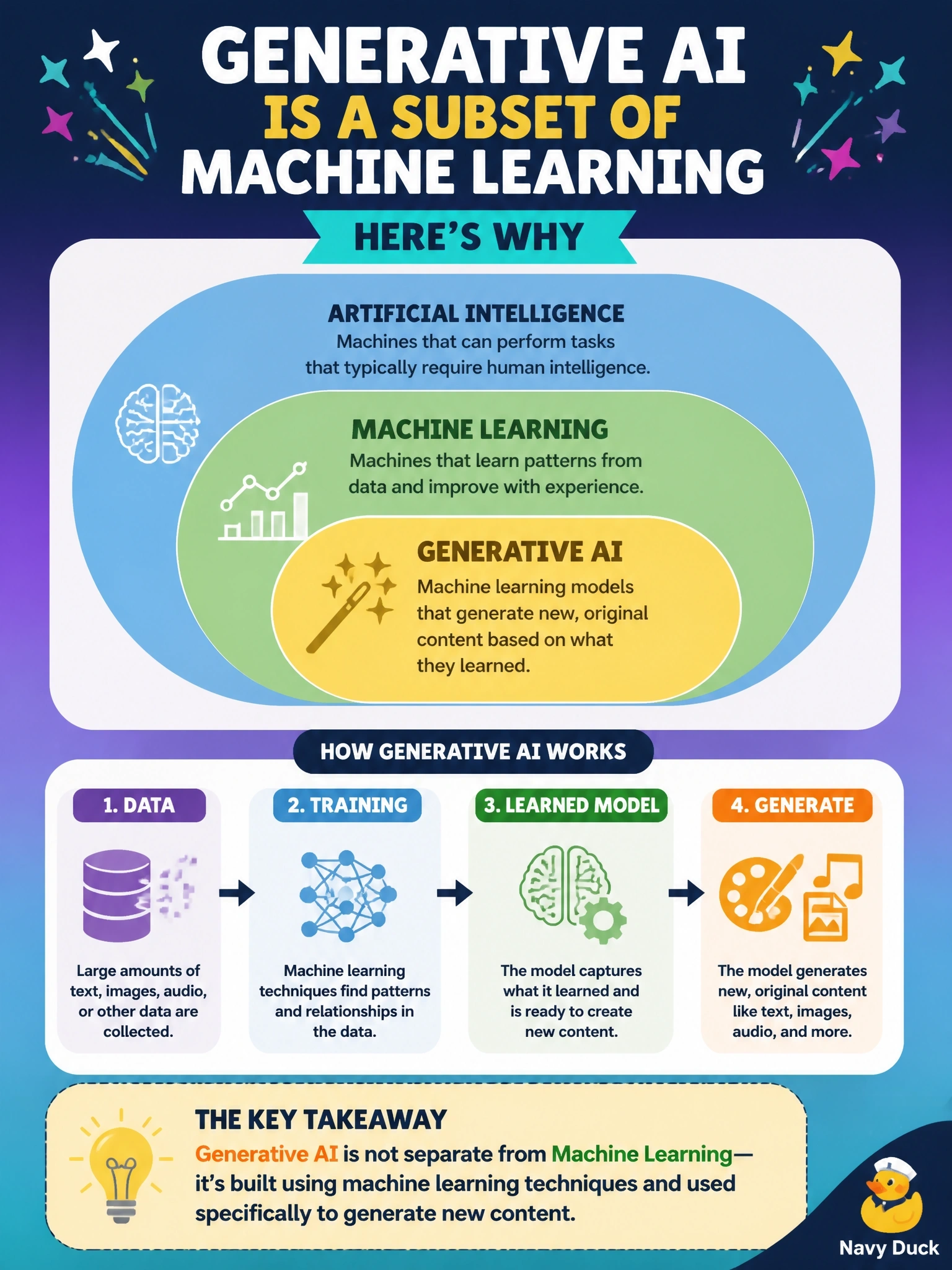
Picture machine learning as the parent tree you already know, and generative AI as one of its branches. GenAI models get built using the exact same training process as other ML systems — they're just pointed at a different job afterward: producing new content instead of predicting a number or sorting things into a category.
Full Explanation
The defining mechanism here is the training method, not the output type: generative AI models learn from data using the same core machine learning process — adjusting internal parameters based on patterns found in training examples — as any other ML system. What sets GenAI apart within that family is simply what the trained model is then used for: producing new text, images, or other content, rather than predicting a numeric value or classifying an input into a category. That is a difference in application, not in underlying technology, which is exactly why GenAI sits inside ML rather than beside it.
The claim that GenAI predates machine learning gets the history backwards. Machine learning is the older, broader discipline, and generative techniques are a more recent specialization built on decades of ML research, not the other way around. The claim that GenAI is essentially a marketing term with no real technical connection to how these systems are built also misses the mark — GenAI models genuinely depend on ML training pipelines and optimization methods to function at all. And the claim that GenAI and ML use entirely different data and share no technical relationship ignores that both draw on the same kinds of training data and statistical learning foundations.
A quick operational check: if a system had to learn from examples before it could do its job, it's ML — and if that learned system's job is to generate new content, it's specifically GenAI, a member of the ML family, not a rival to it.